The $10 Billion Blind Spot: How Ad Buyers Are Picking Up the Bill for NFL Piracy
Live sports are the last real pillar holding up traditional linear television, and broadcasters are paying a fortune to keep it standing. With NFL rights fees projected to surge more than 50% in the next cycle, networks are running a two-front squeeze: hiking ad rates to cover the check while locking more matchups behind streaming paywalls.
High ad prices aren't pushing fans to pirate games, but ad buyers are paying the price for it. As subscription fatigue sends millions of viewers hunting for free workarounds, marketers buying guaranteed linear reach are losing a growing slice of their audience to an unmeasured gray market.
The Economics of the NFL Ad Machine
To understand the scale of the leakage, you must understand the size of the container. The NFL commands an outsize share of sports ad budgets. According to Guideline, the league accounts for nearly 40% of annual US sports ad dollars—amounting to $5.87 billion for the 2025-26 season. Measurement firm iSpot places that figure even higher, estimating national TV ad sales neared $10 billion.
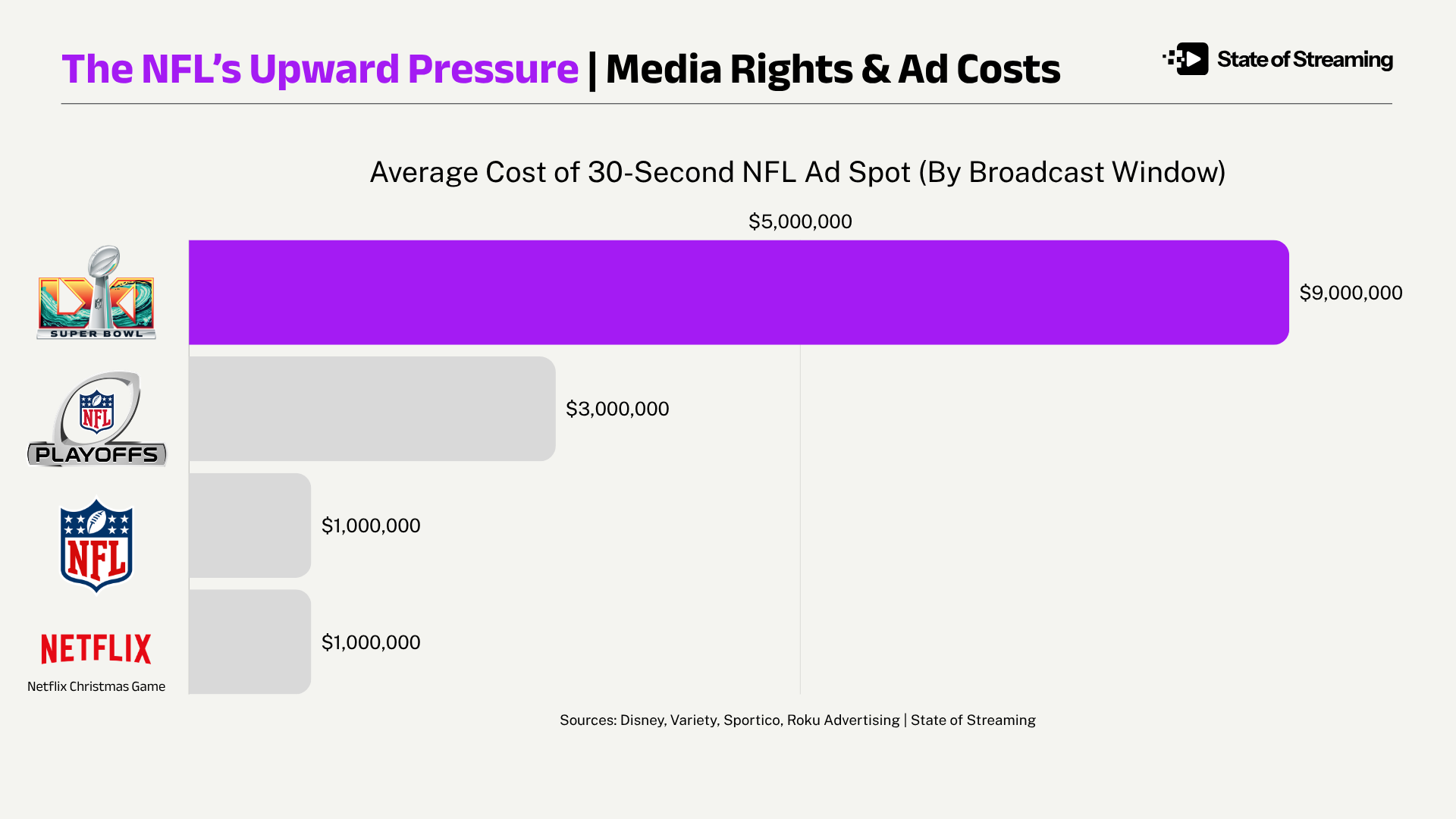
Broadcasters are charging unprecedented premiums for this inventory. Spots for next year's Super Bowl are selling for $8 million to $9 million, putting the big game on track to cross the historic $1 billion ad sales threshold in 2027. Outside the championship spotlight, regular-season spots command up to $1 million, while playoff inventory fetches up to $3 million per 30 seconds.
The primary benefactors remain legacy networks. Despite the pivot to digital, linear TV receives 88% of all NFL ad revenues (led by Fox at 30%, Paramount at 23%, and Comcast at 21%), with pure-play streamers capturing just 12%.
With projections showing post-2029 NFL media rights fees increasing by more than 50%, ad prices face intense upward pressure. The brands footing this bill (predominantly insurance, auto, and telecom) are paying for a promise of guaranteed reach that is slowly deteriorating.
The Attention Leakage and Piracy Boom
While advertisers absorb record CPMs on the buy side, consumers are staging their own revolt against the rising cost of watching football. Juggling expensive cable bundles alongside multiple standalone streaming subscriptions has pushed millions of fans toward the gray market. Over the last 12 months, the Action Network tracked 8.6 million Google searches tied to unauthorized sports streaming across the US.
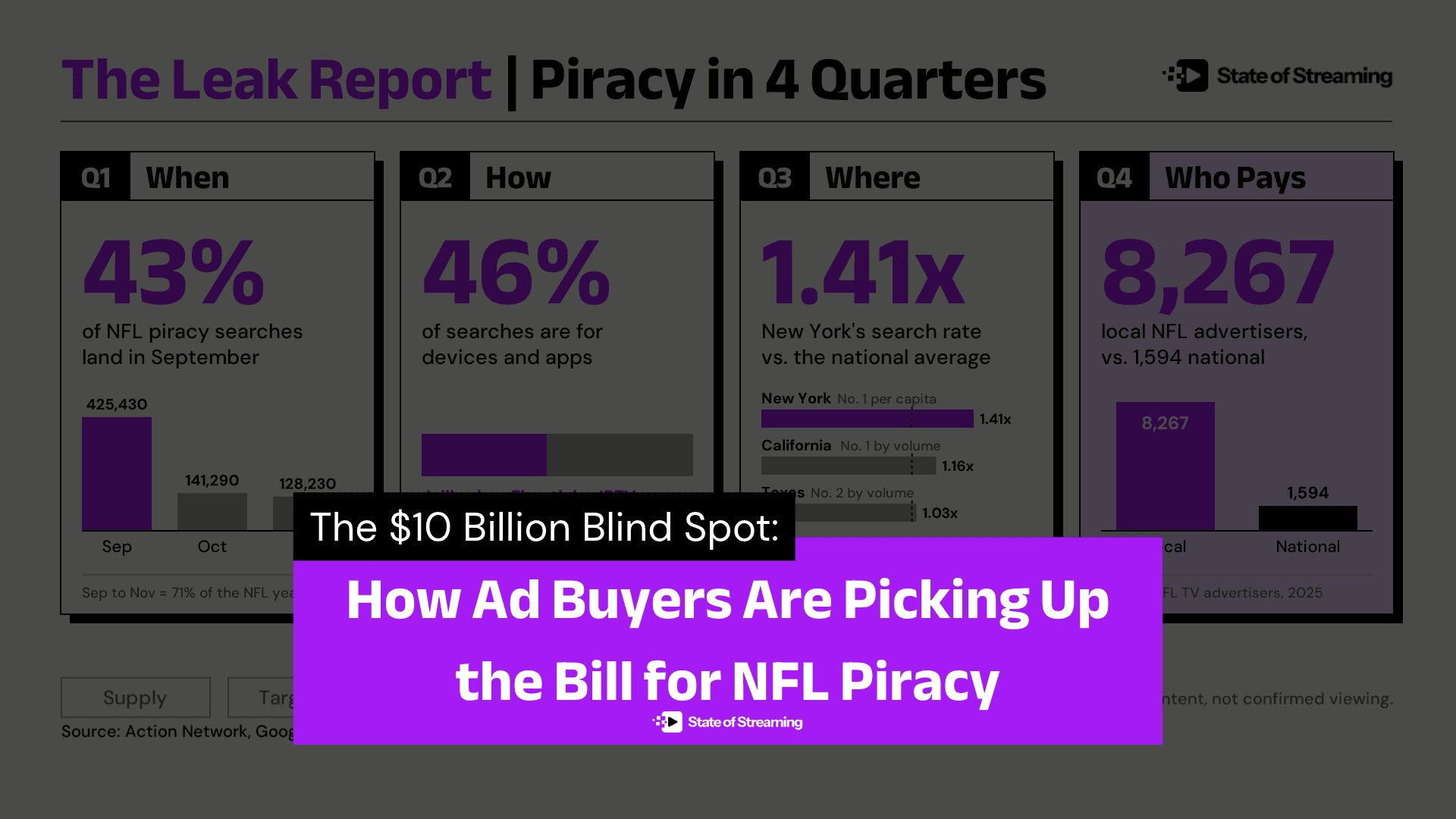
This behavior is highly systemic and heavily concentrated around football. Roughly 71% of NFL-category search volume lands strictly between September and November. September alone generated over 425,000 illicit searches, representing 43% of the category's yearly total. The single most-searched NFL-related term nationally is "watch nfl games live free," driving over 114,000 annual queries.
The infrastructure facilitating this mass migration is hardware-based. Searches for device and app-based workarounds, specifically unauthorized Internet Protocol television (IPTV) services and jailbroken Firesticks, account for 44% of total search volume.
Geographically, this black market thrives in major media hubs. While California and Texas lead in raw volume, New York searches for unauthorized streams at the highest rate per capita—running 1.44 times the national average.
The Local Ad Trap and Measurement Blind Spot
This piracy boom is particularly devastating for local media buyers. While national brands dominate headlines, local affiliates actually account for the vast majority of unique advertisers buying NFL inventory (8,267 brands in 2025, compared to 1,594 buying national spots).
Because unauthorized IPTV streams predominantly scrape and rebroadcast national or international feeds, local ad insertions are bypassed entirely. Regional brands are paying premium local broadcast rates, where CPMs regularly exceed $80, but are losing substantial impressions to the black market. Illicit streams also routinely strip out the dynamic, addressable CTV ads that digital buyers rely on.
This audience leakage compounds an existing measurement nightmare. EMARKETER notes that viewership drops sharply during blowouts; for example, the audience for a recent lopsided Super Bowl plummeted 34.7% by the fourth quarter. Combined with millions of viewers watching through untracked, jailbroken Firesticks, standard measurement platforms are left with a massive blind spot, rendering it impossible for brands to accurately measure their true reach.
The Strategic Pivot for Brands
How can brands maximize football's unmatched cultural gravity as ad costs rise and audience leakage grows? The data points to two distinct plays:
1. Buy Upfront and Go Multichannel
Brands determined to secure premium NFL inventory must maximize efficiency. Purchasing in the upfront market provides a notable discount compared to the scatter market. For example, a spot during a Fox Sunday afternoon game cost around $678,000 upfront, compared to $820,000 in scatter. However, simply buying TV isn't enough. Brands must reuse premium creative across social media, secondary streaming, and digital channels to ensure the message reaches fans bypassing traditional networks.
2. Capitalize on College Sponsorships
For brands looking to avoid the vulnerabilities of 30-second TV spots, the NCAA offers a massive strategic arbitrage. With over four times the number of teams as the NFL, college football offers a wider, more diverse inventory pool that accounted for $1.3 billion in national linear TV ad sales last season.
More importantly, college football is undergoing a sponsorship sea change that directly circumvents the piracy problem. The 68 power conference schools will each generate about $13.5 million through commercial Name, Image, and Likeness (NIL) activity in 2026.
Brands are aggressively moving into on-field branding. Deals ranging from Monster Energy's on-field logos to Ohio State's $20 million jersey patch provide in-camera exposure that cannot be skipped or stripped out by an IPTV stream. This strategy is highly accessible; the median sponsorship deal for Power Four schools is an affordable $90,000, and 80.9% of brands stick with a single, local school to tap into deep regional loyalty.
Surviving the Stream
The broadcast ecosystem is fracturing. Media networks are still pricing NFL inventory as if they possess an absolute monopoly on audience distribution, but 8.6 million illegal streaming searches prove the moat has dried up. As long as the cost of following the sport outpaces consumer willingness to pay, the black market will continue acting as a release valve. Moving forward, the smartest media buyers won't just pay premium rates for a leaky stage—they will invest in upfront efficiency, multi-channel distribution, and in-camera assets that survive the stream.
Get the SOS. Brief
The sharpest streaming intelligence, delivered to your inbox.