Football Still Owns TV: An interview with Ross Benes, Senior Analyst @ EMARKETER
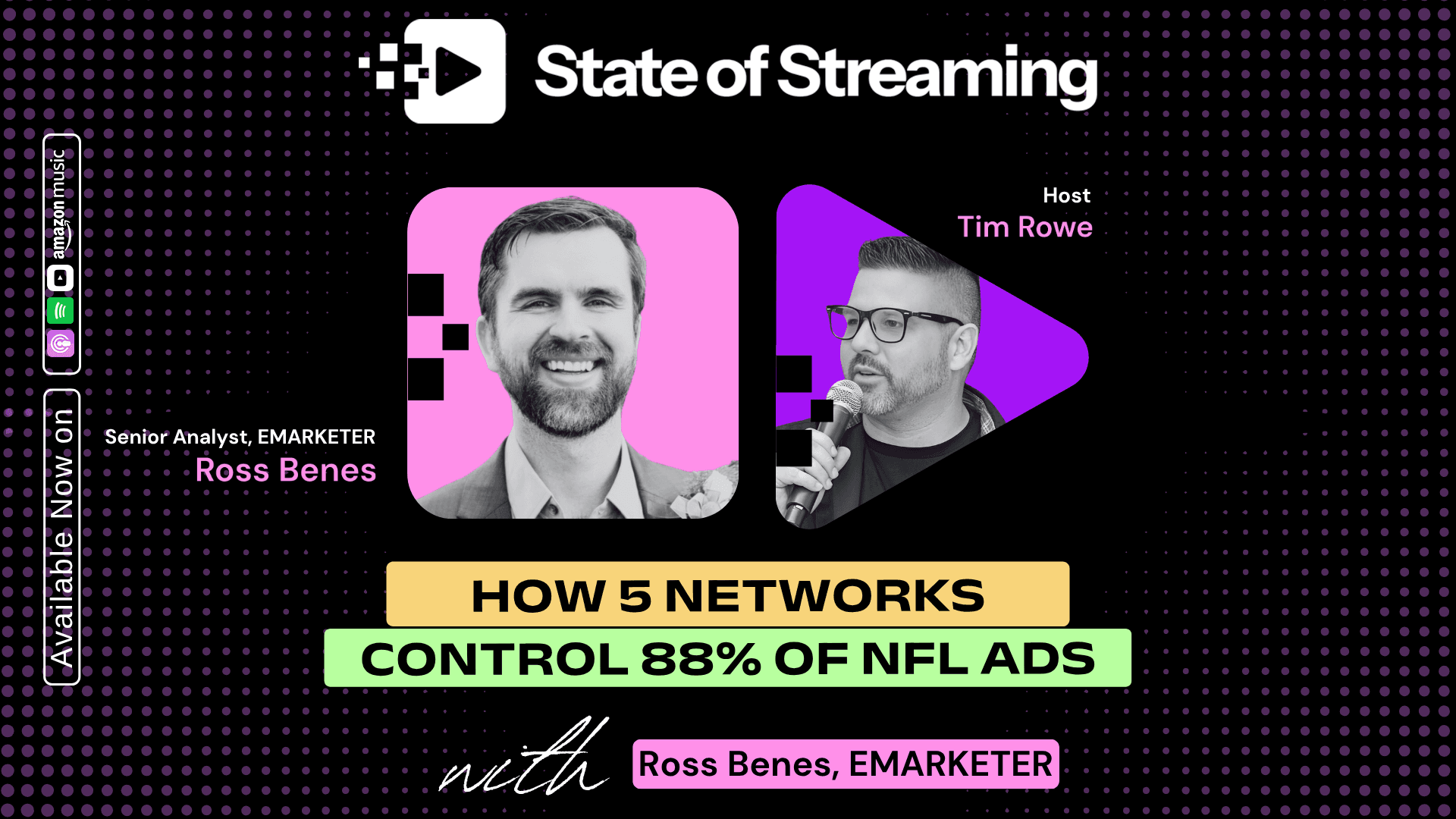
"One of the things that was surprising to me was just how much revenue still goes to those main linear broadcast networks. They are still the lion's share, and I think they're gonna be for a while." — Ross Benes
In this conversation, we sat down with Ross Benes, Senior Analyst at eMarketer, to break down his latest report on U.S. football advertising. We examine why five linear broadcast giants still control 88% of all NFL ad revenue and how Amazon and Netflix are carving out the remaining 12%. We also discuss how the surge in shoulder programming is impacting connected TV CPMs, why Disney commanded a record $10 million for Super Bowl spots, and how media rights deals are turning college football into a mini NFL.
Why Linear Networks Still Dominate
Tim Rowe: You've got a new report out, U.S. football advertising. We are in peak football season. What did you set to uncover through this report?
Ross Benes: I was just trying to get a sense of how advertising in football games is changing as more of it becomes streaming, and if those old ways of buying are still really intact. And one of the things that was surprising to me was just how much revenue still goes to those main linear broadcast networks. They are still the lion's share, and I think they're gonna be for a while.
Tim Rowe: Five companies accounting for 88% of all NFL ad revenue. Fox comes in with 30%, Paramount—I guess now Skydance—23%, Comcast 21%, Disney 12%, and NFL Network owned by ESPN at 2%. Did that surprise you?
Ross Benes: Well, a little bit because you hear about all the digital options that are coming and how you don't want to get behind on streaming if you are a sports league. But the rights are, especially in the NFL, very much held by those linear networks. And I think a big reason why is there's very little local broadcasting. You have some regional, but there isn't a lot of flexibility in the NFL like there is with the NBA and MLB, where you can have a whole assortment of different people broadcasting one team's games. You're a little more restricted in the NFL just due to the number of games.
College Football Becomes A Mini NFL
Tim Rowe: If we look back at last year, 96 of the top 100 most watched television events were sports. 92 of the top 100 most watched television events were football: 84 were the NFL, and eight were college football playoffs. What's the story about college football in this bigger football advertising picture?
Ross Benes: The leagues themselves are becoming much more active on securing giant media rights deals, and that's led to all this conference realignment where you got like Rutgers and UCLA in the same conference, or Cal and Miami in the same conference. You just saw this unfold again where ESPN just paid another huge bonanza to expand the college football playoff. There's a huge demand for more college football games, especially at a top level. And now that they're paying players and the playoff has expanded, the uniqueness and some of the regionality that made college football charming and really much its own thing is going away a little bit. It's a mini NFL with the younger players at this point.
Tim Rowe: Advertisers are hungry for live sports, so people are still watching.
Ross Benes: They're not tuning out. During the playoffs, they're really, really glued in. I think ESPN actually probably got a good deal on that playoff expansion for a few hundred million dollars. They expanded it all the way to 24 teams, just given how much rights have increased. If we look back in five years, we're gonna say that was actually fairly cheap inventory to secure.
Amazon And Netflix Take The Rest
Tim Rowe: On the streaming side, Amazon obviously accounts for the lion's share of that 12 remaining percent—with Thursday Night Football—and Netflix with kind of their curated menu of games. Anything stand out to you there?
Ross Benes: Just that Amazon's been the most proactive with NFL, and I would say with NBA. With the season launching now, they have the consistency that a lot of streaming services lack to turn Thursday Night Football into a stronger brand than it was before and just own that. It's a little different than when YouTube gets an international game, or Netflix will get the Christmas games, which is very one-off. Amazon's strategy, both NBA and NFL, is to consistently appear at least once a week. And I think that helps viewers get accustomed.
The Real Cost Of NFL Rights
Tim Rowe: Michael Beach writes a column called The State of the Screens, and he's got data about the cost per unique viewer per game: CBS/Paramount at $2.91, Netflix at $3.10, Fox $3.20, Amazon $3.89, NBC $3.91, and the average is $4.12, with ESPN and ABC overpaying a little bit. Is there a breaking point to this? Can the market continue to take increases?
Ross Benes: I think it can take a little bit of increases for now. Maybe not the monumental they're seeking—I know the league would like to double its fees, which may be a little aggressive—but they're definitely going to rise faster than inflation. It's one of the few places where you can get that really tuned-in, reliable audience and build your network around it. ESPN overpaying, I think they're fine doing that. That goes back to their Monday Night Football deal several years ago. Now they have the NFL Network. Doing that allowed them to form that partnership that is beneficial for all the shoulder content ESPN produces, all the access they get to players and teams. There's indirect benefits for getting that package that go beyond just the number of games for this price.
Shoulder Content Pushes CPMs Down
Tim Rowe: Connected TV CPMs fell 13% against live football. Why was that?
Ross Benes: CPMs and streaming in general have been flat to declining, whether you're talking about sports or non-sports. But I think there's just a big uptick in the amount of shoulder content, especially on streaming services. There are so many little docuseries or reality TV spin-offs that come out of the league that are tangentially related. Ten years ago, you had Hard Knocks and not much else. Now most of the networks who have a deal with the NFL produce some sort of show about the league that isn't live games. The increased ad supply just drives down the prices a little bit.
Tim Rowe: It is interesting to see how streaming has unlocked this long tail of shoulder content, which now allows you as an advertiser to reach those audiences, perhaps at a discount, with the same relative context to the big game itself.
Ross Benes: Peyton Manning has a whole company built around doing this.
Super Bowl Pricing Hits New Highs
Tim Rowe: On the other side of it, this Super Bowl is on pace to be the first billion-dollar ad spend Super Bowl. Disney did something different this year. What did Disney do?
Ross Benes: Variety reported that Disney sold out their inventory, asking about $10 million per spot. They didn't always get that, but now that they're sold out, they're still going out to market asking for increases in case someone backs out. They're already upselling on the event that there'd be a new advertiser to slot in, which is a little bit unusual. I think it shows how confident they are. They keep adding those alt-casts—they just added a Star Wars one. There's more ways to segment the Disney audience for this Super Bowl than there is for most Super Bowls, which tend to rely on one or two feeds.
Want to watch or listen to the entire conversation?
Get the SOS. Brief
The sharpest streaming intelligence, delivered to your inbox.