When Ad Verification Accuses the Wrong Publishers - "see Fou yourself" FouAnalytics | Dr. Augustine Fou
Editor's Note
FouAnalytics is a syndicated column by Dr. Augustine Fou—one of the leading independent voices in ad fraud detection and digital marketing measurement—applying methodological rigor to the programmatic advertising supply chain. This piece details how legacy verification vendors falsely accuse legitimate publishers of invalid traffic and brand safety violations, relying on flawed URL-level keywords while missing true ad fraud entirely.
Over the years, good publishers have been repeatedly and continuously harmed by legacy verification vendors. Let me recount the ways.
Domain spoofing incorrectly detected
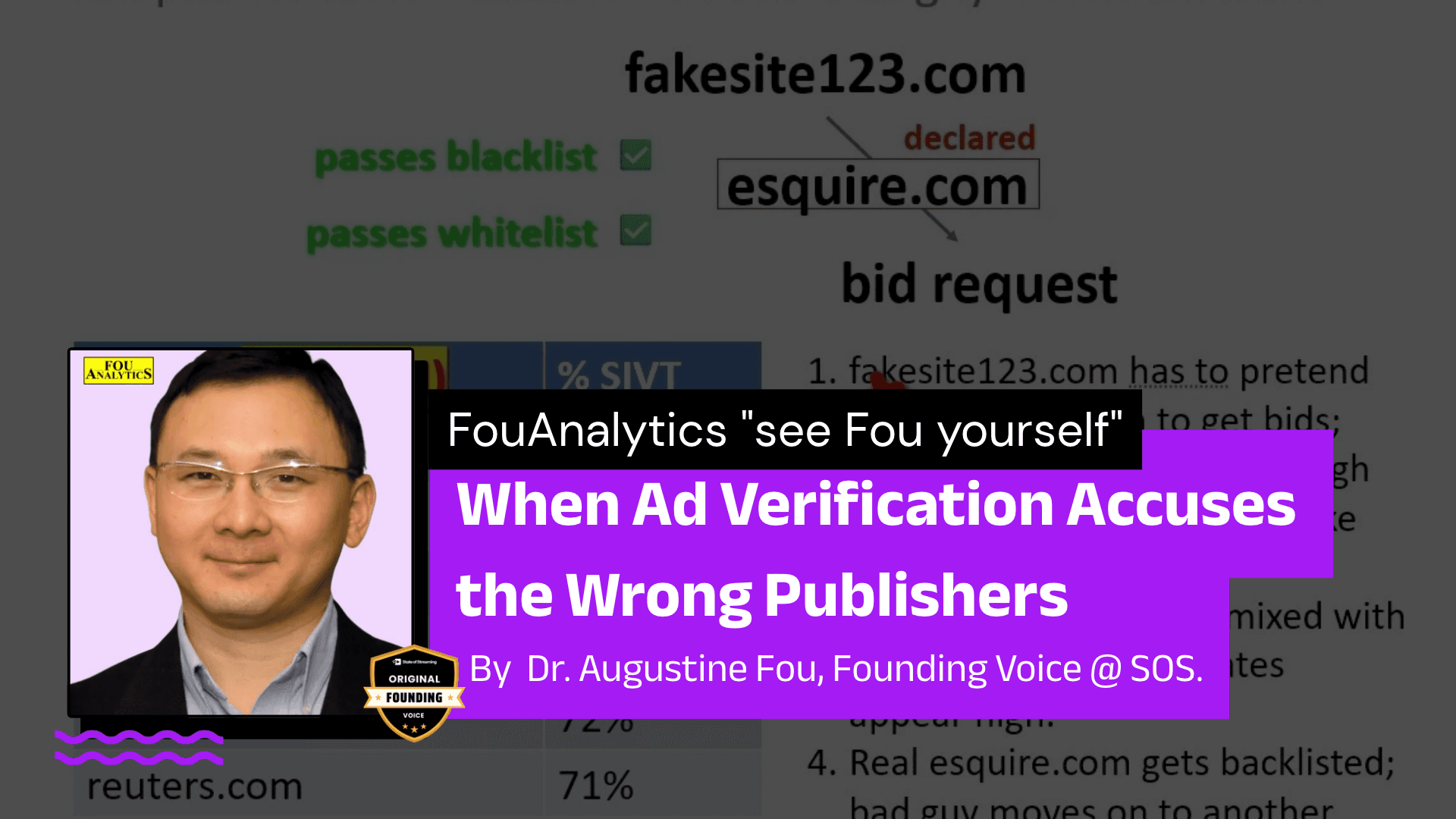
Since 2018, legacy verification vendors accused legit, mainstream publishers of high IVT. These publishers did not have high IVT. It was a measurement error on the part of these legacy vendors. How could they get something so simple, so wrong? It's because they take the domain that was passed in the bid request and assume that's where the ad went. So when a fake site pretends to be esquire.com or espn.com and bots were detected, these real publishers get falsely accused of high IVT. The legacy vendors CAN run a JavaScript tag to detect where the ad actually went, but in many cases they blame their own customers for not paying extra for post-bid JavaScript detection. These vendors' incorrect reports are used to get refunds or make-goods from publishers, many of whom honestly don't know how it's possible because there's little IVT ("invalid traffic") actually on their sites. Publishers use FouAnalytics on-site data to defend against these false accusations.

Brand safety incorrectly detected
So many examples of the BS tech of these legacy vendors from over the years, let me highlight just a few examples.
From last month, IAS stupidly published this study to get PR for themselves. Half of Reuters brand-safe stories were marked as NOT safe and demonetized because the ads were blocked by IAS's brand safety tech. (read the AdExchanger article for yourself). They blamed their own customers for using keyword blocklists. That's NOT cool. How about they make their tech actually work?
But there's another thing that most of these legacy vendors' customers don't know. These vendors did not actually scan the CONTENTS of the pages for brand safety violations. You heard that right. These vendors didn't even scan the content of the page; they only used keywords in the page URLs. That's why none of the "contextual" and "semantic" stuff they talk about even works. There's no context or sentence around the keyword in the URL.
This is why guidance published by the MRC in October 2025 (link above) slapped these vendors' hands and required them to remove the misleading information from their websites and marketing materials that implied that they did [content-level brand safety]. They DO have crawlers that can subsequently crawl the page. But that's a very expensive additional charge that few ad buyers pay for. This is why they missed SO many actual brand safety issues while at the same time falsely accused publishers of brand safety issues and demonetized them by blocking the ads. This is why the DOJ and NCIS are questioning the effectiveness of these companies' BS tech.
FouAnalytics helps publishers defend against false accusations of brand safety issues, by showing the detailed data so everyone can "see Fou themselves" the actual context. Not only has FouAnalytics had page URL level reporting since the very beginning, the brand safety detection actually looks at the content of the page to find keyword matches. These are the brand safety keywords that advertisers are concerned about. Let's take a simple example — the word "kills." FouAnalytics finds that word in the page content, not just the page URL, and collects the 10 words before it, and 10 words after it. With this context, you can see "if the water is too hot, it [kills] the yeast, and your bread won't rise" and immediately understand there's no brand safety issue here.
This kind of detail is NOT available from any of the BS legacy vendors today. Heck, they only "debuted" page URL level reporting after the CSAM scandal of 2025.
Completely incorrect interpretation of their own data
Do you remember the SportsBot case in 2017 and 404bot case in 2020? NEITHER of these cases actually involved bots! You read that right. There were NO bots. Both fraud detection companies failed to understand how the ad fraud worked; yet they sent out press releases for their own PR purposes. SportsBot was just tens of billions of faked bid requests declaring the domains to be sports sites like nfl.com, nba.com, dallascowboys.com, etc. 404bot was also not a bot, just tens of billions of faked bid requests passing URLs of pages that didn't exist (404 error when interns tried to go to the page URLs). There were no pages for bots to visit. These were just fabricated data in fabricated bid requests.
So what?
Given all of these examples of legacy vendors' FAILURE to detect the problems that WERE there AND their INCORRECT measurements that falsely accused real publishers of problems that WERE NOT there, do you think you should still waste money on these legacy vendors and assume they are actually protecting you from something?
Yeah, it's getting harder and harder for anyone to justify continuing to pay for or hide behind these legacy vendors.
Why Subscribe
Because legacy verification vendors might be penalizing your legitimate inventory while letting actual ad fraud slide right past them. Every week, FouAnalytics uses forensic campaign data to expose flawed ad-tech metrics, false IVT claims, and supply path inefficiencies, giving publishers and ad buyers the independent proof needed to defend their media investments.
Subscribe below to read more from FouAnalytics weekly here on State of Streaming.
Get the SOS. Brief
The sharpest streaming intelligence, delivered to your inbox.