Delivering Live Sports at Scale: An Interview with Shawne Merriman, NFL All-Pro and Founder of Lights Out Sports
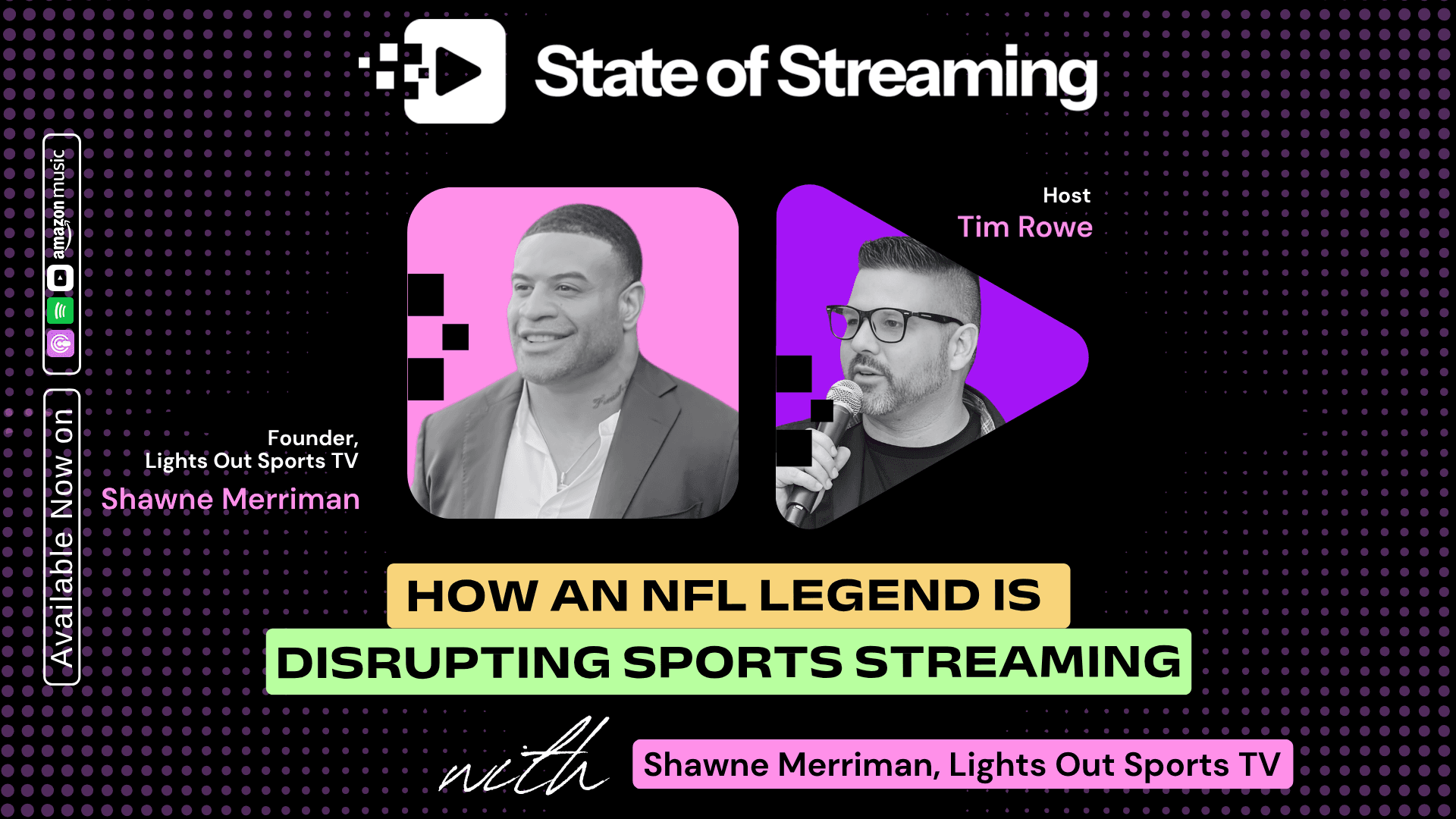
"People don't understand how expensive it is to deliver content. It's very expensive. And the more people you got watching, the more places it's going, it gets very expensive."
In this conversation, we sat down with Shawne Merriman, former NFL star and founder of Lights Out Sports TV. Shawne takes us behind the scenes of his journey from the gridiron to broadcast television and the skyrocketing costs of streaming delivery and distribution. We discuss how major networks are grappling with content delivery network (CDN) expenses, and how a new technological bridge is attempting to solve this problem. We also discuss how upcoming 5G broadcast chips could drastically change the unit economics of live sports streaming, and what the launch of Lights Out Sports TV means for the future of delivering live sports at scale.
“A Thousand Lifetimes”
Tim Rowe: We're going to talk about tech and we're going to talk about economics, but maybe you can take us back in time from your time as a player to time in broadcast to ultimately launching Lights Out Sports. What did you see along the way that it made so much sense for you to take this next step?
Shawne Merriman: I've always been an extremely curious person. Being fortunate enough to play in the NFL, you're playing on the biggest platform there is, at least here in the States. I used to walk out before the big Sunday night football games or Monday night games and I used to walk the field. I would look at the cameras, the ones just gliding over, the sky cameras. I would take a lap or two run and I'll stop at the camera guy like, "What are you guys looking at?" They would just break everything down for me and I didn't understand why I was asking those questions then.
Shawne Merriman: Fast forward... I did a bunch of TV work. I was the first athlete who had a show as a current athlete on Fox Sports called Pro Football Weekly back in the day with Jay Glazer and Eddie George. I retired, went to NFL Network, and I was really a part of a show's creation called NFL AM that shot live at 3:00 am to 7 am. That show later became what we know now as Good Morning Football. I left there, went to Fox Sports... did that for a couple years, went to ESPN for a show called Sports Nation, and then I was also at the WWE Network when they initially launched. I feel a little bit like I lived a thousand lifetimes and not only being a part of the creation of these shows, but also watch the evolution of traditional broadcast TV and linear TV and then soon become streaming.
Solving the CDN Math Problem
Tim Rowe: Break that down for us. CDN, content delivery network. It's kind of the last mile delivery of streaming, if you will. How does that work? Who are you ultimately building this for?
Shawne Merriman: For several reasons. Because we have multiple applications that it can work for. For one, you want to be able to control your own data, right? But also, people don't understand how expensive it is to deliver content. It's very expensive and the more people you got watching, the more places it's going, it gets very expensive. What we have is a capability to offload and be able to distribute content through our platform. The cost savings that any one of these broadcast networks or streaming platforms would get because you're not sending a million signals out to a million people. You're sending one signal out to a million people.
Tim Rowe: Taking advantage of a lower latency bandwidth 5G and still being able to deliver like a high-fidelity premium streaming experience to all of those phones. So as 6G comes online, you're unlocking truly incremental audiences.
Shawne Merriman: 100% with no congestion because a lot of people in this space, I mean congestion when you have so many people on is a huge problem. This never goes down. The GPS never goes down, and there's nothing dropping. If you want to reach more people, you're going to need a bridge and a technology that is going to be able to access millions of people without driving up your cost of delivering content. And we solved a problem for that.
The Trickle-Down Effect
Tim Rowe: I've got a question specifically about how you think about revenue. Programmatic advertising is not enough to just support a really well-done production. How do you approach it? Is it sponsorships and partners first? How much is direct sold versus programmatic?
Shawne Merriman: Programmatic might work for Pluto, right? They got 80 million people that's on it monthly. But direct, you got to sell ads. You got direct ad selling that's how you really increase the revenue. If you're selling live sports right now... it is driving a good portion of your traffic.
If you really want to increase the revenue... you generally would have a live sporting event because that's the only thing you're going to get people live there. What you do is you have enough other content ready to go so when people are done watching that live sporting event, they're now clicking on what else you got on the platform. That's why the NFL, NBA, and all these other major leagues pay so much. It's what is the trickle-down effect when they turn it off. If you have 17 to 25 million people watching a football game, and if you can capture a small percentage of those people who didn't know anything about Land Man or Tulsa King... that's where you make your money at.
Engaging the Next Generation of Fans
Tim Rowe: It's not just professional sports either. You're involved with high school sports. St. Francis versus IMG Academy. Your son is the quarterback at St. Francis. What do you see happening in high school sports?
Shawne Merriman: For that game with St. Francis IMG Academy... I think this game is going to be the most watched high school football game in the country. I'm in talks right now with several different networks and platforms. I'll be producing that game and I got exclusive rights and I have some ideas around the game to include fan engagement. My thing in everything I do is always included around some type of fan engagement. You find a way to get the fans involved where they feel like they're connected to whatever they're doing... you're naturally going to get viewers.
Want to watch or listen to the entire conversation?
Get the SOS. Brief
The sharpest streaming intelligence, delivered to your inbox.