How Roku is Rewiring Sports Streaming: An Interview with Joe Franzetta, Head of Sports @ Roku
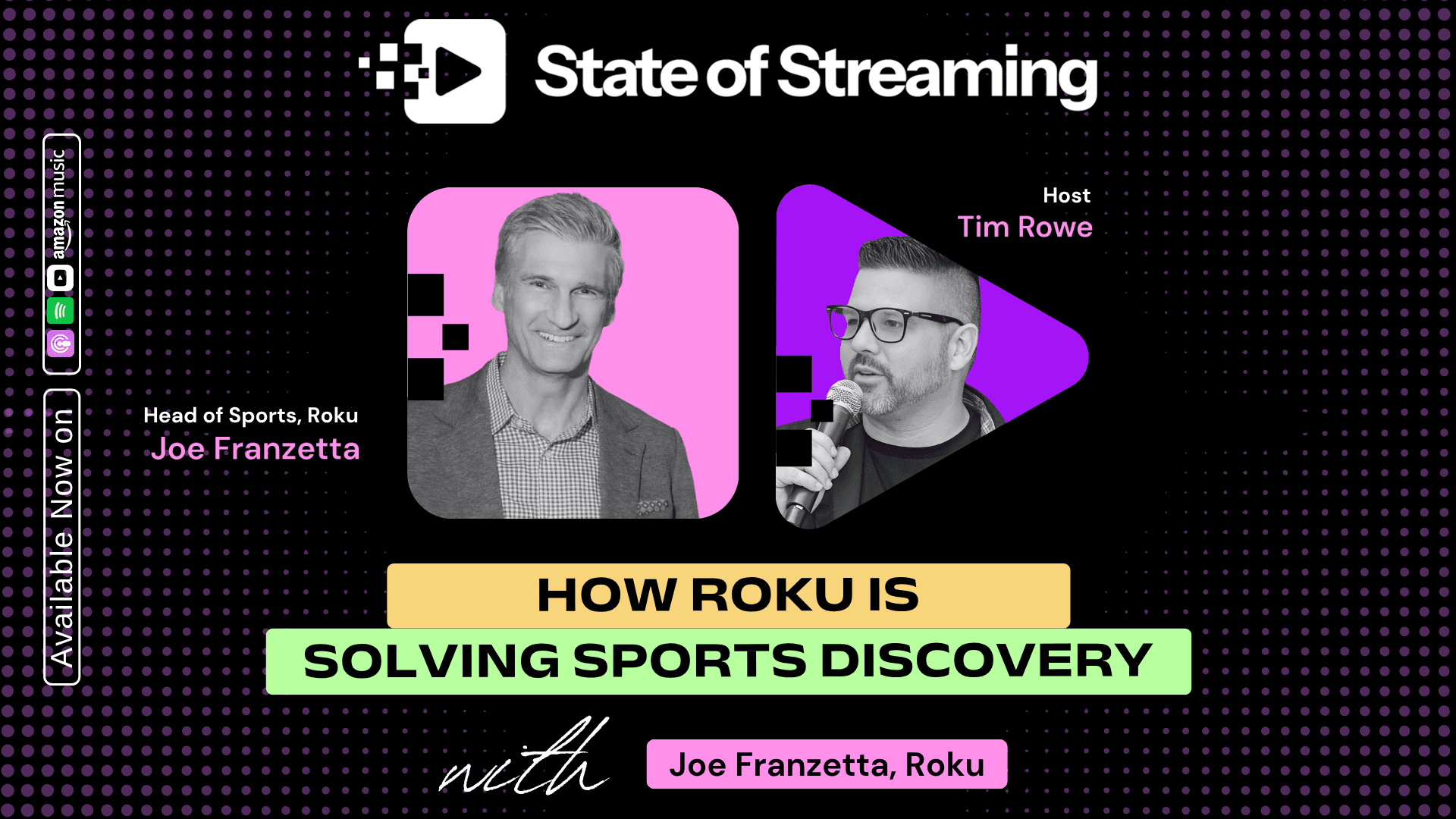
"There's no better way to come into a new territory than on the shoulders of the most favorite local sport. - Joe Franzetta"
In today's conversation, I sat down with Joe Franzetta, Head of Sports at Roku. Joe takes us behind the scenes of how Roku is solving sports discoverability and rights fragmentation for fans across more than 100 million households. We discuss how Roku bridges the gap between being a platform and a service, why integrating unique experiences like the Savannah Bananas into Roku City drives engagement, and how Sport Zones aggregate content for leagues. We also discuss personalization, the shifting landscape of Regional Sports Networks, and Roku's international expansion playbook.
From Soap Operas to Sports
Tim Rowe: I want to start our conversation today about something you said 21 years ago regarding soap operas.
"If you were watching a soap opera and wanted to purchase something on screen, like a mirror or dress, the viewer could pick up the remote control, get more information, and purchase it right there." - Joe Franzetta, October 2005
On-screen engagement, personalization, has maybe taken a little bit longer to get to this point, but you've been in the driver's seat seeing this evolution come to market.
Joe Franzetta: I've certainly been in the clown car with everybody else, I don't know about the driver's seat! Developing a technology that was intended to create interactivity around the television experience was a little bit ahead of its time back then, or the technology was ahead of the execution. But things have evolved, and we're in a world now of streaming television where interactive experiences and commerce have come to fruition. Sports are the perfect home for that because it's where we see the biggest audiences and the most captive attention.
Tim Rowe: Could you paint the picture of how Roku as a platform is a little bit different than Roku as a service?
Joe Franzetta: At a high level, Roku is a platform—it is a television operating system and the front door to your television experience. We manufacture hardware and license our OS to third-party manufacturers, serving as the starting pathway into direct-to-consumer apps like Peacock, Paramount, or Netflix. The Roku Channel is our service—an ad-supported, free-to-the-user app where we aggregate first-party and licensed content alongside all other services on the platform.
Going Bananas in Roku City
Tim Rowe: How did the Savannah Bananas partnership on the Roku platform come to be?
Joe Franzetta: We reached out to them because we saw what they were doing and thought there were things we could do on the Roku platform to differentiate the experience. Jesse Cole and his team put on a phenomenal show—essentially a Broadway production on a baseball field while playing really good baseball. We wanted to put them front and center on our home screen, which reaches over 100 million households and half of all U.S. broadband homes. Think of the Savannah Bananas on The Roku Channel as part of our service, but promoting them on our home screen as part of the platform.
Tim Rowe: How did you capture that live stadium experience for the home viewing audience?
Joe Franzetta: In Roku City, our screen saver, we integrated Grayson Stadium as a clickable building. When you hit the up button on your remote, you entered a virtual stadium greeted by a video message from Jesse Cole, showing a pitcher on stilts throwing a ball towards you. That expanded into Banana Ball Zone, a dedicated destination that aggregates all their live games across different distribution partners into one place, along with clips, highlights, and VOD content.
Video courtesy of @TJCoolxD on YouTube
“Solving Sports Fragmentation”
Tim Rowe: Can you take us through the thesis behind the Sport Zones and how you layer on personalization?
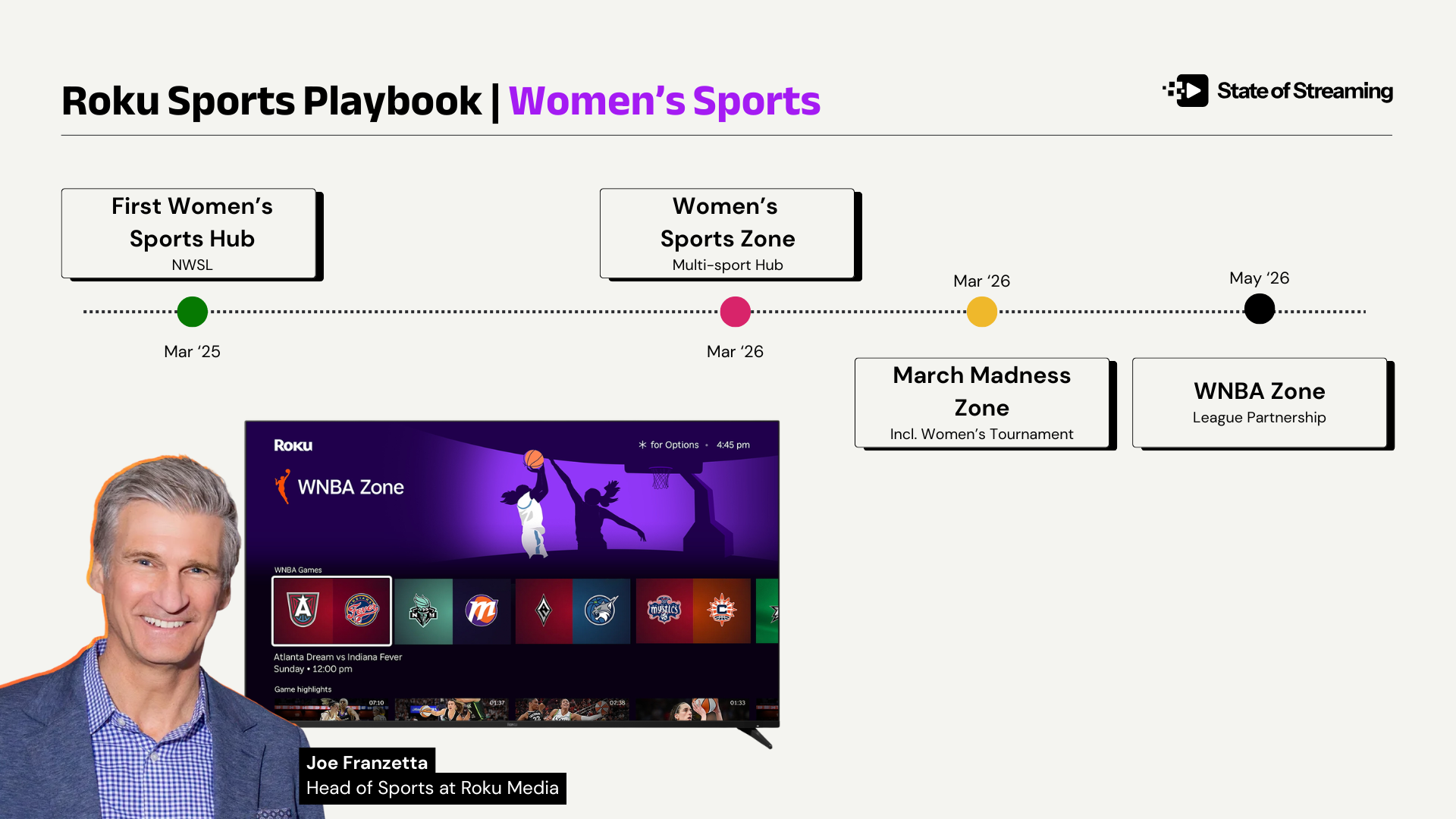
Joe Franzetta: As the world moved from linear to streaming, the challenge for sports has been rights fragmentation. Where rights used to be on one or two partners, now you see four, five, six, or seven. Our North Star has been to aggregate that content in a centralized destination on the platform. We started working with leagues like the NFL, NBA, NHL, MLB, WNBA, and NWSL to build dedicated branded destinations with their IP.
Tim Rowe: How do you take that to the next level of personalization?
Joe Franzetta: Personalization comes through explicit signals, like selecting a favorite team, and implicit signals, like tuning into a [New York] Giants game every Sunday. We aggregate those signals to surface relevant content, clips, score strips, and odds integrations. Down the road, that extends to merchandise sales, ticket sales, and food delivery. Since sports are tribal, we're looking at how to build community and fandom as part of the platform experience.
The Future of RSNs & Global Expansion
Tim Rowe: Roku is much bigger than just the U.S. footprint. What does international expansion look like for Roku Sports?
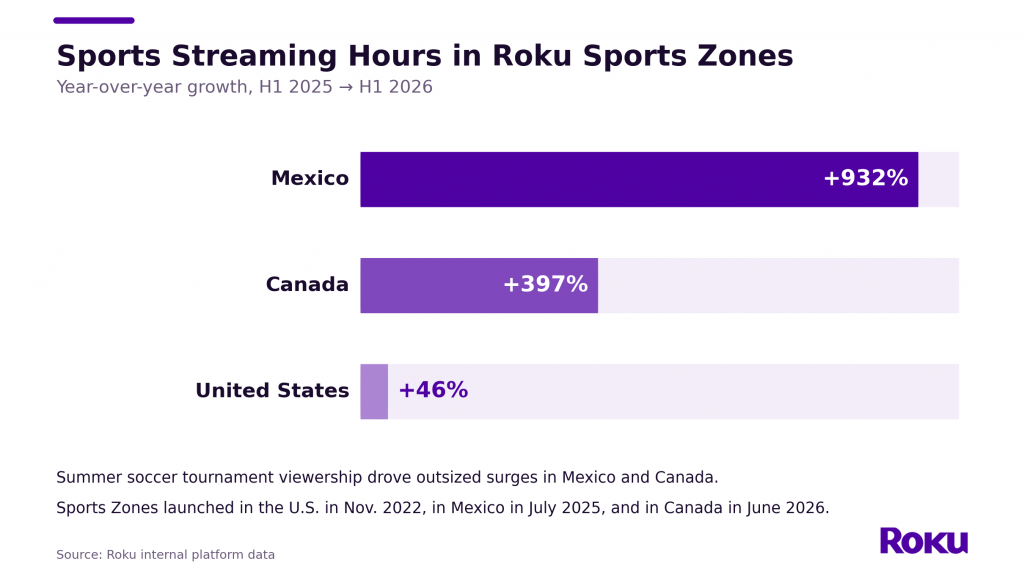
Joe Franzetta: We've launched our Sport Zone playbook in territories like Canada, Mexico, Colombia, Argentina, Brazil, and the UK. There's no better way to come into a new territory than on the shoulders of its favorite local sport. During the World Cup, Nielsen reported Roku was the platform with the most streaming engagement in the U.S., driving hundreds of thousands of subscriptions to partners like Fox One and Peacock. International growth will be a major driver for us moving forward.
Tim Rowe: What are your thoughts on the current state and future of Regional Sports Networks?
Joe Franzetta: The RSN business was built for the cable model, but local distribution in streaming presents challenges. We see hybrid models emerging, like direct-to-consumer subscriptions or unlocking games for free in front of a paywall on a FAST channel like the Roku Sports Channel. Fans can then use their remote control to click and subscribe directly within the live broadcast. As things move to a combination of over-the-air, DTC, and MVPD, we act as the connective distribution platform.
Want to watch or listen to the entire conversation?
Get it here: https://podcast.stateofstreaming.com/joe-franzetta-roku-s5e8/
Get the SOS. Brief
The sharpest streaming intelligence, delivered to your inbox.