NEW RESEARCH: Every Window Counts – The Content Lifecycle Report

GET THE REPORT: Every Window Counts: The Content Lifecycle Report
With streaming now commanding a record 49.6% share of all US TV viewing, the battle for the living room feels larger than ever. But a new study suggests that for content owners, the biggest threat to profitability isn't necessarily a lack of hit shows or massive churn; it’s the silent, compounding cost of minor on-screen errors.
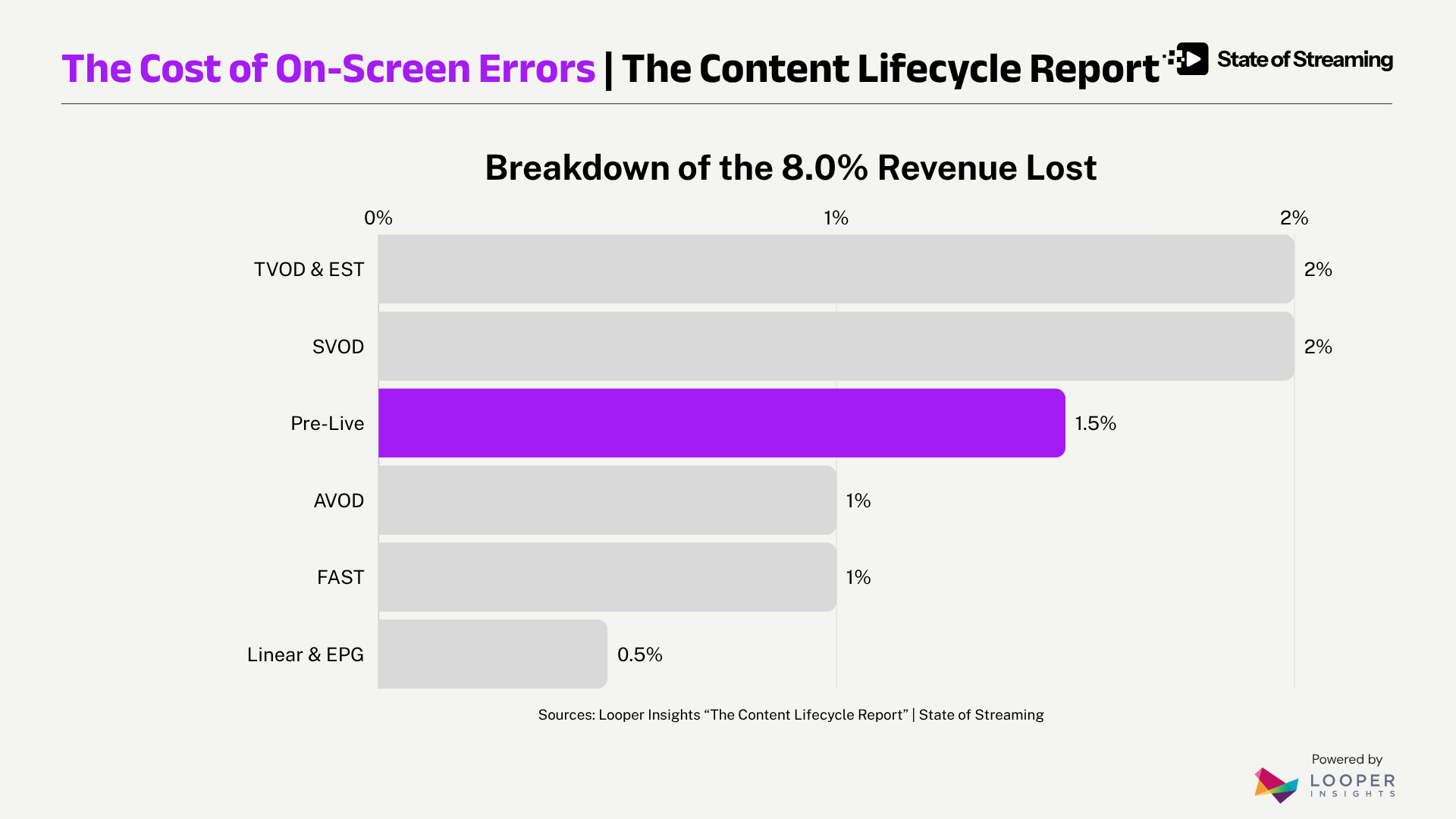
In their new Content Lifecycle Report, Looper Insights tracks the journey of one fictional mid-budget action film, "Ember Coast," across six distinct distribution windows. Because every window is managed by different teams and external partners, the total financial damage of operational slips is rarely added up. The results are eye-opening: small merchandising and placement errors across the Connected TV (CTV) ecosystem can easily cost a studio 5% to 10% of a title's total revenue.
By expanding the lens to look at the entire lifecycle, a clear picture emerges: securing a distribution deal is only half the battle. Surviving the CTV interface is the real war.
Here is how errors in all six windows play out, and what they mean for the bottom line.
The Pre-Release & Transactional Bleed
Get the report Every Window Counts: The Content Lifecycle Report
The overt message of the report is that launch timing and pricing are incredibly fragile. Viewers cannot buy what isn't priced right, and they won't pre-order what is already available to rent.
Two early-window errors prove how quickly premium sales can be cannibalized:
Window 01: Pre-Live (1.5% Revenue Loss): Studios deliver files early to ensure launch-day readiness. But when one storefront made Ember Coast available to rent days before the official release, premium launch-week sales were lost to early, cheaper rentals.
Window 02: TVOD & EST (2% Revenue Loss): During the critical launch week, a leading storefront launched the title at the wrong price and failed to include its pre-order bundle.
Why it matters: Launch week sets the financial pace for a film's entire life. Errors here happen on the screen before they ever show up in a revenue report. By the time the data comes in, the launch moment has permanently passed. Content owners must verify every shelf on every storefront before and during launch day.
The Subscription & Ad-Supported Shuffle
If a title isn't featured prominently, it effectively doesn't exist. With viewers spending an average of 12 minutes searching for something to watch, visibility is currency.
Window 03: SVOD (2% Revenue Loss): When moving to a subscription service, the premiere is a massive promotional moment. For Ember Coast, the agreed-upon home screen placement failed to appear on two CTV platforms over launch weekend, crippling its ability to draw in and retain subscribers.
Window 04: AVOD (1% Revenue Loss): On ad-supported services, titles join massive on-demand libraries. The featuring agreed upon to lift the film out of the depths never went live, leaving it buried in the catalog.
Why it matters: The screen is the shop window. A tile or row decides whether viewers press play. If negotiated placements aren't verified in real-time, studios are leaving money on the table and losing out to the 8 in 10 US viewers who will simply defect to YouTube if they can't easily find something to watch.
Get the report Every Window Counts: The Content Lifecycle Report
The Linear Revival & FAST Fumbles
As the industry embraces always-on streaming, the traditional TV guide has returned with a vengeance.
Window 05: FAST (1% Revenue Loss): Free Ad-Supported Streaming TV relies on guide-style lineups. After a platform lineup refresh, Ember Coast's channel dropped far down the guide on two platforms, completely losing its prominent discovery position despite nothing about the channel itself changing.
Window 06: Linear & EPG (0.5% Revenue Loss): In the run-up to its traditional TV premiere, both the channel and the film sat off the first guide page, forcing viewers to scroll to find it.
Why it matters: FAST and EPGs are grid-based ecosystems. A channel's position dictates its viewership. If a channel drops down the lineup unnoticed, the passive viewership that makes FAST so profitable simply disappears.
Get the report Every Window Counts: The Content Lifecycle Report
The Live Events Disaster
To illustrate the unforgiving nature of real-time broadcasting, the report looks at a championship sports final promoted on CTV home screens 48 hours before kick-off.
The Error (12.5% Value Loss): On one platform, a paid top-banner promotion went live six hours late.
Why it matters: Unlike a film that can be promoted next week, a live final cannot be replayed. Missing just six hours of a 48-hour window wiped out 12.5% of the promotion's booked value. A make-good cannot replace the audience for a live event; slips must be caught in minutes, not days.
Things To Do About This Now
1. Unify Your Window Tracking
No one sees the whole picture because each window has its own team and partners. Studios need a centralized way to track a title from Pre-Live all the way to Linear & EPG so that the full financial picture isn't siloed.
2. Audit the Interface, Not Just the Revenue
Errors show on screen before they show in revenue. Don't wait for the post-mortem report to realize a title was priced wrong or buried in a FAST guide. You must verify what is happening on the actual CTV interfaces (from Roku to Amazon) in real-time.
3. Value Your Placements
Treat your on-screen real estate like the premium ad space it is. Utilize metrics like MPV™ (Media Placement Value) to understand exactly how much money a missing banner or dropped FAST channel is costing you, and use that data to hold platforms accountable.
4. Download the Looper Insights report. They've been a great partner to State of Streaming and bring a truly unique take to the dynamics playing out in streaming and connected TV.

Get the SOS. Brief
The sharpest streaming intelligence, delivered to your inbox.