Monetizing Live Sports Without the Churn: An interview with Simeon McMillan & Scott Young
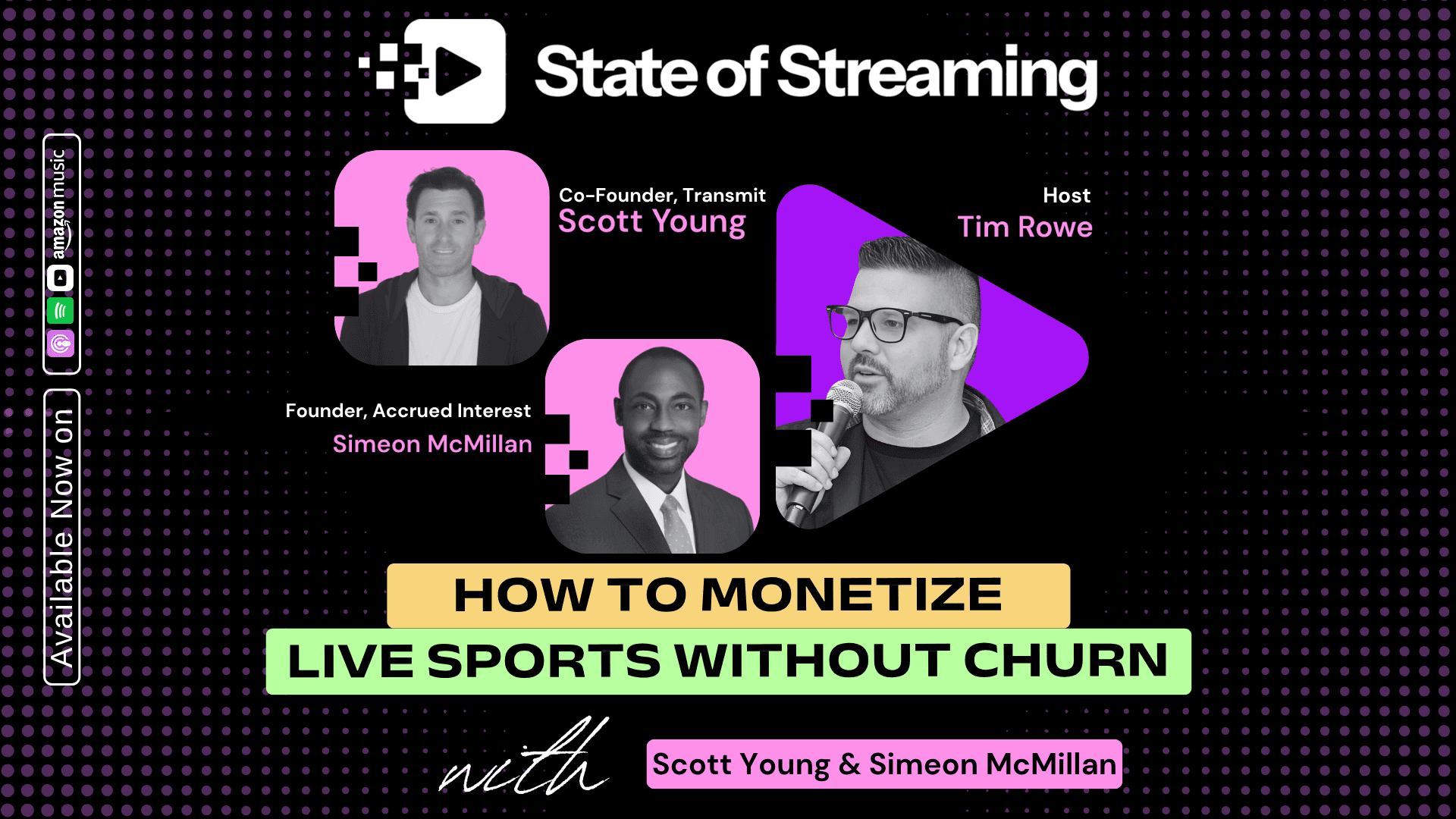
"Don't change the game for ads, change the ads for the game." - Scott Young
In this conversation, we sit down with Simeon McMillan, founder at Accrued Interest, and Scott Young, co-founder of Transmit. Over the last year, ad-supported TV's total share went down from 74% to 72%, while ad-free streaming accounted for 71% of all streaming growth in the quarter. Yet platforms like Netflix—which contributes 2% of total NFL ad revenue—and Disney+, whose properties account for 14%, are diving headfirst into live sports. Simeon and Scott unpack how apps that trained us to hate commercials can serve ads during live cultural moments without breaking the user experience or triggering subscriber churn.
The SVOD vs. Live Sports Collision
Tim Rowe: The data shows that ad-free streaming is booming, accounting for 71% of all streaming growth last quarter. Yet subscription video-on-demand giants like Netflix are diving headfirst into sports with properties like WWE, NFL games, and an initial slate of the 2030 World Cup games in Spain and Andorra. Simeon, how does Netflix introduce more advertising to their subscriber base without triggering massive churn?
Simeon McMillan: Netflix is definitely continuing full speed ahead on having more sports. Whether or not you are on the premium tier, you're going to be served some sort of ads or sponsorships during the segment breaks. What Netflix has shown they've been excellent at doing is pinpointing specifically the sports that drive the most impact for their audience. Instead of bidding billions of dollars for a full season of NFL, which could turn some people off if you're not an NFL fan, they're going after the World Baseball Classic, but only for Japan. Or they're going after the World Cup rights for 2030, but only for Spain, and within the realm of that, they can serve more ads without alienating their core viewer.
Scott Young: Regardless of tier, there needs to be an ad experience that can monetize within content that doesn't disrupt the viewer experience. Subscriptions alone are not enough to support the macroeconomic success of the industry, so ads have to cover the gap, especially in live sports. The World Cup is a good example of what we learned from Fox and how you can monetize better without changing the game.
Don't Change the Game for Ads
Scott Young: Fox took an expensive media rights opportunity and turned it into a profitable one by adding eight new 30-second spots, generating over $290 million of incremental revenue. However, they created new rules to the sport, and fans in the stadium were booing. You don't need hydration breaks or new stoppages because soccer already has 40 minutes of time in the broadcast where the ball is not in play. Based on our analysis, there are at least 15 to 20 monetizable moments where you're not disrupting viewers' attention and can incorporate ads in the natural flow of the game. Keeping them in the game commands premium CPMs, and over an entire World Cup, you have the opportunity to generate an incremental $410 million of revenue. Don't change the game for ads, change the ads for the game.
Simeon McMillan: Hydration breaks likely won't return for future World Cups because that money doesn't flow through FIFA—and FIFA is going to make sure they get paid. Ideally, you don't want to break up the flow of the game, especially in Europe, where the Premier League and UEFA Champions League are not trying to follow suit. With a digital stream, you have more flexibility than on a linear product to introduce banner ads, lower thirds, or different bugs. Plus, they're going to have shoulder content around the game—pregame, postgame, documentaries—like the success of the Formula One series and Netflix's NBA content, Starting 5, despite not having any NBA games.
Scott Young: Shoulder programming creates new premium ad space associated with the tentpole of the World Cup, giving advertisers more exposure throughout the weeks before and after the matchups.
Closing the Ad-Load Gap & AI Live Delivery
Tim Rowe: That EMARKETER research also found that CPMs during live American football events had fallen because there was more demand for shoulder programming. Looking at the ad load gap—linear at 13 to 15 minutes, streaming between four and six—who's leaving money on the table?
Simeon McMillan: Streamers are probably leaving money on the table. Even at four to six or even eight minutes, they could go up 25% to 30% and still be significantly less because the viewer is still comparing their experience to linear television. There's a natural ceiling on CPMs—advertisers aren't just going to pay for anything—so the ad load is going to have to go up, and users will get used to it.
Tim Rowe: Scott, how do you approach dead air moments within the live broadcast from a technical fulfillment workflow?
Scott Young: Netflix missed their earnings on their ad revenue from last quarter, shedding light on the challenges publishers have forecasting and fulfilling digital advertising goals. Even in the ad time they have, publishers drop potential impressions because reliance on programmatic advertising creates duplication in demand sources. Introducing incremental ad breaks opens up direct demand sources at massive scale and higher CPMs. We've integrated AI into our process, looking at things through timing, context, and creative. When a touchdown happens, there's a predictable window of dead space afterward. All those contextual signals flow into the ad request so advertisers can decision on viewers individually during those moments, funneling into dynamic creative relative to the moment.
Simeon McMillan: When I worked in linear television, programmatic was sometimes a four-letter word because you wanted the high-touch experience for better pricing, better placement, and less money leaking through the cracks. Programmatic is great to scale globally quickly, but for marquee sports events, they definitely want to do less programmatic.
Rights Fragmentation & The 2030 Future
Tim Rowe: Let's talk about tentpole events—there's going to be seven different transmissions of the Super Bowl on Disney, plus multiple alt-casts. How should platforms balance immediate ad revenue versus long-term sticky customers?
Simeon McMillan: Streamers have an inherent advantage over the linear world because broadcasters have to deal with local affiliates who aren't going to have exclusivity for the Super Bowl—just like when Fox put it on Tubi for free without authentication. I experienced a similar dynamic watching the WNBA Finals across NBC Sports on USA Network, CNBC, NBC, and Peacock, especially now that NBC and Versant are separate companies. A streamer with one feed doesn't have to appease all those partners and cut up the money different ways.
Scott Young: Media rights fragmentation hurts the viewer experience, though consolidating feeds makes that better. In a football broadcast, the ball is only in play 9% of the time, so there's a really underutilized opportunity for advertising in that dead space.
Tim Rowe: Simeon, what's the single biggest financial mistake you see streaming platforms making with live sports over the next three to five years?
Simeon McMillan: There's still a misconception that all leagues are in demand for a particular sport, and some media companies presume certain leagues are interchangeable. Look at Versant—they are trying to turn Fandango into a sports hub, and one of their marquee gets is the Bundesliga, the German soccer league. From my time in Spanish-language television, even with a soccer-heavy audience, there are some countries they just don't want to watch. If ESPN wasn't able to make the German soccer league work, is a 50% haircut on the rights enough for Fandango to make it work? Platforms have to be careful of not overpaying for second- and third-tier sports just because they missed out on the premier ones.
Tim Rowe: Be a selective shopper. Scott, what will the live sports ad experience look like in 2030?
Scott Young: We've been conditioned to be break-minded in terms of advertising over the last 80 years because that's all we've been doing in television. In 2030, we're still going to see long-duration ad breaks—I'm not forecasting that goes away—but we have the opportunity to make those ad breaks more exciting and synchronize them with what happens inside the game and inside the shoulder programming. Synchronizing the whole lifecycle of sports lets us take advantage of every ad opportunity in our creative portfolio in a synchronized way.
Want to watch or listen to the entire conversation?
Get the SOS. Brief
The sharpest streaming intelligence, delivered to your inbox.