The Third Model - Attention Capital | A Column by Josh Stein
Editor's Note
Attention Capital is a syndicated column by Josh Stein decoding the economics of media, sports, and platform ecosystems — where attention becomes enterprise value and the contracts behind the cash flow get priced like the credit they actually are. Three ownership models have now run on the same kind of attention in the VTuber market: corporate-owned characters, shared agency models, and independent creators. While independent creators now command more than half of global watch time, Tokyo's corporate ownership structure remains the only one producing the kind of audited, contractual cash flow that a credit desk can actually underwrite.
The most-watched streamer across Twitch, Kick, and YouTube Gaming in the first half of 2026 is a man with a peanut for a head.
He operates under the name TheBurntPeanut. He is American. He has not given his real name or shown his full face, and across the three platforms combined, he logged 128.9 million hours watched between January and June, more than anyone else on the combined chart. Second place, Jynxzi, finished at 66.1 million. In North America, he led the region outright, with xQc, HasanAbi, and IShowSpeed all below him.
In the second quarter alone, he did 55.08 million hours, almost seven times the next VTuber on the chart. Streams Charts, the firm that keeps the tape, wrote that his numbers rivaled the combined rosters of Nijisanji and hololive, the two largest VTuber agencies in the world by watch time.
And the industry that tracks him cannot agree on whether he belongs in the category at all.
The avatar is a face filter. His real eyes and mouth show through a cartoon peanut with a propeller cap. He has told his audience he is a “PTuber” and, in plainer terms, “I am not a VTuber.” He said it around the time he accepted VTuber of the Year at The Streamer Awards. Streams Charts files him in the independent VTuber scene and notes in the same report that his status as a VTuber “has caused much controversy.” He answers to no agency, no label, no publisher. Before any of this, by his own account, he sold phones.
So the largest name in the category is a disputed member of it, operating a character he owns outright, with no institution anywhere underneath him.
Welcome back to Attention Capital
In The Graduation Problem, I made the case that the Japanese VTuber agencies ran the first successful experiment in moving audience attachment off the talent’s balance sheet and onto the corporation’s, and that the market has been grading the result in Tokyo, drawdown by drawdown. That essay took one structure apart. This one asks what happened when two other structures ran in the same format.
Three ownership models have now run on the same kind of attention. Japan built the corporate-owned character. The United States built an agency where the talent owned the character. And the independents, who own the character, the channel, and themselves, now command more than half of global VTuber watch time.
The three results point in different directions. Why they do decides whether any of this is financeable.
For the Attention-Constrained
The three models.
Corporate ownership: COVER and ANYCOLOR own the character, contract the performer, and keep the channel and the catalog. Shared ownership: VShojo, founded in 2020, let the talent own the character and paid what its founder called generous splits. Independent ownership: the performer owns the character, the channel, and the business, with no institution beneath any of it.
The results.
Japan’s model prints audited numbers. ANYCOLOR cleared a 36.2% operating margin on ¥55.7 billion in its latest fiscal year, and 81% of COVER’s revenue comes from merchandise, events, and licensing. VShojo shut down in July 2025, days after performers went public with claims that they were owed money; 12 of its 13 remaining performers left within 48 hours and kept their characters. Independents crossed 50% of global watch time in Q1 2026 for the first time in Streams Charts’ tracking and gained almost two more points in Q2.
The cost of each.
When the corporation owns the character, the performer’s grievances become its public problem, on the tape. The agency that shares the character pays for the split and holds nothing. The performer who owns everything has nobody underneath when demand retreats. And demand just retreated: global VTuber watch time fell 15.4% in Q2, to 482.6 million hours, the first quarter under 500 million since Q3 2025.
The tension.
By the financeability test, Tokyo’s structure is the only one of the three a lender can read today, and that says nothing about which is the better business. The independent structure produces the largest audience in the category and revenue nobody outside it can see, and its biggest name is a disputed member of the category. Neither surviving model wins on this evidence.
Cultural or structural.
If Western audiences attach to the person over the character as a matter of culture, no American-owned institution will ever hold the asset, and the value settles with the platforms when the category consolidates. If the attachment is structural, a function of how the American agency was built, then no American-owned company has run the corporate model here at scale, and the experiment is still open.
What would prove this wrong.
An American-owned agency running the corporate-ownership model at 5% of global watch time by the end of 2028 kills the cultural reading. TheBurntPeanut’s hours and the independent share both retreat through 2027 while the Japanese agencies grow, meaning the independent surge was one creator, and this piece overread it.
I. Japan: The Corporation Owns the Character
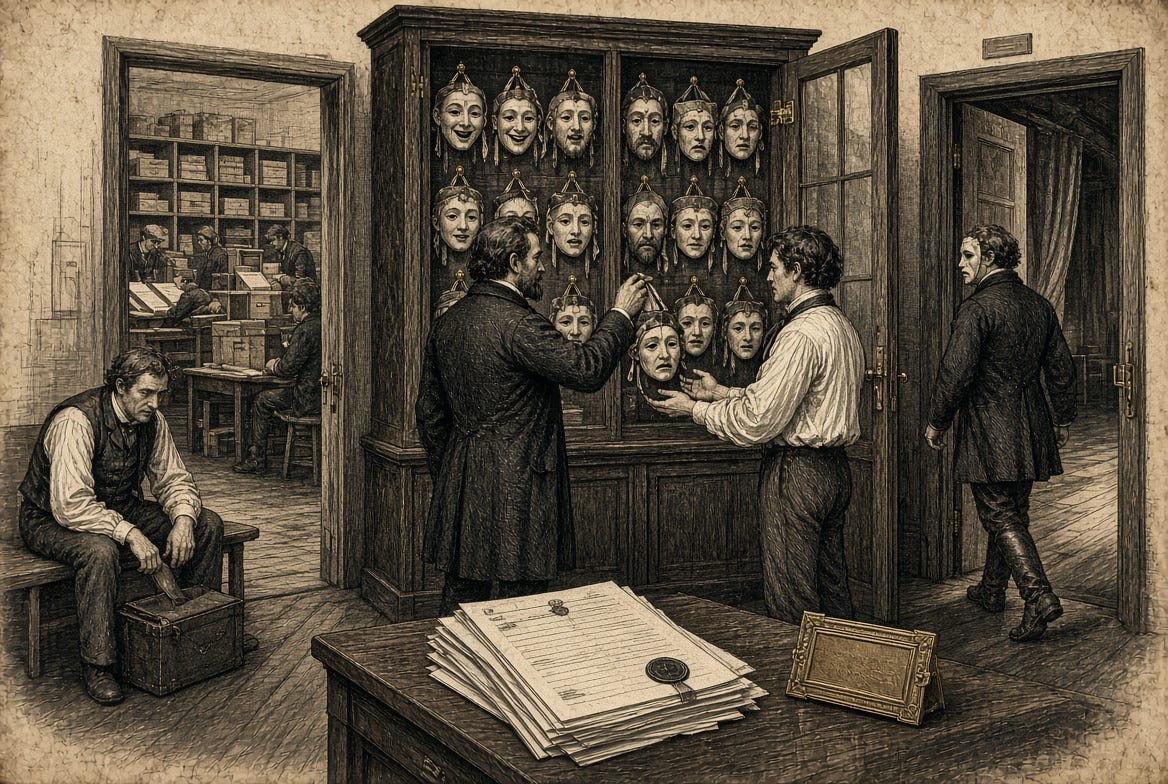
Tokyo first, because it’s the only one of the three with audited numbers.
COVER Corp owns hololive. ANYCOLOR owns Nijisanji. In both companies, the corporation designs the character, holds the name, the channel, the back catalog, and the merchandising rights, and contracts a performer to operate it. The Graduation Problem walked through the mechanics. Here the mechanics matter only for what they produce.
Paper.
ANYCOLOR closed its fiscal year ended April 2026 at ¥55.7 billion in revenue, up 29.9%, with ¥20.2 billion of operating profit and a 36.2% margin. It carries no borrowings and about ¥22 billion of cash.
COVER’s year ended March 2026 came in at ¥49.3 billion, up 13.7%. The composition is the point: ¥23.7 billion from merchandise, ¥9.2 billion from live events, and ¥7.2 billion from licensing and tie-ups. Streaming itself came to ¥9.1 billion, down 2%.
Every one of those categories has a counterparty. A licensing deal has a term and a signature. A concert has a gate. A trading card game has distributors and reorder rates. That is what corporate ownership of the character buys: the attention converts into contracts the corporation signs, and the corporation is the obligor.
The model has a price, and the price prints on the tape.
When a performer leaves a corporate-owned character, the grievance becomes the company’s public problem. On February 5, 2024, ANYCOLOR terminated the contract of one of Nijisanji English’s most popular performers. The company cited contract violations. The performer disputed the company’s account. The argument ran for weeks across the franchise’s English-speaking audience.
Then, in mid-March, quarterly results showed Nijisanji English revenue down about 40%, and the stock fell 22% in a single session, erasing roughly ¥44 billion of market value in hours. The performer’s side printed too. She went back to an independent channel she had run before her agency years, and it added 250,000 subscribers within a day.
That is the structural exposure of Model One. The corporation owns the character, so it owns the performer’s exit, the performer’s complaint, and the audience’s verdict on both, all of it marked to market before the quarter closes.
The price stays visible in ordinary quarters too. In the first quarter of 2026, Nijisanji overtook hololive as the top agency by watch time, 17.1% of global hours to 14.3%. In the second quarter, hololive took the spot back, and Nijisanji gave up around 3% of its share. Two listed companies trading places on a public leaderboard, with the attention of the performers they contract as the thing being counted.
And the model is leaning on its own margin now. ANYCOLOR guided fiscal 2027 operating profit down as much as 11% on revenue growth of 1% to 8%, citing higher personnel costs and a more disciplined pace of talent usage. The stock hit limit-down the next morning. COVER guided 4.1% sales growth and flat operating profit. The margin is guiding flat to down, on a higher personnel bill.
The corporation owns the character, so the corporation owns the exit.
II. VShojo: The Agency Shares the Character
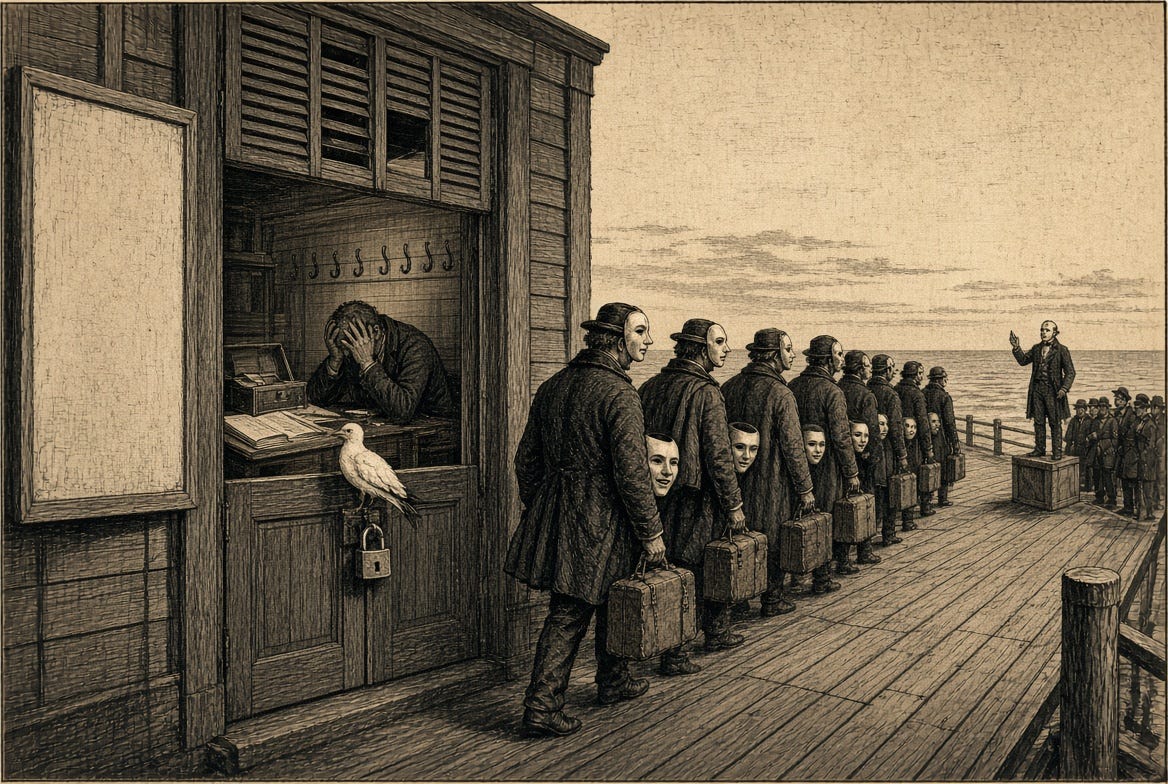
The American experiment ran for four years and eight months.
VShojo launched on November 24, 2020, with seven performers and a chief executive, Justin Ignacio, who had been on Twitch’s founding team. The company called itself talent-first from day one. In March 2022, it raised an $11 million seed round led by Anthos Capital.
The structural bet was the inverse of Tokyo’s. The talent owned the character. When performers left, and some did as early as 2023, the company said publicly that they kept their IP.
On July 24, 2025, Ignacio posted a statement announcing the shutdown. It opened: “VShojo has failed, and I’ve mismanaged the company into the situation you’re all witnessing.” It went on:
“Over the past few years, we raised around $11 million to pursue a bold, talent-first approach in VTubing, prioritizing creators and community over short-term profits, to achieve long-term sustainability. Our funding went directly to our creators through generous splits, debut investments, infrastructure, concerts, events, and staffing, all designed to support them. We also wanted talent to own their IP, which we knew was a unique creator-first approach for an agency.
“However, despite all our efforts, the business failed to generate the revenue we needed to sustain that model, and eventually, we ran out of money.”
By the time he wrote it, the roster had all but emptied.
Over the preceding week, performers had gone public with claims that they were owed money; Bloomberg reported clients saying the company had withheld hundreds of thousands of dollars. Then, on July 21, one of the company’s biggest names announced her departure. Over the next 48 hours, 12 of the 13 performers who remained followed, and every one of them took the character out the door, because every one of them owned it. The shutdown statement followed on July 24. VShojo’s last appearance in the Streams Charts agency rankings was Q3 2025, at 1.6% of global watch time.
The company paid for the split. Debut investment, infrastructure, concerts, events, staff, and a revenue share its founder described as generous: all of it came off the agency’s side of the table. In exchange, the agency held a contract with a performer who owned everything the audience showed up for.
So when the category softened, and Q3 2025 was a down quarter for VTubing as a whole, the ownership terms left the agency no character to soften against. The thing the audience had come for belonged to the performer. Whatever else the company held, it held none of that. The institution carried the cost of ownership without the asset, and when it ran out of money, the talent walked in two days, intact.
Execution mattered. He said so himself, in the first line. Grant every execution failure, and the structural exposure is still there underneath: the asset can leave, and the money that funded it can’t come back.
The agency paid for the split and never held the asset.
III. The Independents: The Person Owns Everything
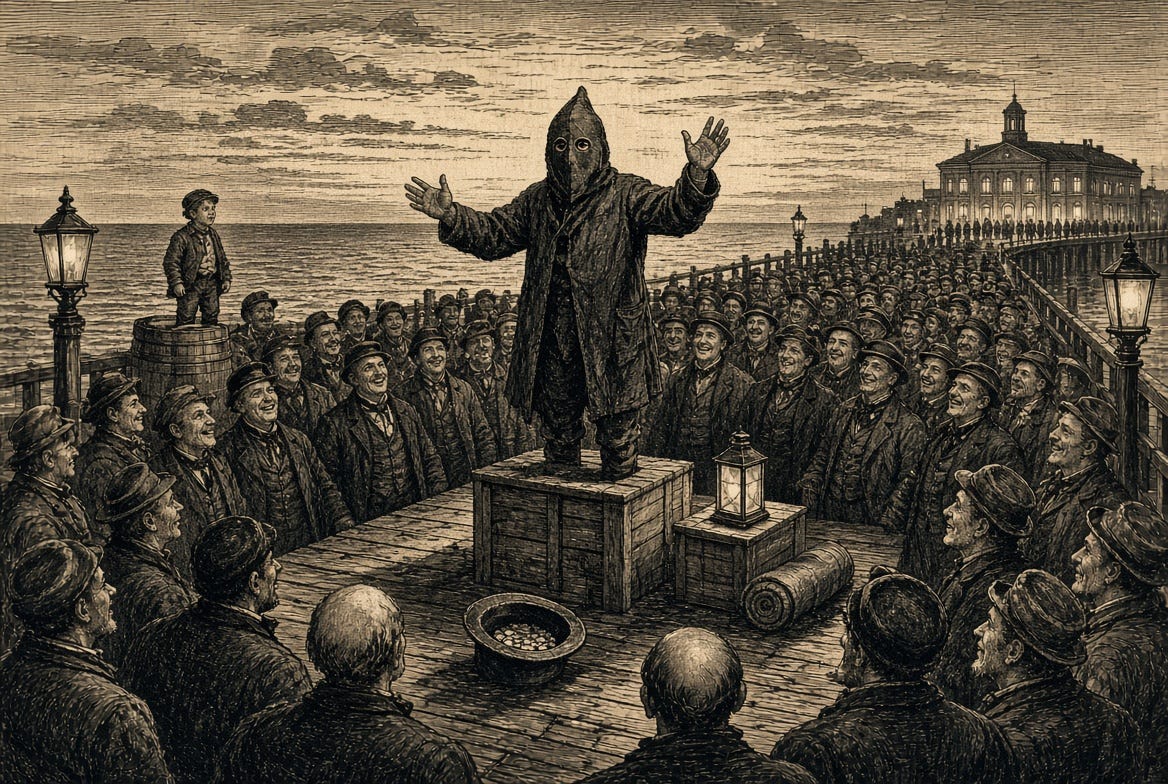
The third model has no founding date, no funding round, and no chief executive. It has a share of the market, and the share crossed a line this year.
In the first quarter of 2026, creators unaffiliated with any major agency accounted for 50.4% of global VTuber watch time, the first majority in Streams Charts’ tracking, in a quarter that set the all-time record at 571.9 million hours. Streams Charts said plainly that the segment would have grown without TheBurntPeanut and that his numbers were what pushed it past half. In the second quarter, independents held above half and added almost two more points of share.
Two listed agencies with a combined market value near $1.8 billion as of early September now sit behind, in watch time, a category of people who own themselves.
The case at the top of that segment comes with the dispute attached.
TheBurntPeanut streams as a man with a peanut where his head should be. The rig is closer to a phone filter than to the fully rendered anime models that built the category; his own eyes and mouth stay visible, stretched inside the cartoon. Streams Charts calls him “crass, unapologetic, and most of all, American,” files him in the independent scene, and reports that his status as a VTuber has caused much controversy. He has told the world he is not one. He accepted the category’s top award anyway. In its Q2 report, the firm wrote that the question “remains a subject of controversy.”
The label can stay unsettled. One thing holds whichever way it lands: an audience of that size attached to a person operating an avatar, with no institution anywhere underneath him. That fact frames the other two models.
The independent structure produces watch hours, and watch hours are public. 55.08 million in the second quarter. 128.9 million across the half, on the combined three-platform chart.
It also produces revenue, and revenue is private. He answers to no board and files nothing. The figures floating around are third-party guesses. The hours are on a public chart, and nothing about the cash is.
And what the structure carries is one human being, load-bearing for all of it: the channel, the character, the schedule, the sponsor relationships, the moderation, the rig. A hololive performer can go quiet for a month, and the company still ships merchandise. When the independent goes quiet, no enterprise is left running.
Which matters this quarter, because the category just softened. Global VTuber watch time fell from the Q1 record to 482.6 million hours in Q2, down 15.4%, with around 300 fewer channels live. It was the first quarter under 500 million hours since the third quarter of 2025. Independents gained share in a pie that shrank 15%.
In the independent model, there is no institution to absorb a bad quarter, no second business line, no counterparty on the other side of a contract. What’s left is one person and a public chart.
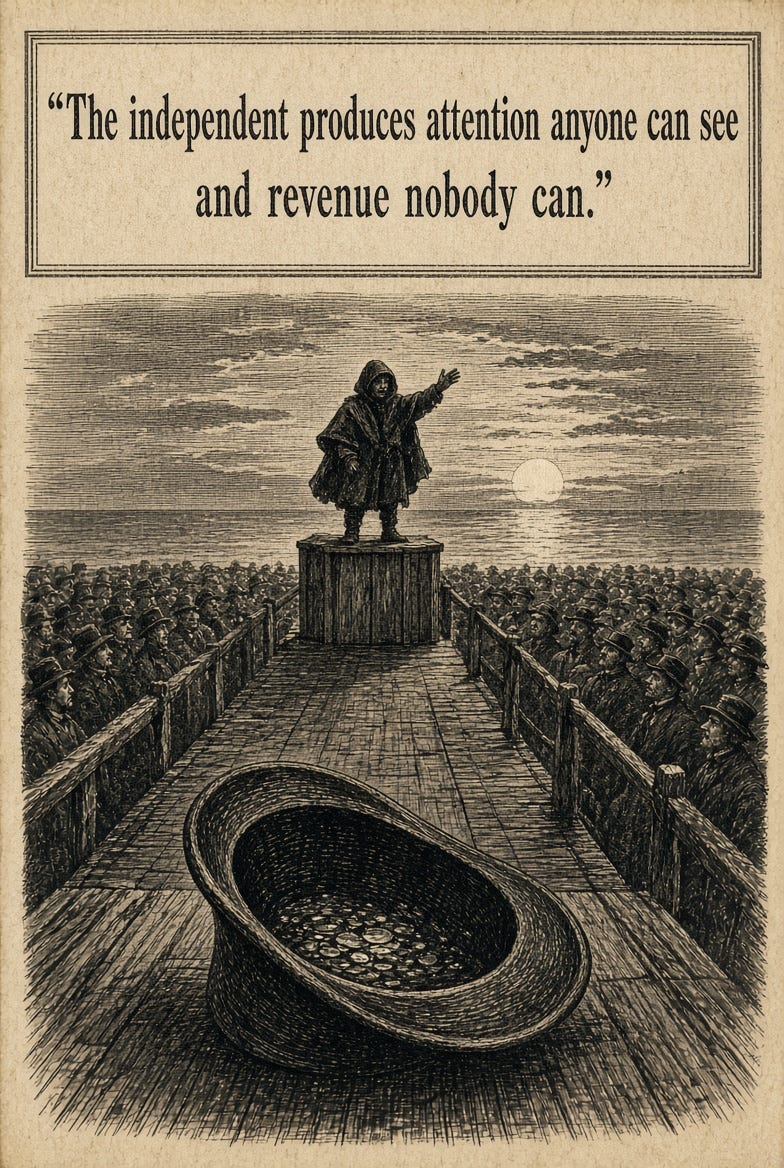
The independent produces attention anyone can see and revenue nobody can.
IV. The Tension
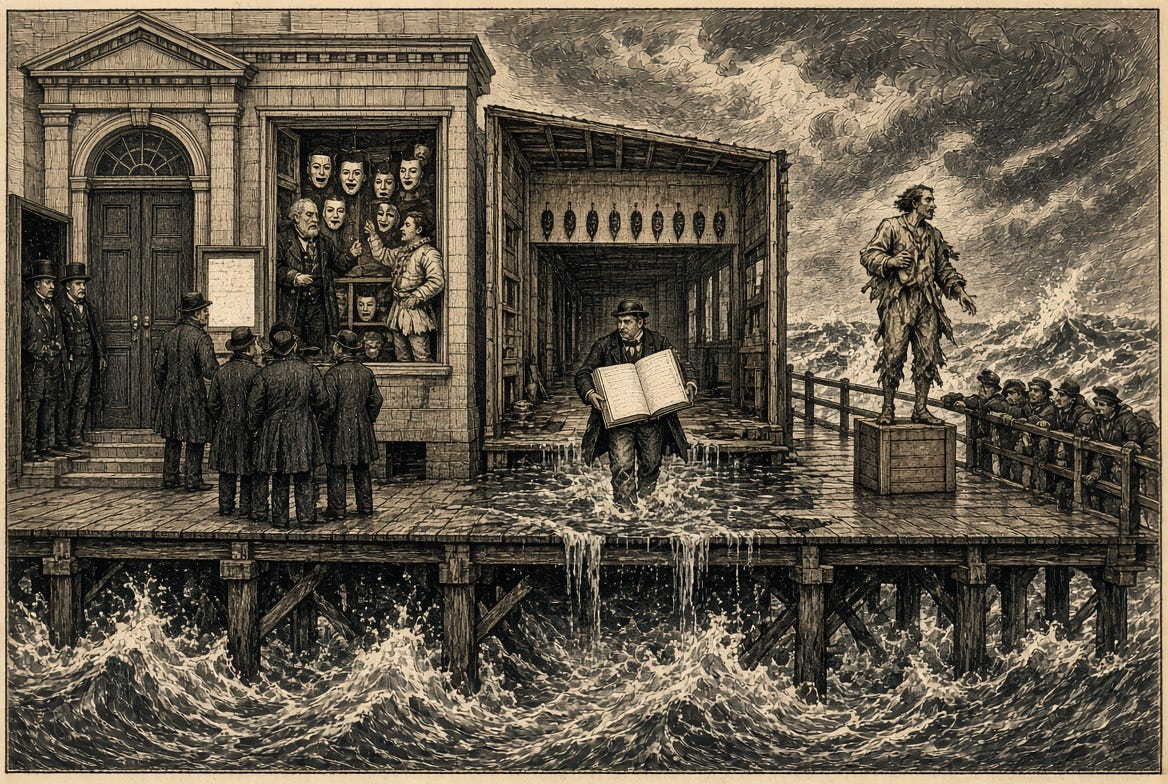
Each structure carries a cost, and none of the three costs cancels the others.
Own the character, and you own the exit. ANYCOLOR’s March 2024 session is the clearest example in the category, but every graduation, every termination, every performer who says on stream that the company was hard to work with prints on a listed company’s tape. The corporation holds the asset. The asset holds a person. When the person is unhappy, the market finds out, and so do the rest of us.
The shared model pays for the split and holds nothing. VShojo’s structure was the inverse of the one on ANYCOLOR’s tape: the performer owned the thing that made her valuable, so no company could keep it when she left. That structure went out of business. An institution that funds the asset and doesn’t hold it has nothing left the day the funding stops.
Owning yourself leaves nobody underneath. The revenue flows to the person, after the platform’s cut, and so does every risk the audience produces, with no one to share it. In a rising quarter, that looks like freedom. In a falling one, it looks like a very large job.
Attachment sits somewhere between the character and the person. Model One puts the institution on the character’s side and pays for it in public exits. Model Two puts it on the person’s side, and the one American test of it ended in insolvency. The third has no institution at all, and pays for it in concentration.
None of the three holds the asset, keeps the performer, and survives the down quarter. The one built to split the difference is the one that didn’t survive.
V. Cultural or Structural
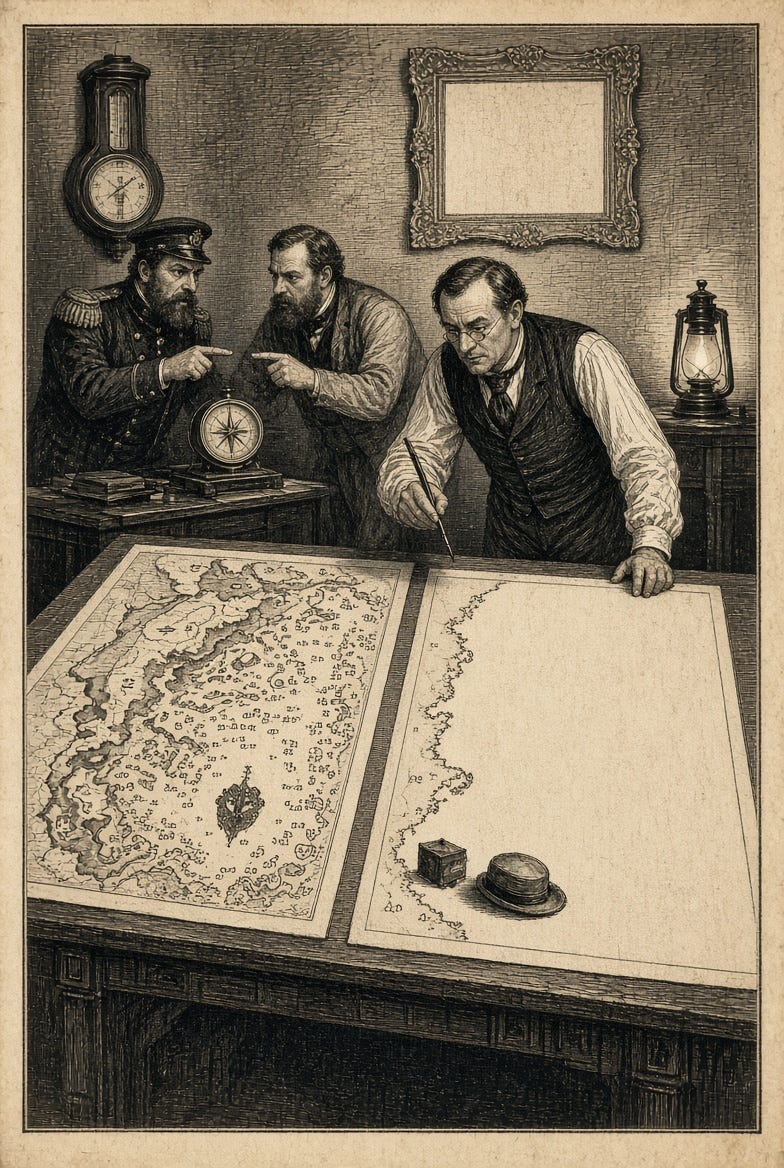
Why did the American experiments run the way they did? Two readings lead to opposite conclusions about where the value sits.
The cultural reading says Western audiences attach to the person. On this reading, Japan’s audience had a long run of character-driven entertainment before the first corporate VTuber and accepts a character that outlives its performer the way it accepts a role that outlives an actor. The American audience never made that bargain. It watched a man with a peanut for a head, saw his real eyes through the filter, and attached to the man. If that is what’s happening, no American-owned institution will ever hold the asset, because the audience won’t let it. The value settles with the person while the person streams, and with the platforms, which hold the rails and the data, when the category consolidates.
The structural reading says the American agency never ran Japan’s experiment. VShojo’s model was the opposite of COVER’s by design: talent-owned IP, generous splits, a company whose founder described its purpose as prioritizing creators over profit. No American-owned company has run the corporate-ownership model Tokyo runs in the United States at scale. The test is ultimate ownership. The one US entity running the model, COVER USA, is a subsidiary of the Tokyo parent, and a Tokyo parent’s subsidiary doesn’t meet it. So the American record covers two cases. A company that chose to share the character couldn’t survive, and a person who owns himself is winning. Whether an American-owned corporation could hold a character the way COVER does: untested. Under this reading, the experiment is still open.
The evidence in hand can’t separate the two readings.
What would?
An American-owned agency that runs the corporate model. If one debuts characters it owns, contracts performers to operate them, and reaches a meaningful share of watch time, the cultural reading fails on contact.
Or a performer transition on this side of the Pacific. If an American-owned character survives a performer’s departure and keeps a measurable slice of its audience, the way hololive’s characters demonstrably keep a slice through graduation, the attachment was never purely cultural.
Or the reverse. If every American attempt at corporate ownership leaks its audience to the performer on departure, at every scale, over enough events to count, then the cultural reading is what the tape supports and the structural one was hope.
None of those has printed. The data that would separate the two readings is exactly the data nobody in the United States has generated.
No American-owned company has run the corporate model here. The experiment is still open.
VI. The Credit Read
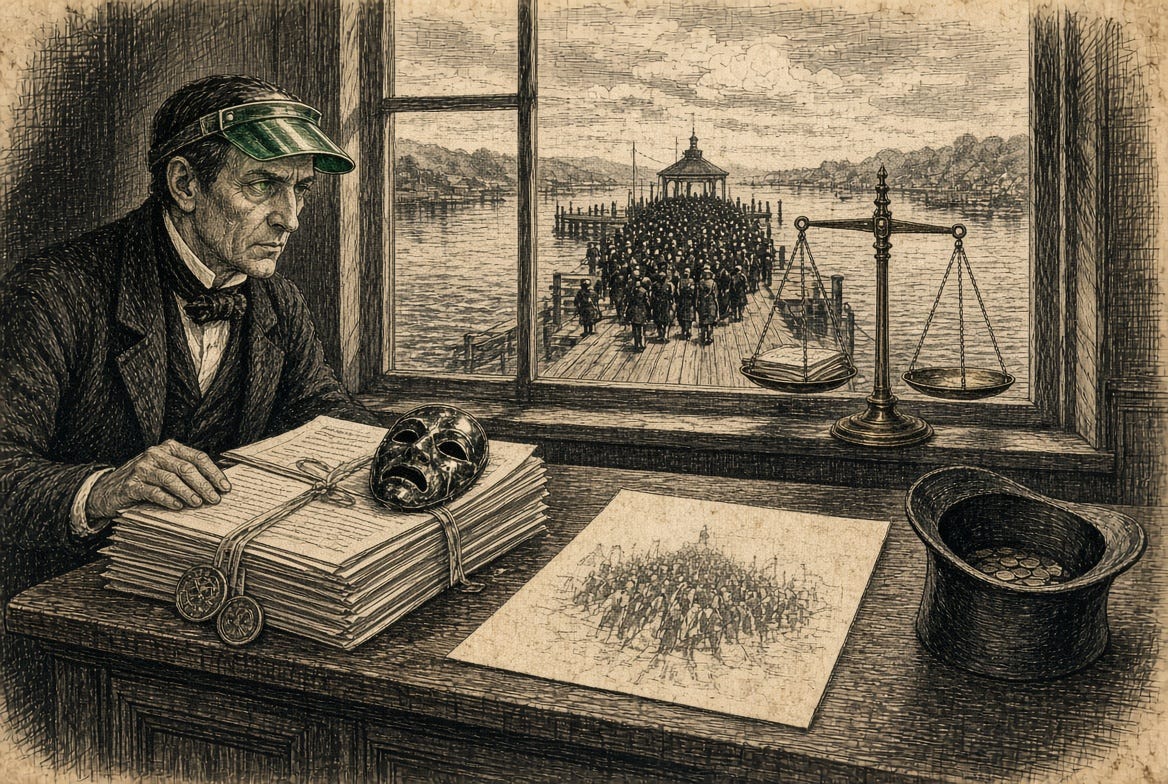
This is a framework. It names no instrument and no lender.
By the financeability test, Tokyo’s structure is the only one of the three a lender can read today. Contracts with counterparties, gate receipts, reorder rates, a corporation as obligor, audited annually and filed quarterly. That is a statement about readability. It says nothing about which model is the better business.
The performer risk in that structure is real, and it is visible. The March 2024 session put a yen figure on it.
The independent structure produces attention a lender can see and revenue a lender can’t. The hours are on a public chart. The cash flows through platform payouts, sponsorship agreements, and merchandise arrangements that no one outside the enterprise has read, held by a single person with no board, no filings, and no obligation to disclose. That describes the file. It says nothing about the person.
The open question: what would an independent at that scale have to build for the attention to become financeable? The list belongs to a different essay.
And the second question, the one that follows from Section V. If no American-owned institution ever holds the asset, where does the value settle when the category consolidates? The candidates are the person, for as long as the person streams, and the platforms, which hold the rails, the payout, and the audience data on every model at once. In Creators Are the Canary, Not the Economy, I argued that creators are what businesses look like once you strip every layer of insulation. The creator Streams Charts puts at the top of the 2026 independent charts is that canary, with 128.9 million hours attached.
VII. What Would Prove This Wrong
Two conditions, stated as conditions.
First. If an American-owned agency running the corporate-ownership model reaches meaningful share by the end of 2028, the cultural-portability argument in Section V fails. Meaningful share, in numbers: 5% of global VTuber watch time in a Streams Charts quarterly report, roughly a third of what hololive held in Q1 2026 and about three times VShojo’s last print. Reaching it would establish that an American-owned corporation can hold a character an American audience attaches to.
Second. If TheBurntPeanut’s watch time and the independent share both retreat through 2027 while the Japanese agencies grow, the independent surge was a single-creator anomaly, and this piece overread it. In numbers: independents back under 50% of global watch time for two consecutive quarters, its quarterly hours below half its Q2 2026 print, and hololive and Nijisanji both gaining share over the same stretch.
The answer to the sample-size objection, for now, is that the independent share crossed 50% before the half-year ranking and gained ground while the whole category shrank. That is a category move. If it reverses, the objection was right.
Both conditions are checkable on the same public tape this piece is built on.
The Lingering Questions
Four questions, one per model and one for the whole board.
Does the Japanese model survive its own success? The performers inside the characters hold more bargaining power than they did: bigger audiences, better documentation of what walks when they leave, and a public record of what their departures cost the stock. ANYCOLOR just guided profit down on higher personnel costs. The structure that put attention on the corporate balance sheet is paying more to keep the humans inside it.
Is an independent at that scale a business or a very large job? 128.9 million hours in six months is a number most media companies would put on a slide. It is also one person, one rig, and one schedule, with no institution to catch a bad quarter and no filing anyone can read.
What does the absence of an American-owned institution mean for where the value settles? If no American-owned institution holds the asset, the two parties left holding anything are the person and the platforms, and only one of them consolidates.
And the one underneath all of it: is portability cultural or structural? Tokyo proved a corporation can own the character. Nobody has proved an American-owned one can, and nobody has proved it can’t. Who runs the experiment that settles it?
Why Subscribe
Because three ownership structures have now run on the same kind of attention, the results point in completely different directions, and almost nobody reading the Tokyo filings is also reading the Streams Charts quarterlies.
Every week, Attention Capital tracks how documented audience behavior becomes enterprise value: the contracts, the balance sheets built on them, and the layer underneath that finance has not learned to read. If you allocate capital, this is where the difference between attention you can see and revenue you can read gets drawn before anyone lends against either. If you operate in media, this is where the ownership structures that set your multiple get taken apart in public. If you build audiences, this is the market finding out what an institution underneath you is worth, and what it costs.
Get the SOS. Brief
The sharpest streaming intelligence, delivered to your inbox.