Viant Revenue Rises 29% on Strong CTV Advertising in Q3
Editor's Note
TheDesk.net on State of Streaming is a syndicated partnership featuring reporting by Matthew Keys — founder and editor of TheDesk.net, covering adtech, media technology, and digital distribution. This report examines Viant Technology’s third-quarter financial results: revenue climbing 29% to $110.4 million on a nearly 40% surge in connected TV (CTV) ad spend, the $20 million acquisition of generative AI creative platform Waymark, conversational campaign integrations with ChatGPT and Claude, and plans to triple TVision’s attention-measurement panel.
Advertising technology company Viant saw a sharp increase in revenue during its most recent financial quarter as the company experienced stronger spending on connected television (CTV) advertising amid an expansive effort to invest in artificial intelligence and audience measurement products.
During the third quarter (Q3) of the year, Viant's revenue reached $110.4 million, compared with $85.6 million a year ago. Gross profit increased 30 percent to $51.6 million, while adjusted earnings before interest, taxes, depreciation and amortization (EBITDA) rose 24 percent to $19.8 million. Net income declined 49 percent to $2.6 million, down from $5.2 million last year, as operating expenses increased.
CTV was a major source of growth, with advertiser spending on the platform increasing nearly 40 percent from last year. Streaming television accounted for more than half of Viant's total advertiser spending during the quarter, while video advertising overall represented nearly 70 percent, the company disclosed in regulatory filings.
During a conference call with investors earlier this week, Viant co-Founder and CEO Tim Vanderhook said the company was attracting new ad buyers while securing larger budgets from existing customers.
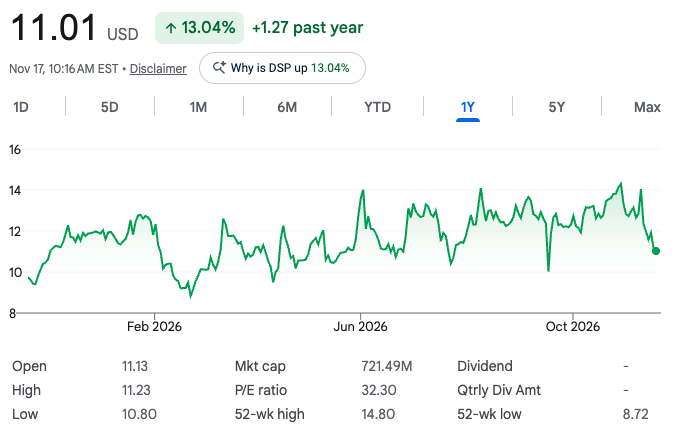
(Snapshot of stock at time of publishing)
Some of that stronger interest comes from Viant's strategy of building out new products and services that allow buyers to target audiences based on viewing habits, programming content and the likelihood that viewers are actually paying attention to commercials.
One of its newest investments is Waymark, a generative AI video advertising company that Viant acquired for a base cash purchase price of $20 million. Waymark's technology allows businesses to generate television commercials using AI-produced scripts, visuals and voiceovers, potentially reducing the costs associated with conventional commercial production. Viant intends to combine those capabilities with its existing advertising technology to produce multiple versions of commercials tailored to particular audiences and programming.
"The era of broadcasting a single static ad to broad audiences is giving way to hyper-relevant targeting, where each creative is tailored to the viewer and the content and is dynamically optimized to maximize attention," Vanderhook said during the call.
The acquisition also gives Viant relationships with television companies already using Waymark's technology, including Nexstar, Sinclair, Comcast, Fox, Scripps, Gray Media, Hearst Television, TEGNA and Cox Media Group. During the call, executives said Waymark's capabilities would be bundled into the platform for smaller advertisers, while larger enterprise customers would be able to purchase them as an additional service.
Viant is also expanding the use of AI in the advertising buying process: The company has introduced integrations with ChatGPT, Claude and Cursor that allow advertisers to create, manage and evaluate campaigns through conversational prompts without opening Viant's traditional advertising platform.
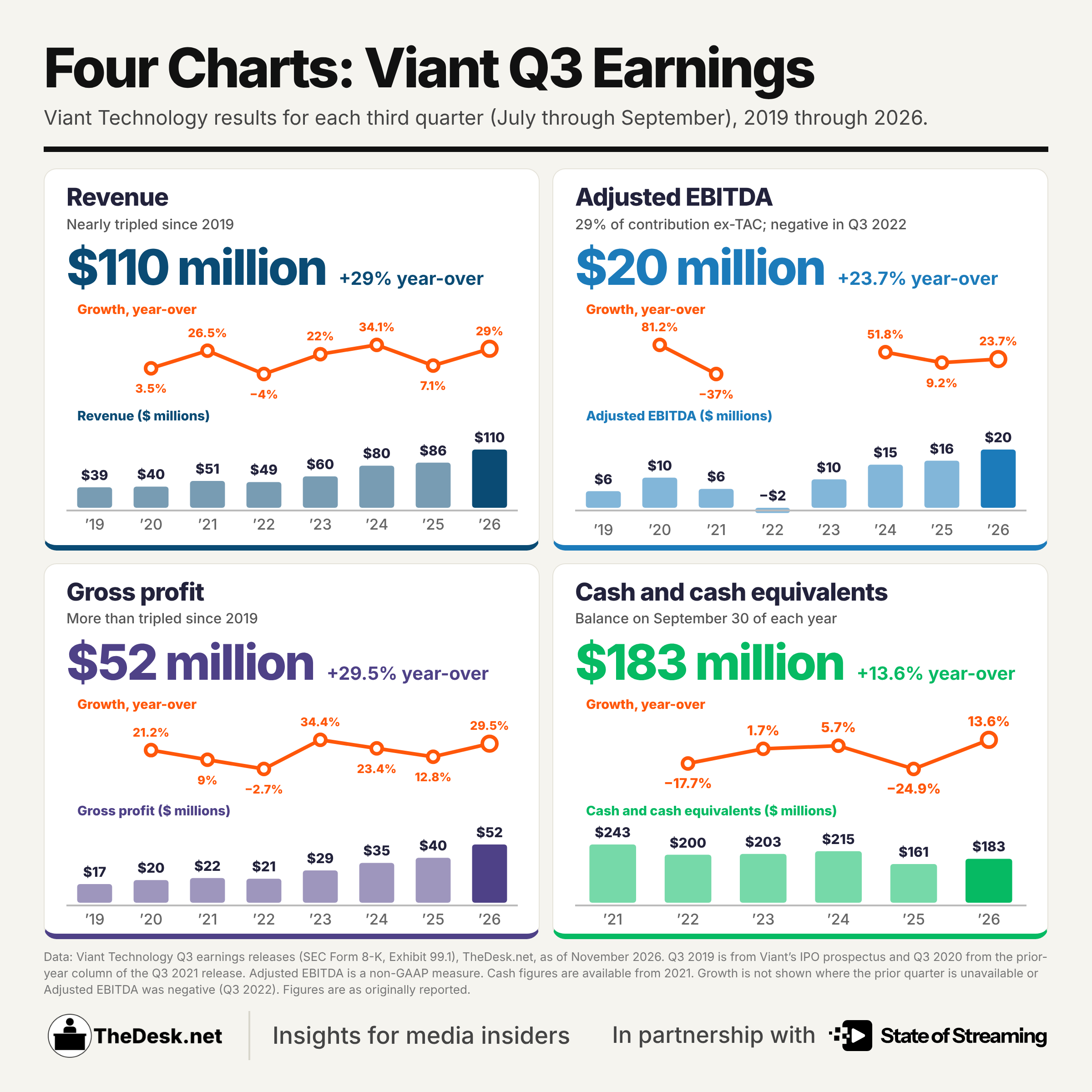
(Infographic by Matthew Keys for The Desk and State of Streaming)
Co-Founder and Chief Operating Officer Chris Vanderhook said the integrations could help attract advertisers who prefer working through AI tools rather than learning another advertising interface.
"Through simple conversational prompts with these models, advertisers can now manage the entire campaign life cycle outside of our traditional user interface," he said.
Viant is making a similar investment in advertising measurement through TVision, which uses technology to monitor television viewing and audience attention. Its recently-introduced mobile meter links television advertising exposure with subsequent activity on mobile devices, including online searches, website visits and purchases. The company plans to triple TVision's measurement panel over the next year to reach 15,000 households and 50,000 individuals across most U.S. television markets.
WATCH: Viant CMO Jon Schulz explains how TVision’s panel tracks in-room presence and eyes-on-screen attention to eliminate wasted CTV ad spend.
Still, executives acknowledged that adoption of TVision's advertising products remains in the early stages, with usage representing a low-single-digit share of activity during the quarter. But other technology products are gaining traction: Ad spending through Viant's IRIS Content ID system, which allows advertisers to target commercials based on individual television programs and scenes, increased 41 percent from last year. Viant's Outcomes advertising product is now used by more than 10 percent of its advertiser base, including all 10 of its largest customers.
Executives said those largest advertisers allocated an average of 26 percent of their spending on Viant's platform to Outcomes, which is intended to compete for performance advertising budgets traditionally directed toward search engines and social media. That spending is largely coming from additional advertising budgets rather than money previously allocated to other products on Viant's platform.
"That's nearly all incremental budgets," Chris Vanderhook told analysts.
Viant finished September with $183.2 million in cash and no long-term debt. The company also increased its share repurchase authorization by $50 million, bringing its cumulative authorization to $150 million. Looking ahead, Viant expects fourth-quarter revenue between $130.5 million and $133.5 million, with adjusted EBITDA between $31 million and $32 million. For the full year, the company anticipates revenue near $435 million, an increase of 26 percent from 2025.
Why Subscribe
Because connected TV advertising is rapidly shifting from broad demographic buys to AI-generated creative, scene-level contextual targeting, and verified eyes-on-screen attention metrics.
State of Streaming and TheDesk.net decode how independent adtech platforms build proprietary data stacks, integrate agentic AI buying tools, and capture performance budgets from search and social giants. If you buy programmatic CTV, manage broadcaster ad sales, or build measurement software, this is where the industry’s balance sheets get unbundled.
ADDITIONAL RESOURCES:
Viant Q3 2026 earnings press release:
Investor presentation: Viant to acquire TVision:
https://investors.viantinc.com/static-files/56508590-1c0b-4e88-9812-561b91182c55
Get the SOS. Brief
The sharpest streaming intelligence, delivered to your inbox.