The $18B Question For Streaming: An interview with Mark Stenberg, Senior Media Reporter @ Adweek
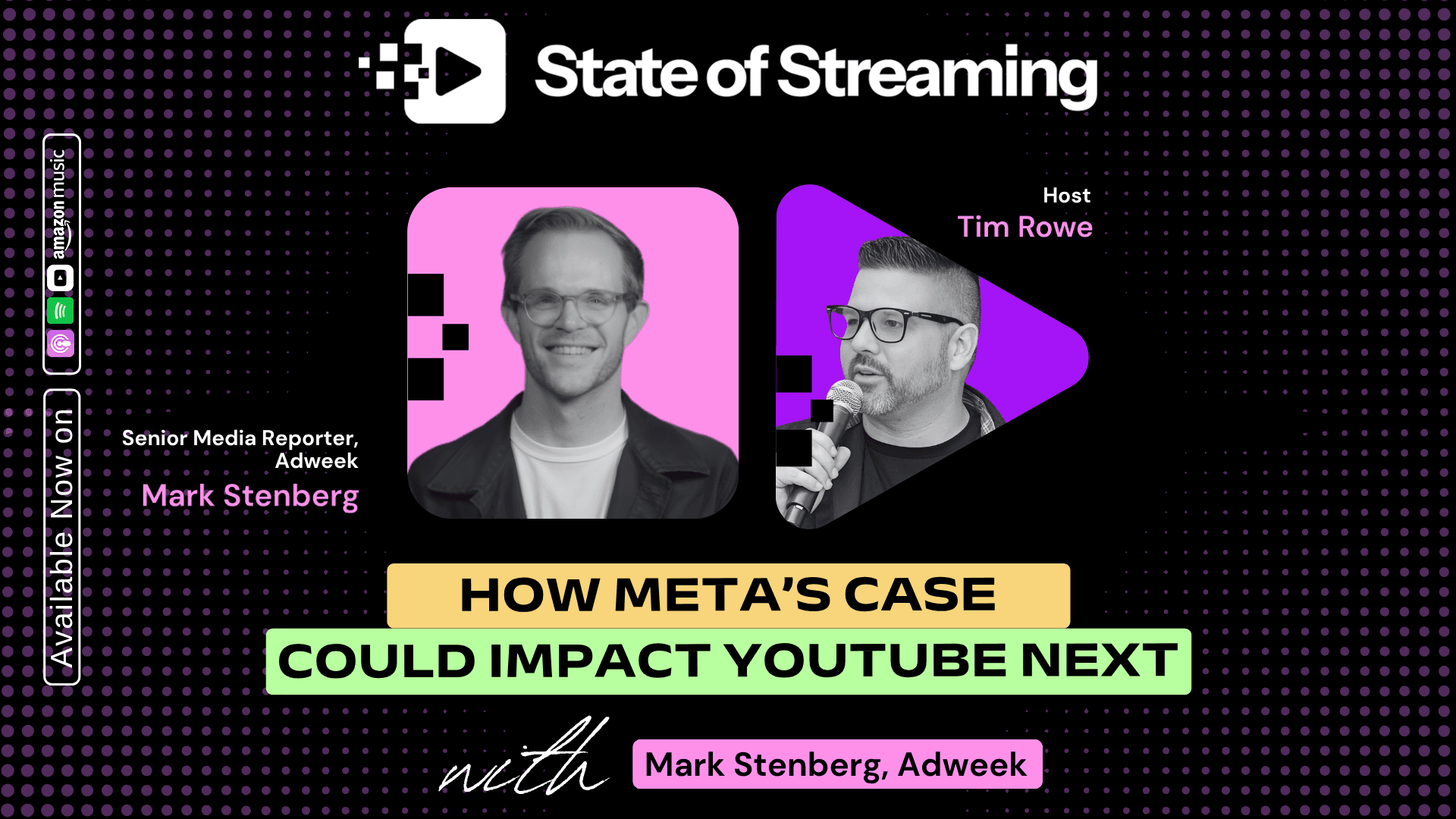
"If you take the addictiveness of mobile scrolling and you plug in even better IP and you get people watching TV in bite-sized chunks on their phone, that could be a huge sea change." - Mark Stenberg
In this conversation, we sat down with Mark Stenberg, Senior Media Reporter at Adweek. Mark takes us behind the scenes to analyze the real ripple effects of Meta's landmark settlement. We unpack what happens if YouTube gets hit with matching teen usage limits, how agencies targeting youth-centric categories in gaming, apparel, and QSR are reacting, and why a drop in mobile watch time might force buyers to align ad dollars with YouTube's living room dominance. They also explore the rising leverage of the creator economy and how bite-sized microdramas could become the next big mobile format.
Breaking Down Meta’s Settlement Terms
Tim Rowe: Mark Stenberg, you've got a piece out on this big Meta $17 billion settlement. Can you take us through the details?
Mark Stenberg: It was a coalition of state attorneys general who were suing Meta for $200 billion. This was a settlement of $12 billion plus a conditional $5 billion, and $1 billion paid to the Texas attorney general. So it's a total of 18, but $12 billion certain cash on the table spread over 10 years—about $1.2 billion a year for a company that just made $60 billion in its last quarter. From a financial perspective, it's not crippling the company. Obviously, the more interesting element is the conditions and the new teen restrictions Meta is going to have to implement.
Teen Safeguards And Media Buyer Reactions
Mark Stenberg: They include restrictions like reduced notifications during school time, dark mode after midnight, and a cap on total usage over two hours. The big question I was bringing to media buyers was: is this going to affect your strategy as it relates to buying on those platforms?
Tim Rowe: Yeah, tell us what they said.
Mark Stenberg: By and large, the answer is no, but we're going to keep an eye on it. Most media buyers I spoke to said this isn't going to change anything in the short term. The more qualified answers were, if other social platforms also implement these safeguards—YouTube, TikTok, and Snap—then that could be a big difference. Meta itself said less than 1% of its revenue comes from this demographic. If you're working for brands targeting younger consumers, like fast food, this might have a bigger impact, but most people said they're going to monitor spend over the next six to 12 months.
Why Meta Wants Ecosystem-Wide Rules
Tim Rowe: Meta said, 'We'll pay that additional five billion if YouTube, TikTok, and Snapchat all go along and say that they're doing the same thing.' Is that right?
Mark Stenberg: Yeah, because it really is like, 'if we're going down, we're all going down.' The language their legal team returned to was basically that this is an ecosystem-wide problem. Young users are hopping between a universe of apps. Under legal scrutiny, Meta started puffing up their competitors—saying people spend way more time on TikTok and YouTube and barely use Facebook. So all of a sudden they're like, 'You got the wrong guy here.' If you really want to solve this mental health crisis that social media is allegedly causing, you need to address all the major players in the ecosystem, not just us.
Could YouTube Face Teen Time Caps
Tim Rowe: But YouTube makes the case we're not social media, we are television. Does YouTube get dragged down with this?
Mark Stenberg: I think YouTube is different, but those differences are continuing to disappear. You have social platforms trying to be on TV, and TV companies through microdramas increasingly trying to resemble social platforms. YouTube specifically has never really been a social media, but it is so popular with kids and teens. I wouldn't be surprised if YouTube elects to take voluntary steps to follow Meta's lead and avoid bad press. So long story short, I think YouTube ends up changing some of its policies to be more teen and child friendly, but I don't think it ends up looking exactly the way that it is with Meta.
Creator Economy Leverage Keeps Rising
Tim Rowe: Do you think this gives the creator economy more leverage in how it flexes its weight around platform to platform?
Mark Stenberg: I see the leverage of creators growing for completely separate reasons, and that trend line is up and to the right. The creator economy has reached a point of maturation at which the biggest creators are beginning to act like media companies. The most popular YouTube channels are beginning to function as individual pieces of IP or media operations on their own. The evolution of creators into standalone media companies is going to be the dominant trend in the next year or so. Any distinctions we have between platforms now will just continue to blur to the point where Spotify's introducing video, YouTube's introducing podcasts, and Netflix is introducing music.
Microdramas And The Next Mobile Format
Tim Rowe: Is there room for a new platform that could come in and disrupt some of that?
Mark Stenberg: I've really lately gotten super interested in the micro drama space because I do think that is a really interesting blend of the addictiveness of social media combined with the compelling IP of Hollywood. Man, if you take the addictiveness of mobile scrolling and you plug in even better IP and you get people watching TV in bite-sized chunks on their phone, that could be a huge sea change.
Tim Rowe: Streamers are trying to figure out their mobile offering. I don't ever really watch streaming television on my phone because the format's just not right. It has to move at the pace of all the other things that you do on your phone.
Mark Stenberg: Exactly. A company out of Tel Aviv is using AI to take pre-existing Hollywood IP, cut it down into its most engaging segments, and effectively speed up a half-hour show into five minutes worth of clips. But what's really crazy to me is this idea of creating original IP for microdramas rather than repurposing old IP. You just take this thing that people love and you make it swipeable.
Want to watch or listen to the entire conversation?
Get the SOS. Brief
The sharpest streaming intelligence, delivered to your inbox.