The Real Math Behind the Heavyweight Battle for Attention: An interview with Simeon McMillan, Principal of Accrued Interest
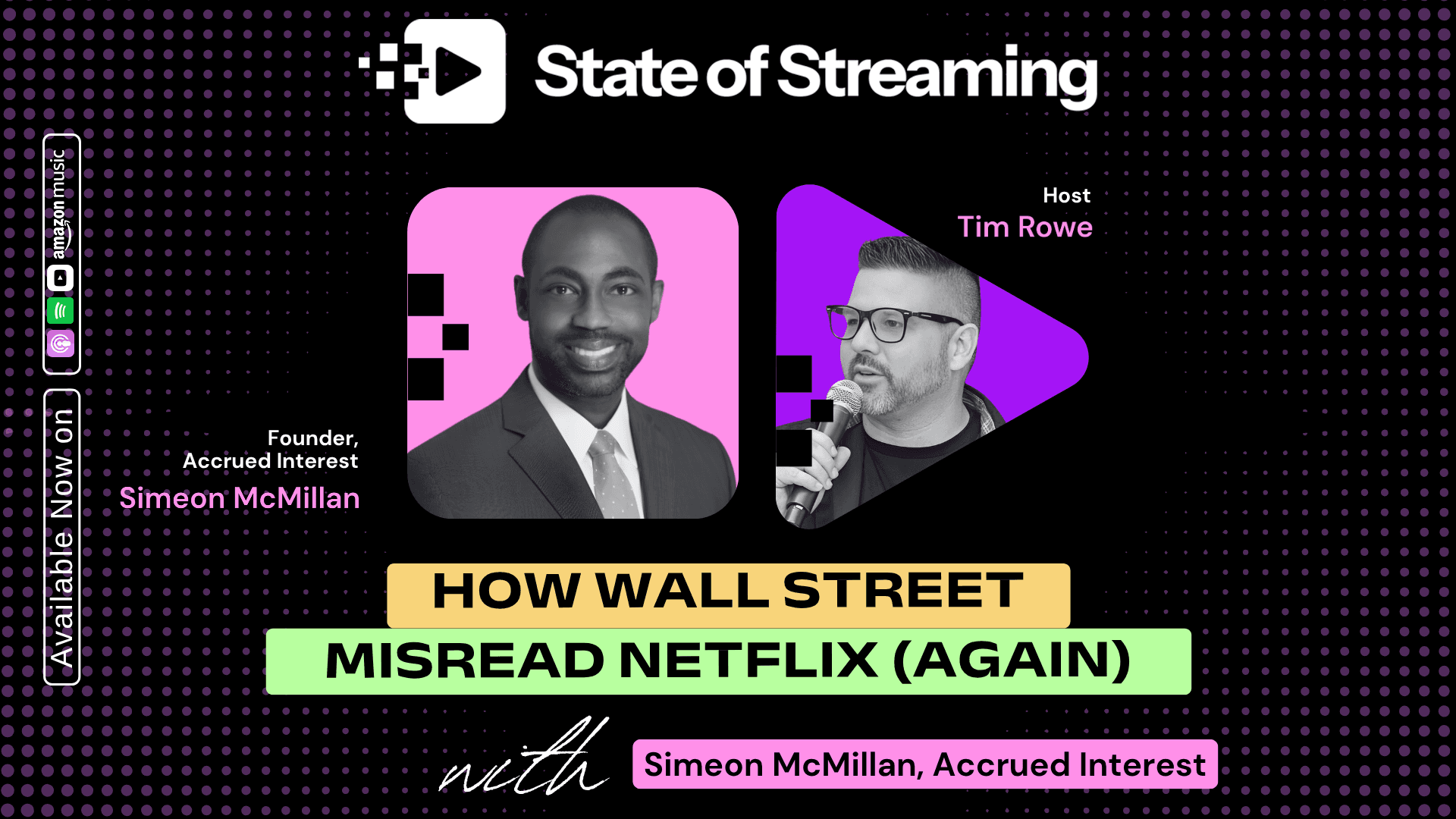
What matters is how much revenue you can squeeze out of every programming hour. And on that metric, Netflix is in a class of its own. – Simeon McMillan
In this conversation, we sat down with Simeon McMillan, former media investment banker and principal of the Accrued Interest podcast and Substack. Simeon pulls back the curtain on the financial metrics of the streaming wars, breaking down why treating engagement hours as the sole benchmark fundamentally misreads the market. We discuss why YouTube is Netflix’s only true global peer, how media buyers approach their distinct ad models, what Fox’s move on Roku means for connected TV distribution, and why the television home screen has become the critical battleground for viewer discovery.
YouTube as Netflix’s True Peer
Tim Rowe: The first topic is what YouTube teaches us about Netflix. You've covered this recently on your Substack. What is it that YouTube teaches us about Netflix?
Simeon McMillan: Taking a step back, I pulled out the financials that YouTube discloses on Google's earnings call. The big caveat is that Google does not disclose revenue from YouTube subscriptions as a separate line item, so it slightly understates it. But my thesis is that YouTube is a sort of super-entertainment company, an all-in-one entertainment app. Both in geographic scale and sheer revenue, YouTube is the only comparable company in the weight class that Netflix compares to. Up until a year or two ago, people didn't really see YouTube as a true competitor to television and film, when it's really competing for everyone's attention.
Tim Rowe: How closely do their financials actually track?
Simeon McMillan: When you strip away the noise and compare YouTube's revenue to Netflix's revenue, the two are remarkably similar in size. In any given quarter, Netflix's revenue is anywhere between 5 to 15% within striking distance of YouTube. If you line up their growth rates side by side, a lot of the Netflix panic is overstated because Netflix and YouTube have been growing revenue at a very similar pace over the last couple of years. Consumers aren't used to analyzing a media company operating at global scale. Netflix's growth in viewership hours is between 1 to 3% in any given year. When you're operating at a global scale where you already have over 90 billion minutes of viewing, it's not realistic to expect viewing to grow at 10% year over year. There's only 24 hours in a day. YouTube grows at low double digits, 10 to 12%, and nobody complains.
Views, Hours, and Monetization Reality
Tim Rowe: How do you think about the YouTube views metric? Does that equate in the math?
Simeon McMillan: I don't think it equates in the math for the simple reason that we know the games people play with measurement, particularly on digital. There's no one uniform viewing metric. With YouTube views, what's important is the scale; it gives you a sense of just how many people are engaging. When you're an entertainment powerhouse operating at global scale, your revenue is not driven by views. This is not pay-per-click. Not every hour of the day is created equally when it comes to monetizing content. What matters is how much revenue you can squeeze out of every programming hour. On that metric, Netflix is in a class of its own. In the last six or seven quarters, they've outgrown YouTube in almost every quarter over the last two years, despite YouTube taking share.
Tim Rowe: Putting on your sales and ad ops hat for a second, how do you think about those two sales conversations?
Simeon McMillan: The paths of YouTube and Netflix are becoming more intertwined. YouTube has pure ad revenue. Netflix has around $50-some-odd billion of total revenue, and about $3 billion of that is advertising, with the rest coming from SVOD. The buyer coming to Netflix for ads is looking for a replacement for television, a replacement for dollars that would have gone to linear. Today, a lot of YouTube buyers come out of the digital bucket, money that would go to other digital services. Over time, those two are going to converge as both companies have more content and formats similar to each other. Netflix isn't even selling ads in all their jurisdictions yet, and their ad load per hour is substantially lower than linear.
Why Netflix Engagement Fears Miss
Tim Rowe: Why is the Netflix engagement panic wrong?
Simeon McMillan: The panic exposed who is actually reading what Netflix discloses versus who is reacting to the news that Netflix pulled back the cadence of one of their viewing reports from twice a year to once a year. Netflix weekly publishes top 10 lists for 90 different countries. That bi-annual viewing report was never meant for investors. During the Hollywood strikes, writers and actors demanded transparency around royalty checks. As an olive branch to unions, Netflix introduced that report in 2023. Furthermore, Netflix has grown viewership hours at roughly the same pace over the last three years. For years, people worried Netflix was burning money giving bags of money to creators. But year after year, Netflix has pulled more dollars for every dollar of content spend. Engagement hours has never been the metric to track.
Tim Rowe: When we see Netflix spending $700 million on two NFL games, we shouldn't just look at the price tag?
Simeon McMillan: Netflix has been the most surgical of them all. They haven't gone after a full NFL package or done Hail Mary desperation attacks. They are targeting live events without getting bogged down in super long-term agreements. NFL games are the most valuable television ad inventory in America. Adding NFL tells the advertiser world: we are open for business to take TV dollars. It also signals to the industry that Netflix has the anchor tenant to build around for other sports.
Fox-Roku and the CTV Choke Point
Tim Rowe: Does not having hardware hurt Netflix at all?
Simeon McMillan: Not having hardware is not an impediment for Netflix. Without revenue share or cutbacks, Netflix makes up a huge percentage of streaming on Roku and CTV devices. CTV partners can't monetize that inventory, but they have no choice because you can't sell a streaming device without Netflix. Where it matters is for everyone else. Fox acquiring Roku is like acquiring a choke point in the passageway of streaming viewership. For apps outside Netflix or Disney+, placement on the menu and discovery varies widely. Fox sold their studio assets at the peak to Disney. Now they have a say in how to nudge viewers toward services, right as total TV viewing time crosses over 50% into streaming.
The Home Screen as Discovery Power
Tim Rowe: How important is the home screen to streaming?
Simeon McMillan: Its importance cannot be emphasized enough, especially for content discovery. Viewers have been trained not to think of shows as nascent to a brand. With over 50% of TV viewing crossing into streaming and the bulk occurring on the big screen rather than mobile, picking between Disney+, YouTube, and Amazon is like when people used to flip between ABC, CBS, and NBC. Legacy networks are also cross-licensing back catalogs to Netflix for viewership boosts, like Suits or HBO catalog titles. Home screen placement and anything that lessens friction for the user is going to be arguably as important as advertising going forward.
Want to watch or listen to the entire conversation?
Get the SOS. Brief
The sharpest streaming intelligence, delivered to your inbox.