YouTube Ad Revenue Grows, But Slows, During Alphabet’s Q3
Editor's Note
TheDesk.net on State of Streaming is a syndicated partnership featuring reporting by Matthew Keys — founder and editor of TheDesk.net, covering media technology, streaming platforms, and digital distribution. This report analyzes Alphabet’s Q3 2026 earnings results: overall revenue climbing 25% to $127.6 billion, YouTube ad revenue expanding to $11.21 billion alongside 150 million Music and Premium subscribers, YouTube capturing a record 15% of all U.S. TV viewing time, and Google Cloud revenue doubling to $30.71 billion—balanced against $51.36 billion in AI infrastructure CapEx and equity portfolio swings that weighed on net income.
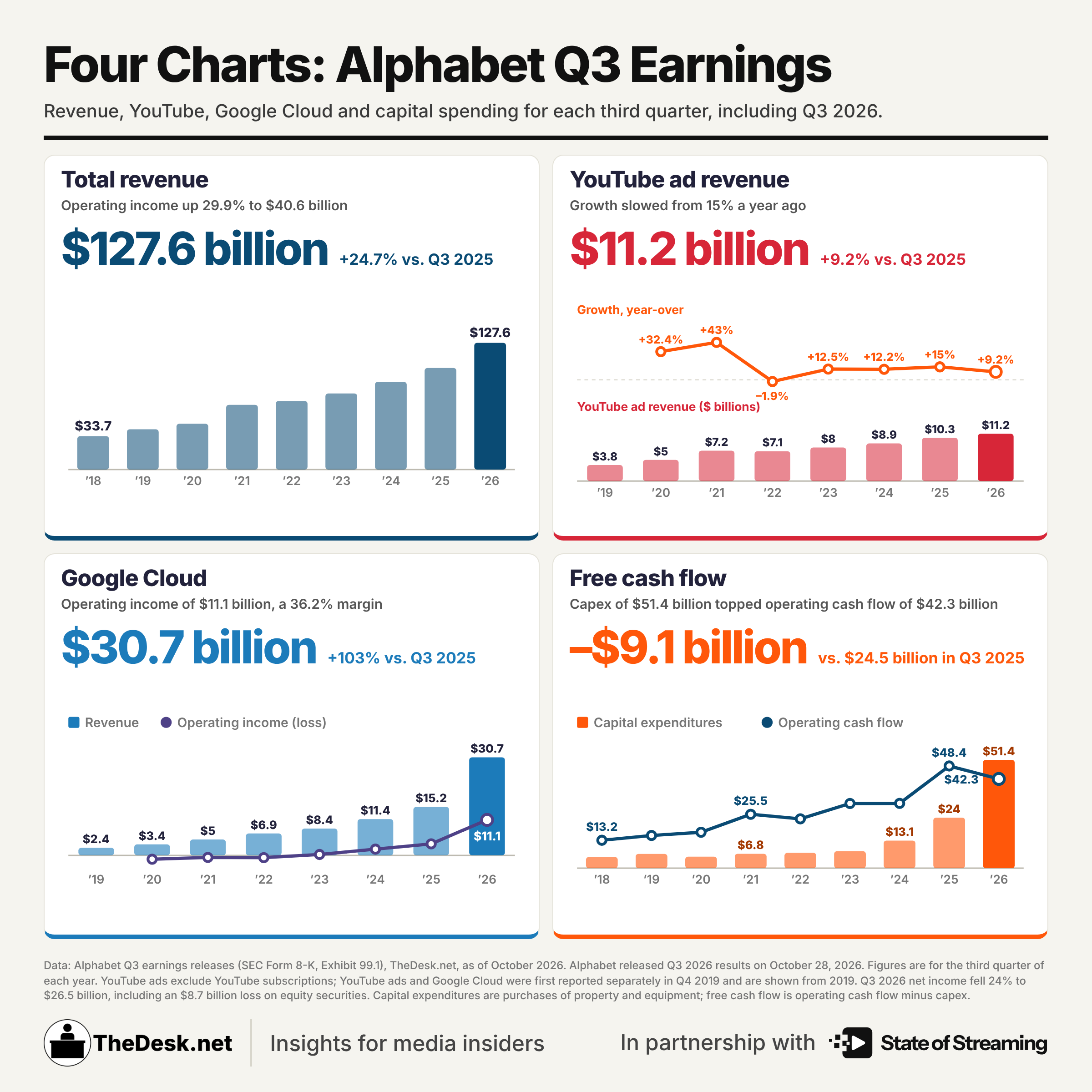
Alphabet reported a 25 percent increase in third quarter (Q3) revenue on Wednesday, driven largely by continued growth in Google Search advertising, higher revenue from YouTube and surging demand for artificial intelligence services through Google Cloud.
The parent company of Google generated nearly $127.6 billion in overall revenue during the three-month period that ended September 30, compared to just over $102.3 billion that was earned during the same period last year. The results marked Alphabet’s 13th consecutive quarter of double-digit revenue growth.
Operating income increased 30 percent to $40.58 billion, while operating margin improved to 31.8 percent from 30.5 percent.
In a statement that accompanied the Q3 earnings report, Alphabet CEO Sundar Pichai said the company was operating at a “half-trillion dollar revenue run rate,” with opportunities for further expansion across Search, YouTube, Cloud and AI.
Google Services, which includes the company’s advertising and consumer businesses, generated $96.30 billion in revenue, an increase of 11 percent. Operating income for the segment increased 17 percent to $39.16 billion, with operating margin reaching 40.7 percent.
Google Search and other advertising revenue increased 12 percent to $63.35 billion, compared to $56.57 billion last year.
“Our AI investments are driving overall Search query growth, including commercial queries,” Pichai said. “In fact, our year-over-year query growth rate is the highest it’s been in the last five years.”
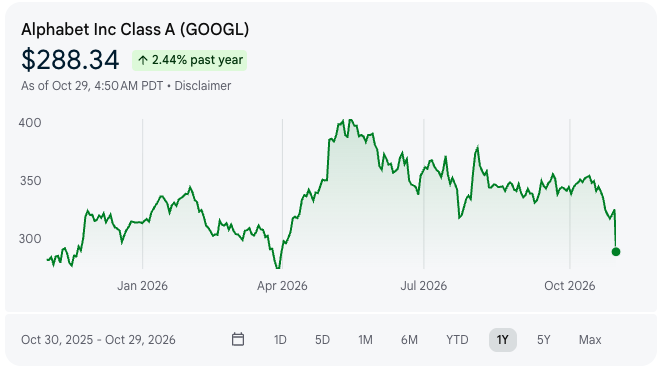
(Snapshot of Alphabet stock at time of publishing)
Overall Google advertising revenue increased to $82.01 billion from $74.18 billion. Of that, YouTube advertising revenue increased 9 percent to $11.21 billion, compared to $10.26 billion during the year-ago quarter. The company also reported that YouTube Music and Premium surpassed 150 million subscribers globally, including customers participating in free trials.
During the quarter, YouTube achieved a milestone, capturing more than 15 percent of all time spent with TV in American households during Nielsen’s August measurement month. It marked the first time that YouTube crossed the 15 percent mark since Nielsen began reporting TV share figures a few years ago, and was a strong indication that the company’s efforts to market its streaming app as a destination for premium TV consumption was resonating with streamers and the broader media industry alike.
Revenue from Google’s subscriptions, platforms and devices business increased 11 percent to $14.29 billion, while advertising revenue from the Google Network increased 1 percent to $7.46 billion.
(Infographic by Matthew Keys for The Desk and State of Streaming)
Google Cloud recorded the strongest growth among Alphabet’s major business segments, with revenue more than doubling to $30.71 billion from $15.16 billion. Cloud operating income more than tripled to $11.12 billion, compared to $3.59 billion last year. Operating margin expanded to 36.2 percent from 23.7 percent.
“Google Cloud revenues grew 103%, powered by huge demand for our AI infrastructure and AI solutions,” Pichai said. “We’re also seeing strong demand for our TPU systems across a wide range of customers.”
Alphabet continued investing heavily in the infrastructure needed to support its AI products and cloud services. Capital expenditures increased 114 percent to $51.36 billion, compared to $23.95 billion a year earlier. The company said its Gemini application surpassed 1 billion monthly active users, while its first-party model APIs were processing nearly 32 billion tokens per minute, more than four times the volume recorded a year earlier.
Despite the revenue and operating income increases, Alphabet reported lower net earnings, while weaker-than-expected advertising results and the mounting costs of AI development weighed on investor sentiment. Shares fell as much as 7 percent in after-hours trading Wednesday.
Net income declined to $26.47 billion from $34.98 billion, while net income available to common shareholders fell 25 percent to $26.17 billion. Diluted earnings declined to $2.12 per share from $2.87. The decrease in net income primarily reflected an $8.66 billion loss on equity securities, compared to a $10.73 billion gain during the year-ago quarter.
The results come as Google faces intensifying competition from AI developers including OpenAI and Anthropic, whose products increasingly compete with Google’s Gemini platform and AI-powered search offerings.
Google recently introduced Gemini 4 Argon, an updated version of its flagship AI model intended to improve performance in areas including software coding, where competing products have gained traction.
At the same time, the company’s expanding AI infrastructure requirements are putting pressure on cash flow. Alphabet previously projected between $195 billion and $205 billion in capital expenditures for 2026 as it accelerates investments in data centers, computing capacity and proprietary AI chips.
The spending also reflects Google’s increasingly complicated relationship with competing AI developers: Anthropic, the maker of Claude, is a major customer of Google’s cloud infrastructure but has made its own commitments to spend heavily on building out its own data centers for its long-term operations. Those plans were laid out in a regulatory filing earlier this week, which came ahead of a much-anticipated initial public offering that is expected in mid-November.
Why Subscribe
Because the battle for living-room TV dominance and enterprise AI infrastructure is redefining the underlying economics of digital distribution.
State of Streaming and TheDesk.net decode how tech platforms monetize user attention, build cloud infrastructure, and convert AI compute into enterprise value. If you manage media operations, allocate digital ad spend, or build streaming technology, this is where the balance sheets of Big Tech get unbundled.
ADDITIONAL RESOURCES:
Alphabet/Google earnings release, Q3 2026:
https://s206.q4cdn.com/479360582/files/doc_financials/2026/q3/2026q3-alphabet-earnings-release.pdf
Note: This story was produced prior to Alphabet/Google’s Q3 2026 earnings call with investors.
Get the SOS. Brief
The sharpest streaming intelligence, delivered to your inbox.