NEW RESEARCH: The Big Reset Revisited
GET THE REPORT: The Big Reset Revisited
A year ago, Looper Insights asked 61 senior streaming executives to predict the 10 major trends that would reshape the industry in 2026. Ten months later, they checked the receipts. The results from The Big Reset Revisited show an industry that read the tea leaves remarkably well: six of the ten top predictions came true or largely true, four were partly true, and zero were contradicted by events.
By expanding the lens to look at all 10 trends in aggregate, a clear picture emerges: the streaming wars have evolved from a battle over content into a war for infrastructure, aggregation, and operational efficiency.
Here is how all 10 trends played out, and what they mean for the future of TV.
The OS Won the Streaming Wars
The overt message of the report is that streaming is stabilizing, but the underlying reality is that the Connected TV (CTV) operating systems, not the individual streaming apps, are the new gatekeepers of television.
Three converging trends from 2026 prove this structural shift:
Trend 4: CTV OS Wars (Largely True): Controlling the default gateway is now as valuable as owning a studio. Fox agreed to acquire Roku in a $22 billion deal, effectively combining a major TV OS with Tubi.
Trend 6: Hyper-Personalized UI (Largely True): The biggest US CTV home screens became cross-service, personalized discovery hubs. Roku launched its first significant home screen update in a decade, personalizing billions of combinations, while Amazon’s Fire TV aggregated live content into a centralized "Live TV" tab.
Trend 10: AI Viewing Assistants (Partly True - Still Unfolding): 75.4% of executives correctly predicted that OS-level AI assistants would determine which shows get surfaced. In 2026, Google TV integrated Gemini, Fire TV launched Alexa+, and Samsung deployed Vision AI, turning voice bots into the new arbiters of discovery.
Why it matters: Content providers are no longer destinations; they are just inventory for the OS. If a viewer asks their Samsung or LG television to find a good sci-fi show, the platform's AI decides which show wins that view. Content owners must now negotiate with, and optimize for, the platform aggregators, exactly as cable channels once had to bow to Comcast and Time Warner.
The YouTube Reality Check
If the OS owns the interface, YouTube owns the audience.
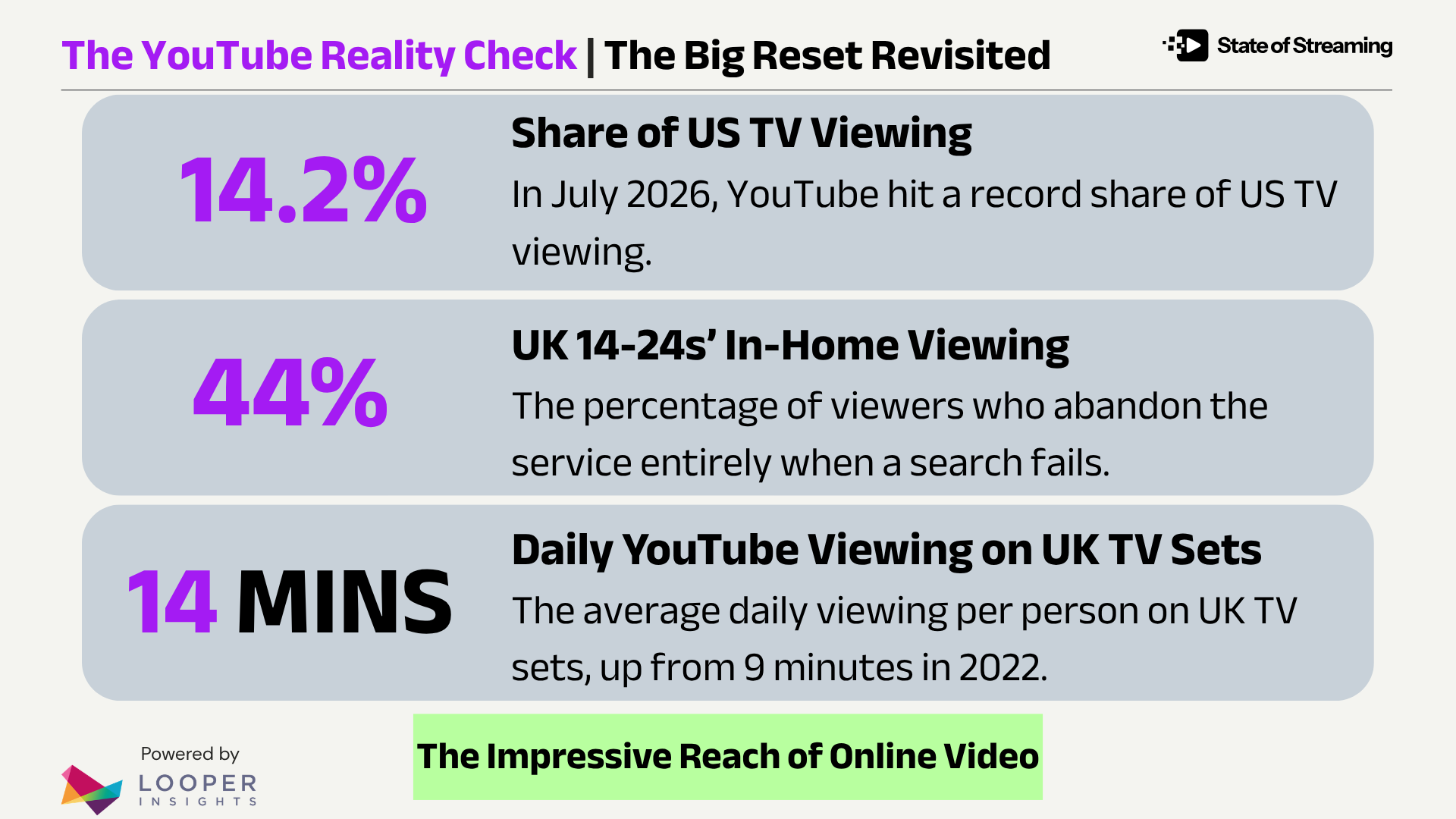
Trend 9: YouTube's Streaming Supremacy (Came True): YouTube dominated outright, hitting a record 14.2% share of US TV viewing in July 2026, sitting a massive 5.0 points clear of the next media distributor.
Trend 8: The Youth TV Revolution (Largely True): For younger demographics, the shift to social video is permanent. 44% of UK 14-24s' in-home viewing now comes via video-sharing services, with average daily YouTube viewing on UK TV sets jumping to 19 minutes per person. Traditional streamers have been forced to capitulate and adopt creator-driven models, highlighted by Netflix acquiring MrBeast views and Disney launching a vertical feed for TikTok creator content.
Get the report The Big Reset Revisited
Why it matters: YouTube is no longer a secondary social platform; it is the largest traditional television network in the world. Executives who thought premium storytelling alone could hold off the creator economy have been proven wrong.
The FAST 2.0 Boom
Trend 1: FAST 2.0 (Largely True): Executives predicted that Free Ad-Supported Streaming TV (FAST) would mature into a premium business in its own right, and the market delivered. FAST grew into a highly profitable, record-setting business in 2026. Tubi reported being EBITDA (Earnings before interest, taxes, depreciation, and amortization) positive in each quarter, hitting its highest-revenue quarter ever in Q4, while The Roku Channel captured a record 3.1% share of US TV viewing.
Why it matters: FAST is no longer a dumping ground for cheap back-catalog content. It has become a frontline, highly profitable destination that commands premium ad rates, proving that audiences are willing to trade their attention for free, high-quality television.
Bundling and M&A: The Survival Tactics
To combat discovery fatigue and churn, the industry retreated into familiar survival tactics: consolidation and bundling.
Trend 2: From Sports Rights to Sports Moments (Partly True): 47.4% of executives predicted streamers would bundle content to reduce subscription fatigue, which played out as live sports rights fragmented further. Prime Video launched a $19.99/month Apple TV and Peacock Premium Plus bundle, and the Disney Trio (Disney+, Hulu, ESPN) reported the lowest churn in their base.
Trend 7: M&A Frenzy (Partly True): 76.5% predicted profitability pressure would force mid-tier streamers to sell or merge. This was highlighted by Paramount completing its Warner Bros. Discovery acquisition to create a 200M+ subscriber giant, alongside Sky agreeing to a £1.6bn deal for ITV Media & Entertainment.
Why it matters: The streaming industry has realized that infinite choice leads to infinite churn. By re-bundling services and merging massive content libraries, platforms are recreating the traditional cable package to lock in audiences and protect their bottom lines.
AI Storytelling & The Gaming Niche
Trend 5: Algorithmic Storytelling (Partly True): Generative AI moved deep into the operational tools that package, promote, and deliver content. Netflix utilized GenAI workflows across roughly 300 titles to improve promotional assets, while YouTube scaled A/B thumbnail tests with AI-generated options.
Trend 3: Gaming-Streaming Fusion (Came True): 72.9% of executives correctly predicted that gaming on streaming platforms would remain a niche. Gaming stayed a complementary feature rather than a core behavior, with growth strictly limited to casual, low-friction play—such as Netflix's standalone kids games app and Prime Video's Luna party games on Fire TV.
Why it matters: The most successful technical implementations in streaming right now aren't flashy consumer gimmicks. Gaming is being used strategically as a low-friction retention tool, while AI is quietly revolutionizing back-office operations to drive creative efficiency at scale.
Three Things To Do About This Now
1. Optimize for OS-Level AI Search Discovery has shifted from in-app algorithms to system-wide interfaces. With Gemini and Alexa+ now taking voice requests directly from the remote, metadata and conversational discoverability are just as important as billboard advertising. If the OS can't "read" your show, it won't recommend it.
2. Stop Treating YouTube as "Social Video" YouTube holds a commanding 14.2% of US TV viewing. Media buyers and distributors must treat it as the primary anchor of the television landscape, rather than a supplementary digital buy.
3. Prepare for a Consolidated Digital Shelf With mega-deals like Fox-Roku and the Paramount-WBD merger, the amount of independent real estate on the CTV home screen is shrinking. Being part of a bundle or securing a preferred partnership with a CTV OS is no longer optional for mid-tier services—it is the only way to avoid being buried.
4. Download the Looper Insights report. They've been a great partner to State of Streaming and bring a truly unique take to the dynamics playing out in streaming and connected TV.
Get the SOS. Brief
The sharpest streaming intelligence, delivered to your inbox.