Strategic Position: Why Media Companies Must Own the Orchestration Layer | A Column by David Dembowski
Editor's Note
This executive analysis by David Dembowski — media executive and contributor tracking the evolving economics of video distribution, CTV adtech, and audience monetization — explores why enterprise publishers must move past point-solution software stacks, how owning an internal orchestration layer safeguards margins against tech intermediaries, and why controlling AI decisioning rules determines who retains commercial value.
For decades, media technology evolved through point-solution specialization. Inventory management, identity resolution, audience data, creative management, programmatic execution, and measurement operated as separate, siloed software categories. While each tool addressed a specific operational requirement, together they created severe architectural fragmentation, compounding operational friction and eroding margin efficiency.
Today, competitive advantage relies on central orchestration capability.
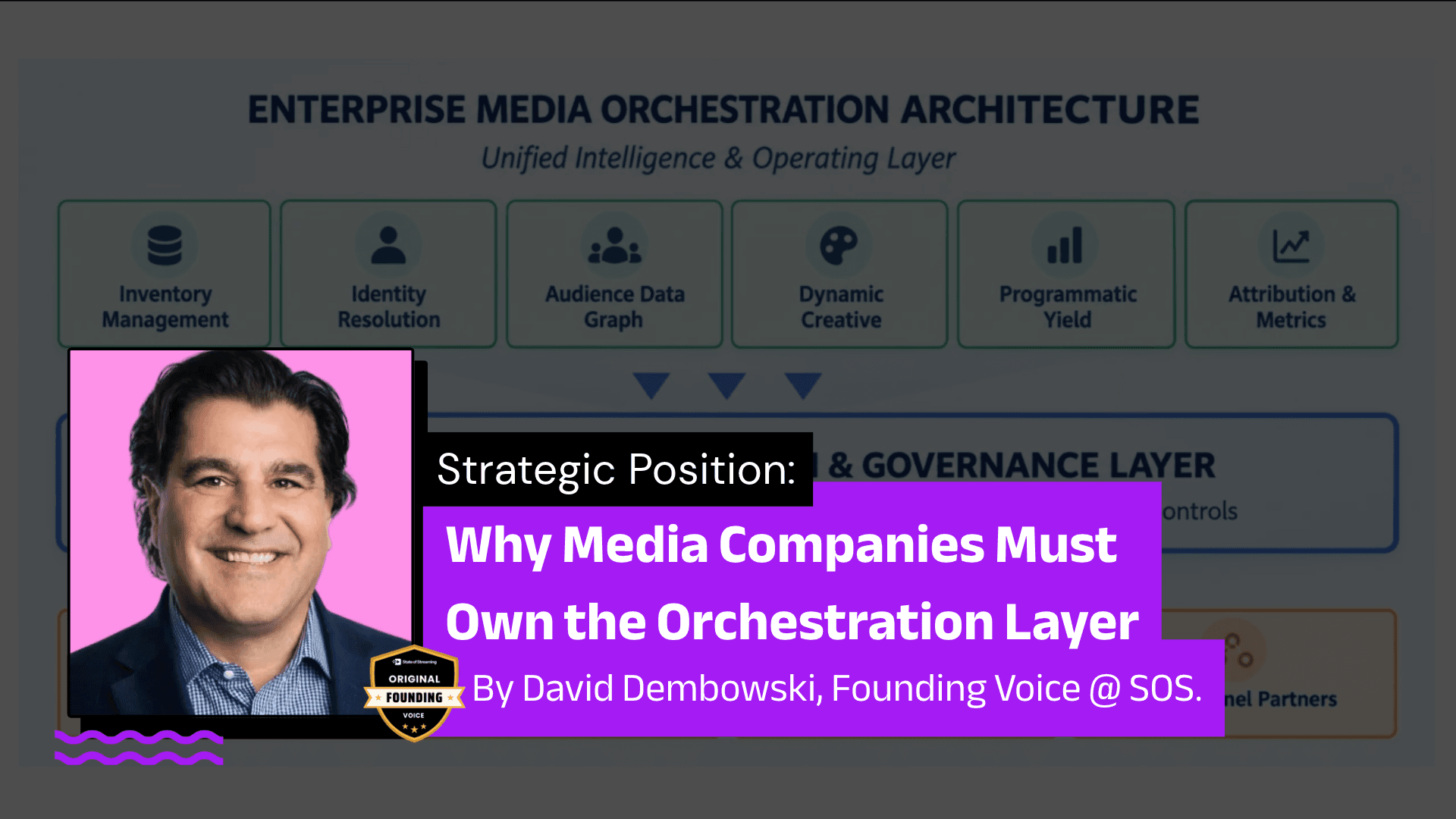
Enterprise media organizations do not need additional point solutions. They require an intelligent, unified operating layer that dynamically orchestrates inventory, identity, audience data, creative, measurement, and omnichannel execution—without ceding governance or margin to external walled gardens.
The Strategic Shift: From Integration to Value Orchestration
Data integration merely enables interoperability between systems. Orchestration dynamically governs workflows, data streams, and automated yield decisioning to maximize commercial return.
An enterprise orchestration architecture resolves core commercial friction points across fragmented technology infrastructure:
Optimal yield allocation across direct sales, programmatic private marketplaces, and strategic partner networks.
Real-time activation of first-party identity and audience graph signals across every monetization channel.
Dynamic, context-aware creative customization optimized for viewer context and platform specs.
Execution path optimization evaluating margin yield, reach efficiency, and operational control.
Automated delivery rebalancing triggered by real-time inventory performance and fluctuating demand signals.
Closed-loop attribution directly correlating ad exposure with verifiable advertiser business outcomes.
These capabilities represent key value drivers that directly impact operating margin and revenue growth.
Mitigating Platform Intermediary Risk and Disintermediation
Major tech platforms are expanding vertically into adjacent sectors. Retail media networks are penetrating CTV, streaming platforms are deploying proprietary ad tech stacks, demand-side platforms are absorbing planning and measurement functions, and AI platforms are capturing user intent at the point of discovery. Each market participant seeks to position itself as the dominant decision engine for advertiser budgets.
While third-party partnerships provide immediate demand access, relying on them creates structural disintermediation risk: external platforms incrementally capture primary ownership of advertiser relationships, proprietary audience data, and measurement standards.
Media organizations that cede this layer retain high-cost content and infrastructure operations while losing pricing power, product differentiation, and margin capture. Establishing an internal orchestration framework ensures publishers engage major demand platforms from a position of leverage rather than dependency.
Core Capabilities of the Orchestrated Media Platform
An enterprise orchestration layer delivers the operational agility required to interface with external ecosystems while safeguarding core digital assets and yield capability.
Key strategic capabilities include:
Unified Inventory Management. Real-time visibility and yield optimization across linear, CTV, digital, and live streaming assets.
Identity & Data Governance. Secure activation of first-party data graphs and partner signals without data leakage or reliance on single-vendor identity schemes.
Dynamic Creative Optimization. Automated alignment of ad formats, creative messaging, and target environments to maximize conversion and yield.
Omnichannel Transaction Flexibility. Seamless support across direct sales, programmatic guaranteed, private marketplaces, open auctions, and commerce channels.
Independent Measurement & Verification. Standardized cross-platform performance analytics based on unified, transparent metrics.
Automated Governance & Decisioning. AI-driven forecasting, allocation, and yield optimization governed by enterprise policy controls.
This architecture unlocks substantial efficiency gains, reduces structural risk, and creates long-term strategic optionality.
AI Execution and Governance Imperatives
AI acceleration increases the strategic importance of control points. As autonomous agents handle campaign planning, inventory allocation, creative generation, and execution, the critical commercial question becomes: whose business objectives are those agents programmed to maximize?
Third-party agents prioritize their parent ecosystem's margin. A publisher-controlled orchestration layer ensures AI agents optimize for publisher metrics: net yield, long-term contractual commitments, audience experience, and total customer lifetime value.
Robust AI governance is a critical commercial requirement. Media leaders must enforce full auditability over agent inputs, decision rules, data boundaries, and execution authority. Winning architectures combine autonomous optimization with explicit governance frameworks, strict least-privilege security, explainability, and operational override controls.
Executive Decision Framework
The future of media technology will not be won by owning every underlying point product, but by controlling the intelligence layer that connects and governs them.
Executive leadership must evaluate their operational architecture against five key criteria:
Control of Monetization Logic: Are core yield and pricing decisions executed natively or delegated to external platforms?
Data Ownership: Do third-party intermediaries capture primary ownership of audience intelligence and attribution measurement?
Omnichannel Visibility: Can the enterprise compare margin return seamlessly across all demand channels and transaction types?
AI Governance: Are automation agents optimizing internal publisher economics or external buy-side margins?
Relationship Governance: Does the publisher maintain direct strategic ownership of advertiser relationships and campaign performance data?
Market leadership will not belong to organizations with the largest stack of disconnected tools, but to enterprise publishers that unify their technology, data assets, and partnerships into a cohesive, orchestrated operating system.
In the next media platform war, orchestration is the ultimate strategic control point, and whoever controls that layer will capture most of the industry value.
See More From David Dembowski:
The Content ROI Paradox: Why Media's Biggest Investors Don't Always Capture the Biggest Returns
How Publishers Win the Live Sports Streaming Era | David Dembowski, Streaming TV Architect (PODCAST)
Get the SOS. Brief
The sharpest streaming intelligence, delivered to your inbox.