The Content ROI Paradox: Why Media's Biggest Investors Don't Always Capture the Biggest Returns

Editor's Note
The Content ROI Paradox is an executive analysis by David E. Dembowski — media executive and contributor tracking the evolving economics of video distribution, CTV adtech, and audience monetization. This piece explores why media’s biggest content spenders don't always capture the largest financial returns, how tech platforms like Amazon and YouTube control distribution infrastructure and audience data, and why media executives must shift from raw reach to measuring "Retained Content Yield".
For decades, the media industry has operated on a relatively straightforward economic premise: invest in compelling content, attract an audience, and monetize that audience through advertising, subscriptions, licensing, or some combination of the three. The model was capital-intensive, but investment and return were relatively direct. Media companies controlled much of the content, distribution infrastructure, audience relationship, and advertising inventory.
Today, content creators and rights holders continue to invest billions in programming, talent, production, sports rights, and audience development. Yet platforms and intermediaries that control distribution, discovery, identity, data, and monetization are capturing an increasing share of the economic value generated by those investments.
This raises a fundamental question: Who bears the cost of creating content, and who ultimately captures the return? The answer may define the next era of media economics.
We've Seen This Movie Before
The digital publishing industry provides a cautionary example. Publishers invested in journalism, editorial talent, content production, and audience development. They created the environments that attracted consumers and generated advertising opportunities. As programmatic advertising matured, intermediaries could aggregate inventory across thousands of publishers, apply sophisticated audience targeting and measurement, and monetize that inventory at scale.
Advertisers increasingly purchased audiences rather than individual publications. This created substantial efficiencies and opened new demand sources, but it also shifted economic leverage away from many publishers.
A publisher might invest heavily in attracting a valuable audience, only to see an intermediary use identity, behavioral data, and targeting capabilities to monetize that audience across the broader digital ecosystem. The publisher retained the production costs. The intermediary could capture a meaningful share of the monetization value. Not every intermediary earned
superior margins, and not every publisher lost control. But the structural lesson was clear: Creating the content does not guarantee control over the economics of the audience it attracts.
Streaming's Next Chapter: From Subscriber Growth to Economic Yield
The first generation of streaming competition centered on subscriber acquisition.
Media companies invested aggressively in original programming, exclusive rights, international expansion, and direct-to-consumer platforms. The objective was to build scale, reduce dependence on traditional distribution, and establish recurring subscription revenue.
But subscriber growth alone is not a sustainable measure of economic success.
Content investment must ultimately generate sufficient lifetime revenue to cover production, acquisition, distribution, technology, marketing, and operating expenses. As streaming matures, the industry is moving toward a more diversified economic model that combines subscription revenue with advertising, licensing, bundling, and distribution partnerships.
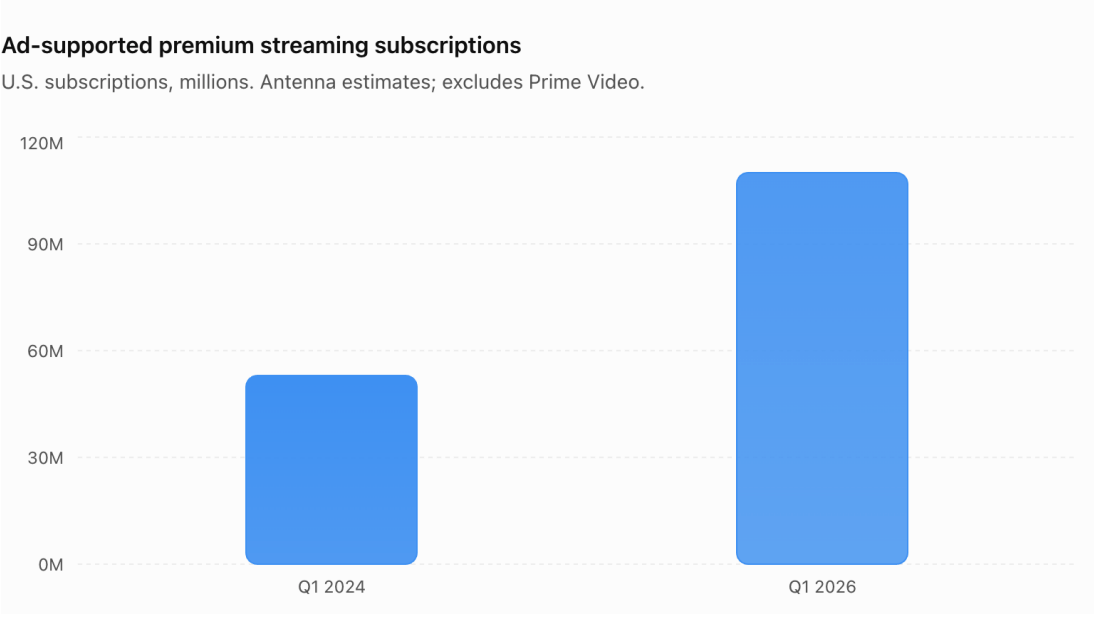
According to Antenna, U.S. ad-supported premium streaming subscriptions reached about 110 million by the end of the first quarter of 2026, more than double the 53 million from two years earlier. Ad-supported plans now represent the majority of new subscriptions for several leading services.
Meanwhile, Nielsen reported that streaming accounted for 46.6% of all ad-supported television viewing in the first quarter of 2026. The advertising opportunity continues to expand. IAB projects U.S. digital video advertising spending will exceed $80 billion in 2026, with connected television, online video, and social video competing for growing shares of advertiser investment. These trends point toward a more sophisticated streaming economy.
SVOD remains an important foundation. Hybrid subscription-and-advertising models are expanding. AVOD and FAST create additional monetization opportunities, particularly for library content and audiences unwilling to pay for another subscription.
But these models carry very different economic characteristics. Subscription services emphasize recurring revenue, retention, and customer lifetime value. Advertising-supported services depend on audience scale, engagement, sell-through, targeting, and advertising yield. FAST channels often leverage existing content libraries and lower-cost distribution models, but can face challenges around inventory pricing, audience discovery, and revenue sharing. The question is no longer simply how many subscribers or viewers a service attracts. It is how efficiently each business model converts investment in content into sustainable economic returns.
The Platform Advantage: Amazon and YouTube

Two companies illustrate how dramatically media economics have evolved: Amazon and YouTube. Both compete for consumer attention and advertising budgets. Yet their economic models differ substantially from those of traditional broadcasters and studios.
Amazon operates at the intersection of streaming, advertising, commerce, and consumer data. Prime Video contributes to a broader ecosystem that includes Prime memberships, retail transactions, advertising services, and customer relationships. Amazon can connect media exposure with commerce signals and, in supported measurement environments, purchasing outcomes. That creates advertising opportunities extending beyond conventional reach and frequency metrics. Importantly, Amazon is also a major content investor. Its competitive advantage isn't avoiding production costs; it's connecting content engagement to multiple economic engines.
YouTube demonstrates a different model. Independent creators, media companies, and rights holders finance and produce much of YouTube's content. YouTube provides the infrastructure for distribution, discovery, advertising, audience development, and monetization, sharing revenue with eligible creators and partners. This shifts how capital and risk are allocated. Rather than financing every piece of content, YouTube can benefit from a vast ecosystem of creators who experiment with formats, develop audiences, and assume much of the upfront production risk. The platform then monetizes engagement through advertising, subscriptions, and other services. Nielsen reported that YouTube captured a record 14.2% of U.S. television viewing in July 2026, underscoring its growing importance as a television distribution and advertising platform.
YouTube is not a zero-cost content business. Creator revenue sharing, infrastructure, technology, rights, and operating expenses are substantial. But its model shows the strategic value of controlling discovery and monetization across others' content.
For traditional media companies, this presents both an opportunity and a dilemma. Distributing content through YouTube can expand reach, develop audiences, and generate incremental revenue. At the same time, the platform may retain significant influence over discovery, customer relationships, advertising decisions, and monetization. The content owner gains distribution but may sacrifice some economic control.
Open Distribution Versus Walled Gardens
This tension sits at the center of modern media strategy. Historically, media companies benefited from controlling both content and distribution. Digital platforms have separated those functions. Today, content can move across owned streaming services, connected television platforms, FAST channels, social video environments, third-party marketplaces, and licensing arrangements. Each distribution decision creates a trade-off between reach and control.
Closed ecosystems can offer stronger control over subscriptions, customer identity, user experience, advertising inventory, and monetization, but they require investment in technology, marketing, acquisition, and ongoing engagement.
Open or broadly syndicated distribution can create incremental reach and revenue without requiring every media company to build its own consumer destination. However, broader distribution can also introduce platform fees, revenue-sharing arrangements, limited access to audience data, and reduced control over advertising decisions. Neither model is inherently superior.
The optimal strategy depends on the content, audience, rights structure, customer economics, and monetization opportunity. A premium sports property may justify a direct consumer relationship because of its scarcity, engagement, and pricing power. A large library of evergreen programming may generate attractive incremental returns through FAST distribution. Short-form promotional content may deliver greater value through YouTube or social platforms.
The strategic challenge is determining where content creates the greatest net economic value, rather than simply the largest audience. That distinction matters. A million viewers on one platform may generate less retained economic value than a smaller audience on another. The future of distribution strategy must therefore shift from optimizing reach to optimizing economic value.
Retail Media Offers a Glimpse of What's Next
The growth of retail media adds another dimension to this transformation. Retailers have demonstrated that advertising value increasingly depends on the ability to connect audiences, identity, purchase behavior, and measurable commercial outcomes. Traditional media companies have historically monetized attention. Retail media networks monetize attention in a commercial context. That distinction can be economically significant. A media company may know what a consumer watches, how long they engage, and which advertisements they encounter. A retailer may also possess transaction data that helps advertisers understand purchasing behavior and measure outcomes.
As retail media expands beyond retailer-owned websites and apps, companies increasingly apply these capabilities to advertising inventory across the open web and connected television. EMARKETER forecasts U.S. offsite retail media advertising spending will reach approximately $17.05 billion in 2026, representing 29.5% year-over-year growth. This creates a familiar economic question. If a media company provides the premium content environment and advertising inventory, but a commerce platform provides the audience intelligence and attribution, how should the resulting advertising value be shared?
Retail media partnerships can create meaningful incremental demand and higher-value advertising opportunities. But media companies must avoid repeating the digital publishing industry's mistake of surrendering the most valuable monetization components to external intermediaries. The objective should not be to exclude retail media networks or commerce platforms.
Instead, it should be to develop partnerships in which the content owner meaningfully participates in the incremental value generated by better targeting, measurement, and commerce outcomes.
AI Changes the Cost Equation, But Not Necessarily the Power Equation
Artificial intelligence introduces another important variable. Generative AI can reduce the time and expense associated with certain aspects of content development, localization, production, post-production, creative adaptation, and advertising operations. It also enables faster experimentation. Creators can test formats, adapt content to different audiences, and iterate more rapidly without committing the same level of capital required by traditional production workflows. This could improve content economics substantially. But lower production costs do not automatically produce higher returns.
If platforms that control discovery, audience identity, advertising technology, and monetization distribute the resulting content, they may share the economic benefits of greater production efficiency unevenly. In fact, as content becomes easier and less expensive to produce, competition for consumer attention may intensify. Content supply can expand faster than
audience demand. That places even greater economic importance on discovery, trusted brands, differentiated intellectual property, distribution, and audience relationships.
AI may make content production more efficient, but it can also strengthen the competitive position of platforms that control how content is discovered and monetized. The next competitive advantage will not simply be the ability to create more content at a lower cost. It will be the ability to convert content into measurable, retained economic value.
A New Governing Metric: Retained Content Yield
For media executives, this requires a shift in how they evaluate content investments. Traditional metrics remain important: audience reach, engagement, subscriber growth, advertising revenue, CPMs, and total viewing hours. But none independently captures the full economic return on content investment.
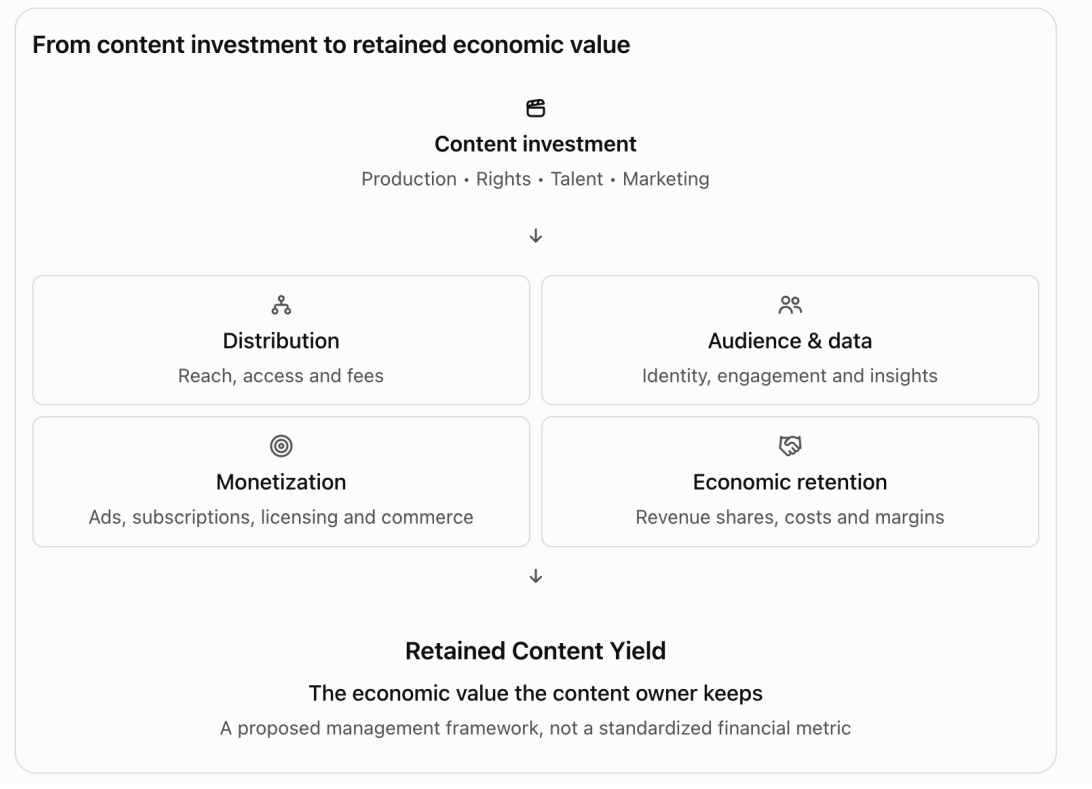
A more comprehensive framework should evaluate five interconnected dimensions:
1. Content investment: What is the total cost of producing, acquiring, marketing, and maintaining the content?
2. Distribution efficiency: Which channels deliver the greatest incremental audience and revenue relative to their associated costs?
3. Audience ownership: How much control does the media company retain over identity, engagement data, customer relationships, and discovery?
4. Monetization yield: How effectively does the content generate revenue through advertising, subscriptions, licensing, commerce, and other models?
5. Economic retention: After accounting for platform fees, revenue sharing, technology, distribution, and monetization expenses, how much value does the content owner retain?
Together, these dimensions form what I would call Retained Content Yield. This is not intended to replace established profitability or return-on-investment measures. Instead, it offers a strategic lens for understanding how content economics shift across distribution and monetization models. A media company may generate more gross revenue through a third-party platform while retaining less economic value.
Another distribution model may deliver lower gross revenue but higher contribution margins, stronger customer relationships, and more valuable long-term audience intelligence. The optimal strategy is not necessarily to maximize reach, subscribers, or advertising impressions
independently. It is to optimize the economic return across the entire content lifecycle. That requires more integrated decision-making across content strategy, distribution, data, advertising, technology, and finance.
The Future Belongs to Those Who Control the Economics
The media industry is entering a period in which content creation, distribution, advertising, and commerce are becoming increasingly interconnected. Traditional distinctions between broadcasters, streaming services, technology platforms, retailers, and content creators are becoming less meaningful. Competition is shifting from individual business models toward interconnected ecosystems.
For media companies, this creates a strategic imperative. They must continue investing in compelling content and differentiated intellectual property. But they must also strengthen their ability to control the economic decisions surrounding that content. That means understanding where audiences are created, how content is discovered, which distribution relationships generate the strongest returns, how data improves monetization, and where economic value is retained or lost.
It also means treating distribution, audience intelligence, and monetization as interconnected strategic capabilities rather than isolated operational functions. Platforms will continue to create enormous value through technology, scale, discovery, and commerce. Content owners should benefit from those capabilities. But the industry needs more balanced economic models that recognize the investment and risk associated with creating the content that fuels those ecosystems.
The next chapter of media economics will not be defined simply by who can produce content most efficiently or reach the largest audience. It will be defined by who can translate content investment into sustainable, measurable, and retained economic value. Because content creation builds the audience, controlling the economics determines who captures the return.
Research and source references
● Antenna: The Ad-Supported Majority (2026). U.S. premium streaming ad-supported subscription growth and gross additions by tier.
● Nielsen: Q1 2026 Ad-Supported Gauge (June 2026). Advertising-supported viewing distribution across broadcast, cable, and streaming.
● Nielsen: July 2026 Gauge Reports (September 2026). YouTube and streaming shares of U.S. television viewing.
● IAB: 2026 Digital Video Ad Spend & Strategy Report (May–July 2026). Digital video advertising growth and changing buyer priorities.
● EMARKETER: Retail Media's Offsite Opportunities Require Measurement and Careful Planning (March 2026)—offsite retail media forecasts and monetization opportunities.
Get the SOS. Brief
The sharpest streaming intelligence, delivered to your inbox.