The Death of "Ad-Free" and Streaming’s Messaging Dilemma
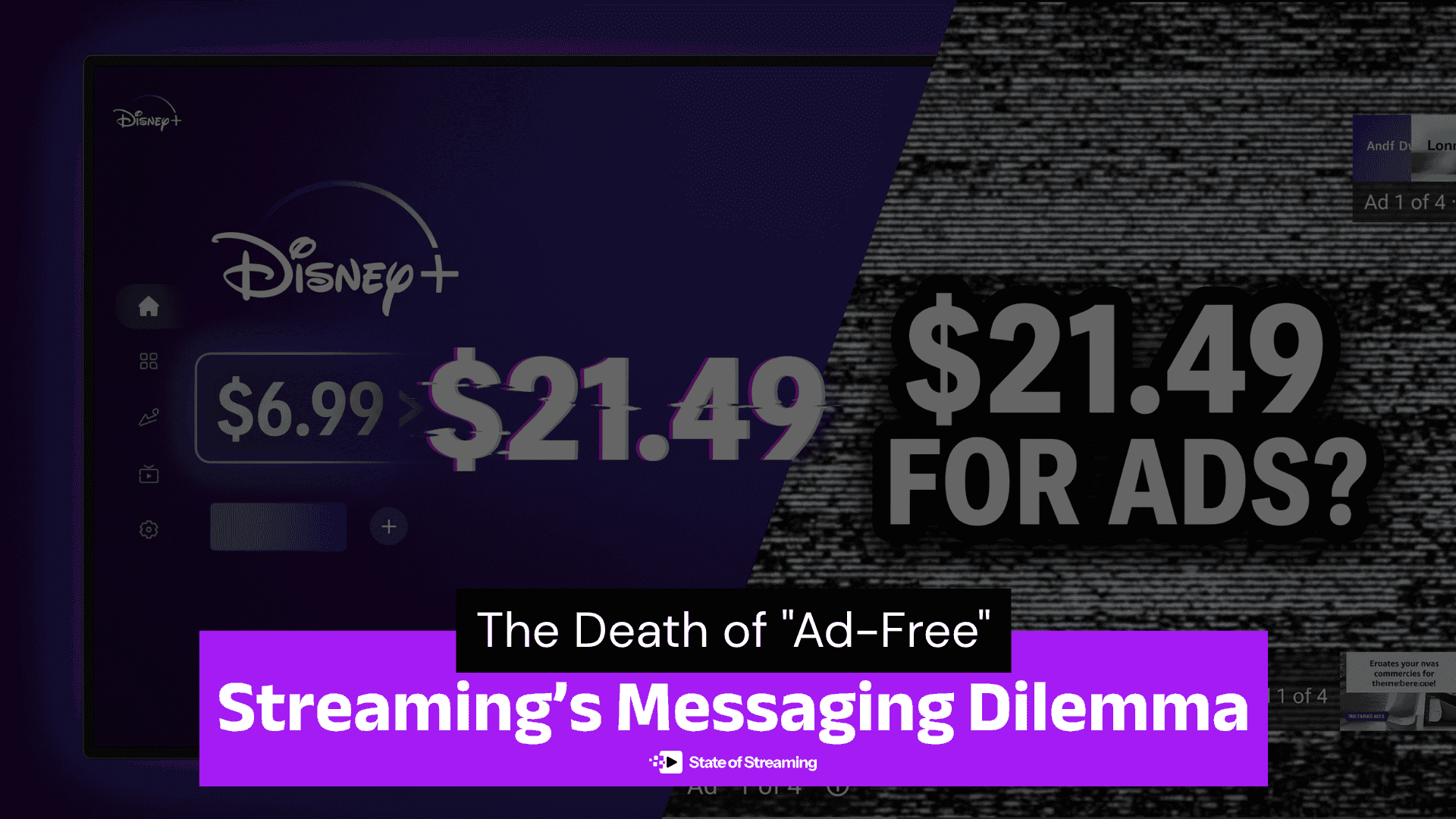
When Disney+ launched in late 2019, its value proposition was aggressively clear: $6.99 a month for the entire Disney, Pixar, Marvel, and Star Wars vaults, completely uninterrupted. It was the quintessential zero-interest-rate phenomenon: a customer acquisition play bankrolled by cheap capital and Wall Street’s mandate to chase scale over immediate profitability.
Seven years later, that era is officially over. What started as an ad-free sanctuary has turned into a relentless monetization squeeze. The "ad-free" label is no longer a rigid product guarantee; it has devolved into a squishy marketing term that platforms are actively rewriting in the fine print.
The Repricing of the Attention Economy
The financial pressure driving this transition is starkly visible in the numbers. Disney+ is rolling out another price hike for its premium tier, pushing it to $21.49 per month. This marks the platform's sixth price increase since launch, more than tripling its original subscription cost.
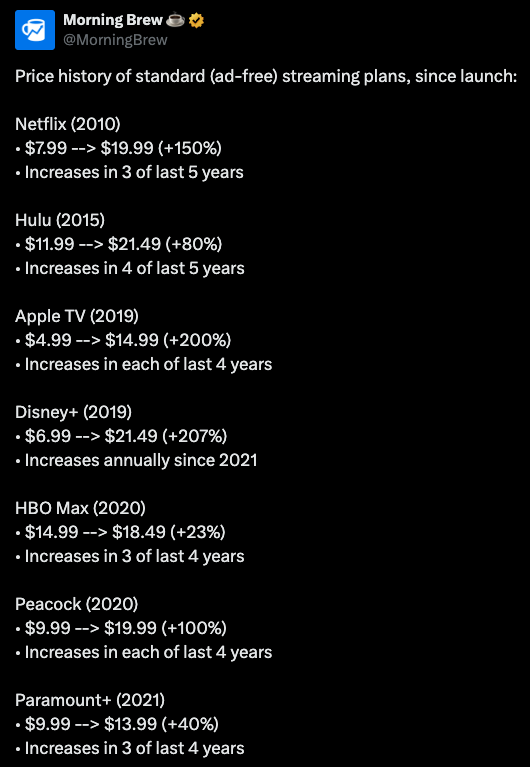
This isn't an isolated Disney pivot; it is an industry-wide realignment around Average Revenue Per User (ARPU). Recent price history data compiled by Morning Brew details the steady compounding of standard ad-free tiers across the market:
The Terms of Service Pivot
While price increases force consumers to make hard budget choices, the larger paradigm shift lies in what that premium tier actually guarantees. Disney updated its Terms of Use to officially reserve the right to display advertisements before and after movies and series across all subscription plans, including tiers marketed as "ad-free."
As reported by Digitec and Disney Fanatic, Disney’s updated subscriber agreements (notably rolled out in Europe and mirrored in U.S. fine print) create a notable contractual contradiction: landing pages still feature a prominent checkmark beside "Ad-free movies and series," while footnotes clarify that pre-rolls, post-rolls, sponsorships, and live sports ads are explicitly permitted.
Disney maintains that reserving the right ("can") does not mean immediate mid-roll commercial breaks ("will") for standard on-demand films. Yet, by establishing the contractual framework to serve ads across all tiers, the platform has formally breached the perimeter of the ad-free tier.
Industry Sentiment and the Comms Dilemma
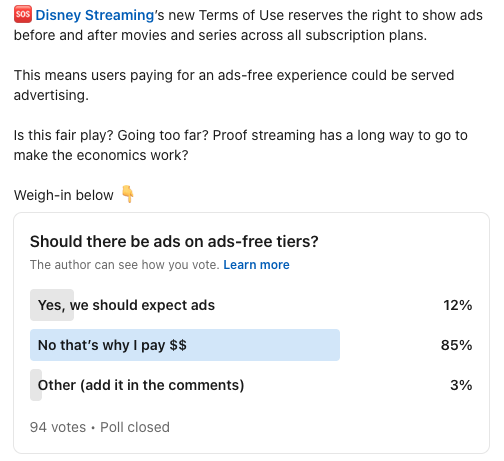
The legal maneuver highlights a growing divide between platform monetization strategy and consumer expectations. In a LinkedIn poll conducted by State of Streaming asking 94 industry insiders whether ad-free tiers should carry advertising, the response was decisive: 85% of respondents voted "No, that's why I pay $$," while only 12% accepted ads as inevitable on premium tiers.
As industry executives noted in the discussion, the core issue stems as much from naming conventions as it does from commercial load. One senior product manager framed the friction as a messaging failure: "To me it's all a comms issue. Have variable ad loads, but if you call them things like 'ad supported' or 'ad free'... they damn well better be."
Other media executives point out that the expansion of live sports rights is accelerating this contractual overhaul. A strategic partnerships leader noted that as premium live sports migrate to platforms like Disney+, linear commercial breaks are unavoidable regardless of tier. Meanwhile, another adtech executive drew a parallel to modern movie theaters, where audience members pay top dollar for a ticket only to sit through 20 minutes of pre-roll ads and promotional trailers.
The ARPU Arbitrage
Why risk alienating top-paying subscribers? Because the economics of ad-supported tiers have become superior to static subscription fees.
Platforms do not necessarily expect every user to remain at the $21.49 price point indefinitely. Instead, they are setting up an ARPU (Average Revenue Per User) arbitrage. By simultaneously raising the price of ad-free tiers while softening their purity with pre-rolls, pause ads, and sponsorships, platforms create a path of least resistance for subscribers to downgrade to cheaper, ad-supported tiers.
When combining base subscription fees with programmatic ad yield, ad-supported subscribers frequently generate higher monthly ARPU than ad-free tiers. For advertisers, this shift unlocks high-value, brand-safe inventory in premium TV environments that were previously walled off.
The industry has effectively engineered Cable 2.0. The era of cheap, friction-free, uninterrupted streaming was an entry strategy, not a permanent business model. As platforms continue to test the boundaries of price elasticity and commercial load, "ad-free" is rapidly transitioning from a consumer right to a legacy marketing term. Streamers that handle this shift with transparent positioning will preserve brand equity; those that rely on fine-print redefinitions risk turning subscription fatigue into permanent churn.
If You Liked This You May Also Like
StreamScoop Presents: The ESPN App: One Year Later
Disney and TikTok Partner to Bring Short-Form Content to Disney+
Why Fubo’s Deal With The Athletic Is Really About Disney’s Data Moat
Get the SOS. Brief
The sharpest streaming intelligence, delivered to your inbox.