STOP buying OLV NOW, Why? - FouAnalytics "see Fou yourself" | Dr. Augustine Fou
Editor's Note
FouAnalytics is a syndicated column by Dr. Augustine Fou—one of the leading independent voices in ad fraud detection and digital marketing measurement—applying methodological rigor to the programmatic advertising supply chain. This piece dissects how bad actors manipulate online video (OLV) completion metrics, exposes the illusion of 90% view-through rates, and outlines how marketers can independently verify performance or protect their budgets before the next ad cycle.
Let's start with a simple question – what's your average completion rate for video ad campaigns? 90% or higher? Do you believe that's real? Do you watch 30-second video ads to completion? Or do you skip the ads to get to the content?
Consider the following data from FouAnalytics. unload_ms means the milliseconds at which the user left the page. The 514 - 17,414 means 0.5 seconds to 17 seconds. If 92% of the users left the page between 0.5 seconds and 17 seconds, how does a 30-second video ad get played to completion? Right, it doesn't. So why does your agency or ad platform keep reporting 90% completion rates or greater on your OLV (online video) campaigns? It's because of the following giant loophole on how video completions are recorded and reported.

Data from FouAnalytics showing when users left the page
One giant loophole bad guys have been exploiting
This has been staring us in the face since the beginning of video ads. Why? How? Everything is declared. And it relies on parties being honest and invoking the complete.gif pixel only when the video ad is watched to completion.
Any standard that relies on parties to tell the truth is not good enough. Can you rely on bad guys to tell the truth? Of course not. If you are looking for high video completion rates, they will give you high completion rates, simply by invoking the complete.gif pixel even when the video ad was not viewed to completion, for example at 0.5 seconds or 1 second or 17 seconds, whatever. They can also invoke the firstQuartilePixel.gif, midpointPixel.gif, and thirdQuartilePixel.gif too any time they want. When these tracking pixels are invoked, the ad platforms record these as if they were the truth — i.e. 1/4 of video ad was watched, half of it was watched, 3/4 of it was watched, or watched to completion — even if these did not actually occur.

Actual data on video completes: 1-6% reach "thirdQuartile"
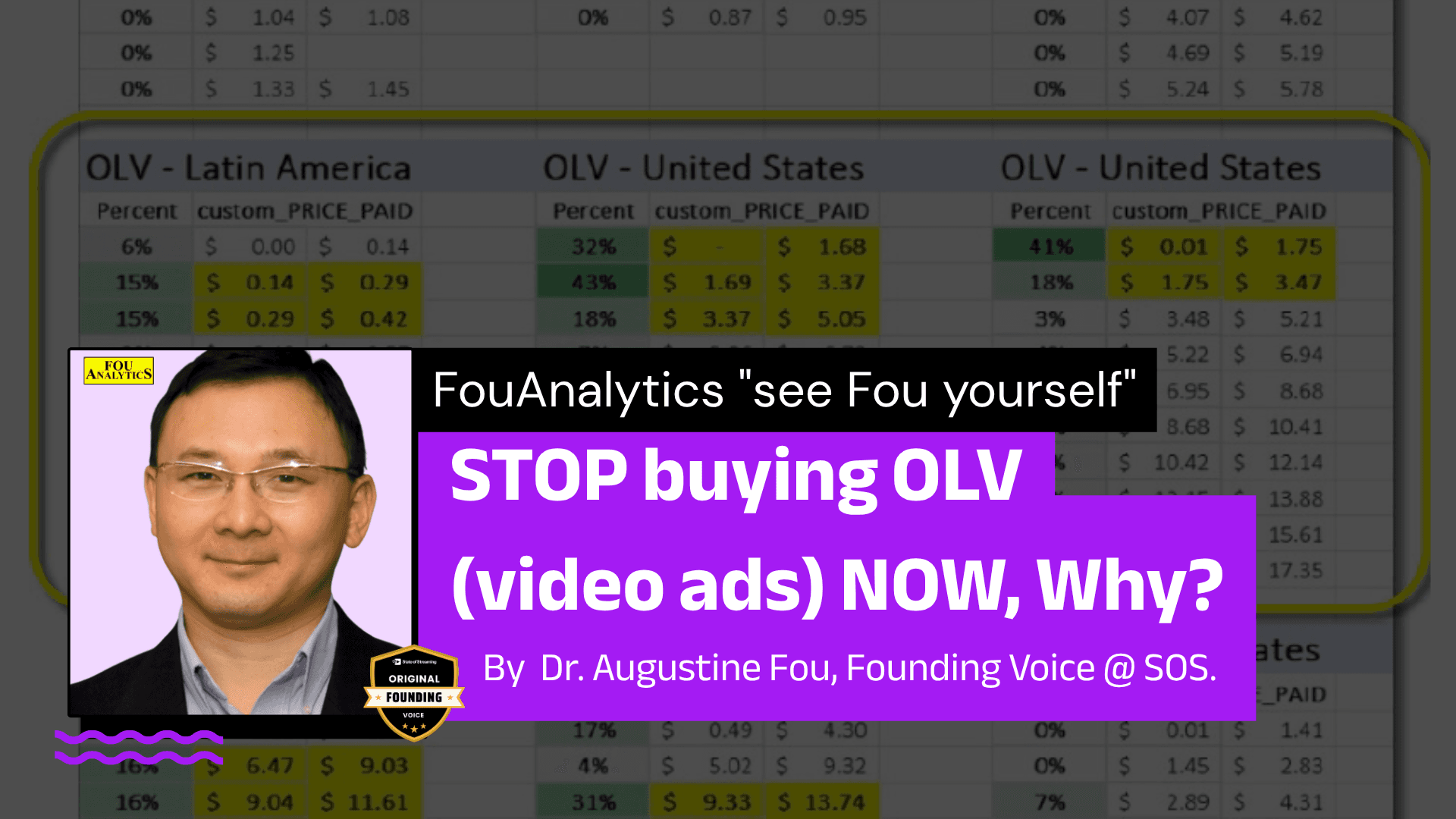
The reason video ads are marked at 80–90% complete rates is because bad guys can call the complete.gif tracking pixel even when they are not supposed to — i.e. falsified the video completion rates. Now that you know this, do you think your OLV campaigns are working like you thought they were? If only a quarter of the users watched the first quarter of your video ad, what impact do you think your expensive video ads had? OLV is also far more expensive than display ads. Video ad CPMs are 5–10x higher than display ad CPMs. The table below is from FouAnalytics data in Q1 2024.

What portion of your OLV ads were audible?
Most advertisers assume that video ads work better than display because humans remember the ads better if they hear audio. That's true. But, most video ads are not played with sound on. Legitimate publishers don't autoplay video ads with sound on, out of respect for their users. Fraudulent publishers play lots of video ads in the background or in popunders, ALSO without sound on so they remain undetected. So what portion of your video ads have sound on, or are "audible?" Right nearly 0%. OK, ok, I will be generous and round up to 1% of your video ads are audible. Note the data below. Most rows are 0% audible. Only 2 rows show >0% audibility — cnn.com and Pandora's Android app. These make sense because humans do leave cnn.com on with sound on in the background. So video ads get to play with sound on too. And folks listen to Pandora so sound is on when video ads come on too. In all other cases, humans have to unmute deliberately to hear the audio of the video ads. The % in the rightmost column tells you what % of humans do that — almost none.
So what?
If users leave the page in 0.5 seconds - 17 seconds, then 30-second video ads cannot be played to completion even if the reports you get from platforms show 90% completion rates. Those completion rates are easily falsified because fraudsters can invoke the complete.gif tracking pixel at any time, even if the video ad was not actually played to completion. Video ads are 5 - 10X more expensive than display ads, but most people don't watch them. If only a quarter of users watched video ads through the firstQuartile, and only 1-6% watched through the thirdQuartile, how effective are your video ads at generating awareness? Right. Not very. Better to use display ads for 1/5th the CPM and generate awareness in the first 0.5 seconds. Nearly 0% of your video ads are played with "sound on" anyway so they don't have greater impact than display ads.
With all this new information, please let me know if you decide to pause your OLV campaigns or change them over to display campaigns until they "clear this sh*t up." For some of my clients, they are going back to their OLV "partners" and insisting that FouAnalytics JavaScript tags be run — e.g. in VPAID environments — so all of the following details can be independently measured:
Unload_ms — when the user left the page, so we can verify if "completes" for 30s video ads are even possible
What portion of the ad was actually watched — were the tracking pixels invoked at the right times
Was the sound on (volume level detected by FouAnalytics) and did the video ad actually play
If the platform refuses to allow you to measure video ads with a FouAnalytics JavaScript tag, you are within your rights to NOT buy from them anymore, and go with partners, vendors, and platforms that DO allow you to independently verify the video ads you are buying.
Oh, and another no-cost way you can "clear this sh*t up" yourself is by buying video ads from real publishers like Disney, Amazon Prime, Hulu, Netflix, etc. Those publishers are not deliberately trying to rip you off, and those publishers will follow the rules and invoke complete.gif when the video ad is actually viewed to completion. So you don't need FouAnalytics or any other verification anyway if you buy from real, good publishers. You won't be able to detect your way out of trouble if you buy through programmatic channels and your ads end up on unknown sites and mobile apps.
Why Subscribe
Because your "90% completion rate" video campaign might actually abandon after half a second—and platforms won't fix the math. Every week, FouAnalytics uses forensic campaign data to expose online video fraud, fake tracking pixels, and wasted ad spend, giving media buyers and budget owners the independent proof needed to protect their investments.
Subscribe below to read more from FouAnalytics weekly here on State of Streaming.
Get the SOS. Brief
The sharpest streaming intelligence, delivered to your inbox.