The Great Podcast Redefinition: An interview with Emily Williams, Consumer Expert at MRI-Simmons
"If the definition of a podcast is breaking down, it's not because podcasting is losing its identity—it's because it's becoming bigger than the format that originally created it." - Emily Williams
In this conversation, we sat down with Emily Williams, Consumer Expert at MRI-Simmons. Emily takes us behind the scenes of data from MRI-Simmons' annual podcast study surveying 10,000 U.S. consumers. We discuss how video podcasting is blurring the lines between digital creators and traditional television, why 74% of listeners view video as an enhancement rather than a replacement for audio, and why social media clips have officially replaced word of mouth for show discovery. We also explore why streaming platforms are aggressively acquiring creator franchises and where media categories will land by 2031.
Why Defining Podcasts Gets Messy
Tim Rowe: How does MRI-Simmons define what a podcast is, and how is that definition shifting?
Emily Williams: MRI-Simmons is one of the leading consumer insights companies in the U.S., helping brands, agencies, and media companies understand the American consumer through a nationally representative view of attitudes, behaviors, media consumption, and purchasing habits. On our research team, I lead several syndicated studies, including our podcast study, which surveys about 10,000 U.S. podcast consumers each year, projecting data up to 90 million consumers nationwide.
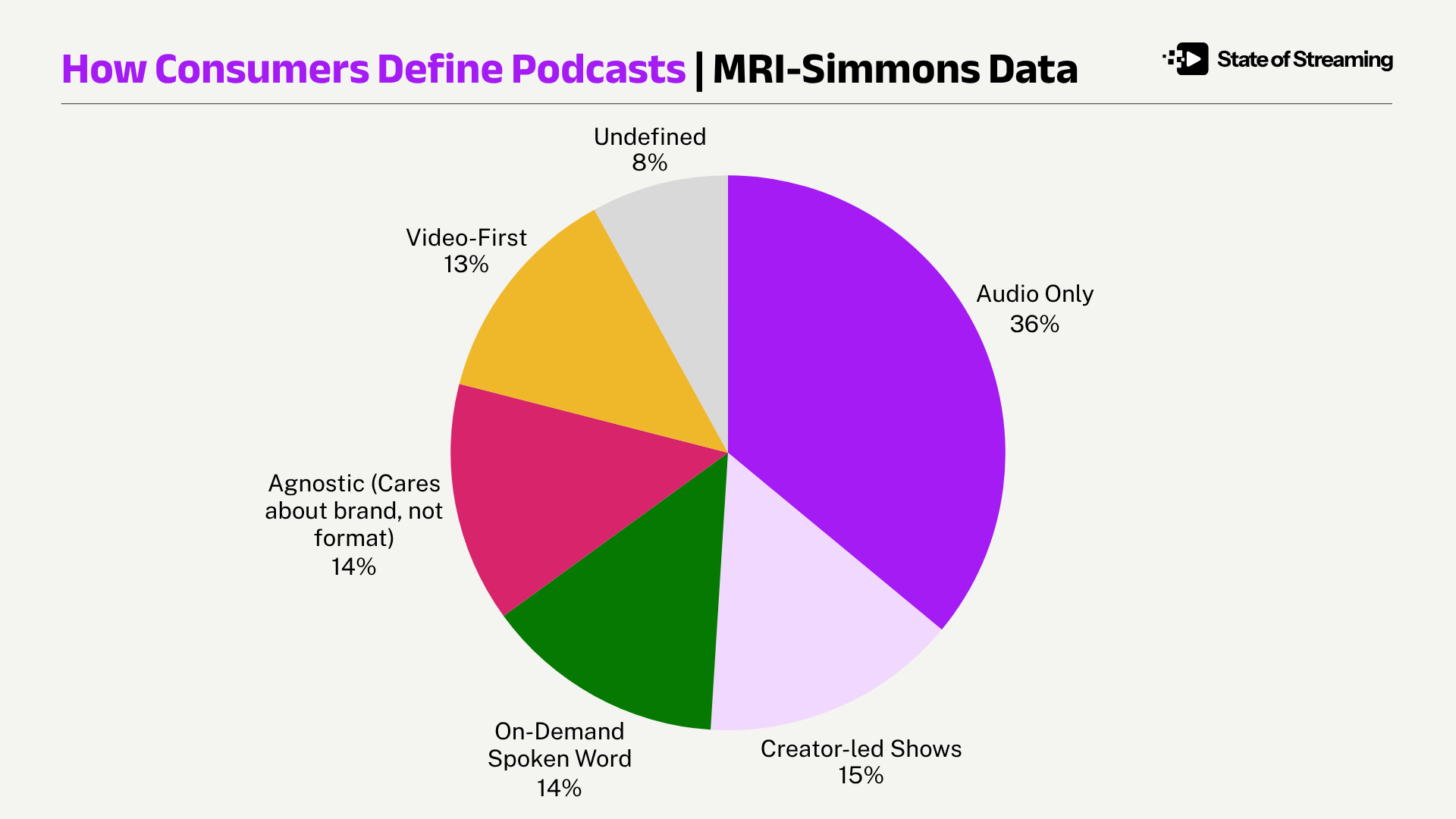
Based on our research, the definition of a podcast is breaking down, but that is actually a sign that the medium is maturing. 10 or 15 years ago, the definition was straightforward: an audio file distributed through an RSS feed that you listen to on your phone or computer. Today, when we ask consumers how they define a podcast, only 23% say it is strictly an audio program, and 13% think of it as any audio content that isn't traditional radio. Combined, only 36% of podcast consumers still define podcasts as an audio-only medium—down from over 60% in 2021.
Meanwhile, 15% define a podcast as any creator-led show online (whether audio or video), 14% say it is simply any spoken word content available on demand, and 13% define podcasts as video programs on an app. Another 14% don't consider the format at all, and 8%—about 7 million active listeners—told us they aren't even sure how to define a podcast anymore.
Podcasting Shifts From Format To Hosts
Tim Rowe: Is that breakdown in definition an opportunity or a problem?
Emily Williams: It's an opportunity. Podcasts have become something much more relationship-driven. Consumers aren't following distribution technologies; they are following hosts like Joe Rogan, Mel Robbins, Alex Cooper, and Tim Rowe.
Podcasting is following the exact same path that television did. There was a time when people cared deeply about whether a show was on broadcast, cable, a premium channel, or a specific streaming platform. Eventually, consumers stopped caring about the delivery mechanism and simply cared about the content itself. Consumers are less concerned about whether something is technically a podcast and instead ask: "Do I like this creator? Is this content valuable? Do I want to spend time with this host?"
Tim Rowe: As a creator who started podcasting back in 2019, the barrier to entry was initially so low. Fast-forward seven years, and today I think most about production, packaging, and discoverability. We see video becoming a huge mechanism across YouTube, Apple, and Spotify.
Video Enhances Audio, Not Replaces It
Tim Rowe: What are you hearing from folks when they talk about video podcasting, and is video replacing audio?
Emily Williams: Whenever a new format emerges, the industry tends to frame it as a winner-versus-loser story. But that's not what the data shows. In our study, 96% of podcast consumers still listen to audio podcasts, while 89% watch video podcasts. Consumers are embracing both formats in different situations.
Nearly three-quarters (74%) agree that video formats are an enhancement to audio, not a replacement. When considering a new podcast, two-thirds say it is important that both audio and video versions are available, and two-thirds prefer to watch video if offered.
Crucially, 53% say that when watching a video podcast, they usually ignore the video and just listen to the audio anyway. Just like television in the background, consumers value having the option of video—glancing up when a guest makes a face or pulls up a chart—while the conversation itself remains the core product.
Why Streamers Are Buying Podcasts
Tim Rowe: How should streaming decision-makers view podcasts, and why do we see Netflix and YouTube competing so fiercely for podcasters?
Emily Williams: Podcasts are competing directly for share of time. This year, about 23 million consumers told us the time they spend with podcasts is replacing time they would have spent on video streaming services, and another 32 million say podcasts are replacing traditional live TV. Nearly 60% of podcast consumers told us they find podcasts more engaging than television.
On the platform side, 55% of podcast consumers—about 50 million people—go to YouTube for podcasts today, up from 38 million four years ago. But the main reason streaming companies are acquiring podcasts is because they want creator franchises. 70% of podcast consumers actively seek out other content from publishers when they find a program they like, 70% would watch a TV show or movie based on their favorite podcast, nearly two-thirds would attend a live event hosted by their favorite podcasters, and over half would buy merch. Streaming services aren't just buying content; they are buying loyal fandoms, trusted creators, and multi-format IP.
Social Clips Replace Word Of Mouth
Tim Rowe: How has show discovery changed over the past few years?
Emily Williams: Up until 2024, the number one way people discovered podcasts was through word of mouth. Starting in 2024, social media surpassed verbal recommendations. Today, 44% of podcast consumers discover new programs through social media, ahead of recommendations, online searches, app directories, or advertising.
Social media clips have become the new podcast discovery engine. A two-hour episode generates dozens of short clips on TikTok, Instagram, and YouTube. Sampling a 60-second clip is a low-friction entry point that showcases the host, genre, and production quality. Once hooked, consumers seek out full video or audio episodes that fit their daily routine.
2031 Predictions For Media Categories
Tim Rowe: If we zip forward five years to 2031, where do you think we land on the conversation about podcasting and streaming?
Emily Williams: In five years, we won't be having separate conversations about podcasts versus TV. We'll realize we were focused on the wrong distinction. Consumers care less about how content is delivered and more about why they are consuming it.
We'll spend less time debating podcasts versus television and more time talking about scripted versus unscripted content. Sometimes consumers want a premium scripted drama; other times they want a conversation, commentary, or advice. The future media landscape will be organized around communities, creators, and interests rather than delivery formats, and we will simply ask whether a show has an audience.
Want to watch or listen to the entire conversation?
Get the SOS. Brief
The sharpest streaming intelligence, delivered to your inbox.