Brands Can No Longer Effectively Market, Influencers are the Unfortunate Solution
The use of influencer marketing has become prevalent in the direct wake of the rise of social media; as the tools for normal people to gain fame became ubiquitous, so did the idea that these people held weight in the opinion and wallets of consumers. Advertisers taking advantage of this new marketing avenue is nothing new, as influencer marketing has now grown to account for approximately 25% of social media budgets according to DigitalApplied.
Vogue Business’ Madeleine Schulz reported on the changing role of influencers within a brand's marketing strategies from the ground at a social media-studded iteration of the yearly Cannes Lions, where she found that "the relationship [between influencers and brands] is moving from ‘make this content for us’ toward ‘help us determine what is worth making in the first place.'" As brands not only invest more money but also more trust and interdependence in these influencers, I believe it’s important to examine the balancing act that is their role in the marketing ecosystem from the eyes of both consumers and brands. Is this transition of responsibility a great step towards truly consumer-based advertising or is it just a way for sponsors to offload more responsibility and blowback onto their mouthpiece?
From Content Creators to Strategy Directors
Examining social media starlets from the perception of their fans is impossible without understanding the dynamics of the parasocial relationship these pseudo-celebrities try to create. Since everyone can create content and have it disseminated by the ever-elusive algorithm, gaining a foothold in whatever niche one occupies requires a level of either truthful or disingenuous honesty (a better descriptor could be commitment). Whatever persona is presented in one’s content that can then further be interpreted as the ever-elusive authenticity. Once lost, it is credibility that is hard to gain back. What differentiates the relationship between the one normally created between celebrity and fan is the consistent and seemingly unrestricted nature of content created for social media. Because the product that can propel someone to stardom is easily filmed in a bedroom on a phone, audiences receive it with favorable interpretations of authenticity; it is seemingly removed from the perceived influence of capital and, by extension, players such as large advertisers or brands. Authenticity then acts as both a spark plug and a shield for fan engagement, which inevitably leads to interest from these same advertisers and brands.
Balancing on the Authenticity Tightrope
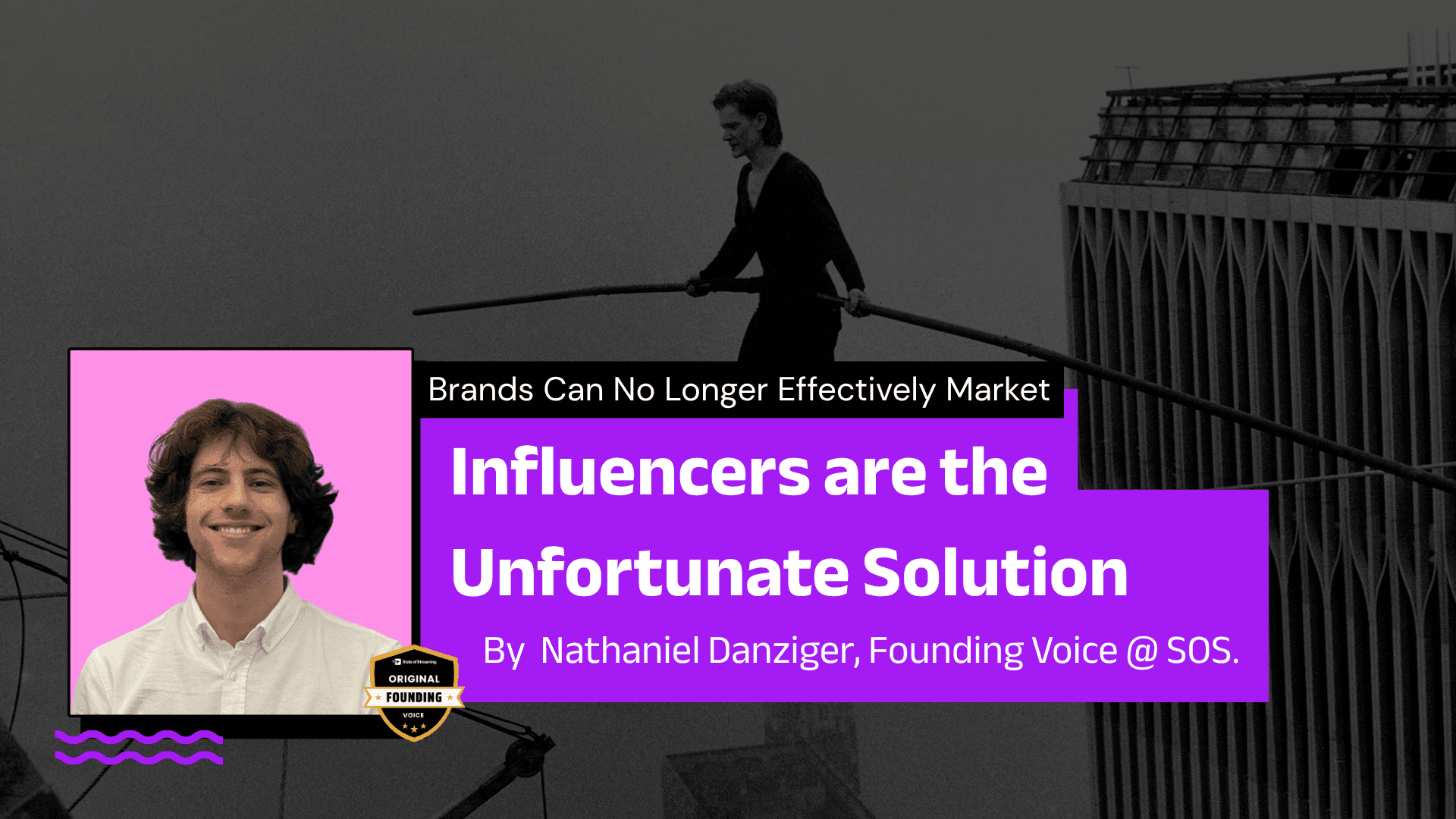
It can be imagined that influencers operate in a figurative manner similar to Phillipe Petit, stranded on a high wire between twin towers, one representing the interests of their fans and the other the interests of their sponsor, with the ground below representing irrelevance. Unlike Petit, the goal is to stay perfectly balanced in the middle of the path as opposed to making it to one side or the other. The authenticity they strive for (which is primarily caused by the medium in which they are using, read my first article here) is what allows for the figurative balance to be kept. This results in content creators, or at least wise ones, carefully selecting brand deals and partnership opportunities to not betray their perceived identity, which would upset their fans.
The other reason Petit came to mind was the fact that, similar to the literal Twin Towers, our imagined buildings come in twos. Brands and advertisers have no use for a celebrity with no fans, so influencers live and die by engagement metrics and algorithmic support. Fans dictate influencer worth and cultural relevance in a way impossible with actual cultural works; since content is not art, it cannot be separated from its artist in the same ways.
All of these interwoven factors mean that from an audience standpoint, a “good” influencer is one who never betrays themselves, promotes a likeminded viewpoint, and makes the viewer feel like the two are actually personable in the physical world. However, because crafting an audience requires this unique type of semi-faux realism, taking on brand engagements can shatter any perceived exclusion from the usual market forces that dictate culture and push further ethical questions about someone who viewers have grown attached to.
The "Mega-Influencer" Entrance
This same phenomenon can work in reverse: the larger an influencer gets, however, someone like Alix Earle (around 14.5 million followers on all platforms and a new reality show) gets away with partnering with major corporations and charging a rumored $450,000 for a single story post specifically because the largess of her following allows her to act in a more celebrity-forward manner. To go back to our metaphor from earlier, the more successful a social media personality becomes, the closer the towers get and the easier it is to balance.
Internet celebrity does not have standardized rules past that, and in actuality the nature of the brand itself matters just as much in the equation of fan reaction. It is the perfect chance to strengthen or betray audience perception while also cashing in on that audience’s attention: a high-risk, high-reward maneuver with payouts too big to simply brush off.
On the other hand, when centering the discussion from the brand perspective, I find it very interesting that brands don’t acknowledge their own position of power when it comes to emboldening or crushing the influencers they partner with.
Forbes Communications Council writes, “In a world where traditional advertising is battling increased consumer skepticism, influencers offer a bridge to credibility and relatability." What the Forbes Communications Council and marketing executives fail to realize is that their interaction with any influencer directly tarnishes the credibility and reliability that made them valuable in the first place.
Influencers exist in categories, and for the Mega and Celebrity classifications of 1M+ and 2M+, respectively, no brand deal is hurting credibility unless the sponsor does something that can reflect poorly. Rather, since they are already viewed as celebrities, sponsorships only help strengthen that association with mechanisms of capital. The larger any influencer grows, though, again, the more they lose the “credibility and relatability” brands value so much. Especially when considering Madeleine Schulz’s observations about giving influencers more power within the relationship they occupy, why would brands give that power to someone who actually knows how to use it? If the stunt happened today, why would we pay Phillipe who fully understands the danger and his worth if we can instead pay an influencer with 8,000 followers and no expectations?
The Nano-Influencer "Race to the Bottom"
Instead, as brands continue to grow both marketing budgets overall and social media investments specifically in a never-ending arms race, I believe they will start turning to “nano” influencers. This is before AI influencers become good enough to not need humans at all, but that is besides the point. “Nano” influencers are classified as accounts with 1,000-10,000 followers and are notable because of their amplified user engagement compared to their small follower base. While this may feel backwards, the limited interaction that happens at the end of the cultural long tail is exactly what makes these types of promotions the most valuable from the brand side. They require less capital, have less experience, and offer a more intimate bond with the consumer advertisers are trying to target.
What happens then when there are no smaller influencers to activate though? If accounts as small as 1,000-10,000 followers are being used by brands to help sell products, audiences never have the chance to become attached to an “authentic” persona. Why would a consumer bother granting extra trust and positive purchasing association to someone who never spent the time to build any trust at all? Without an opinion based in reality, there is no distinguishing feature between sponsored and non-sponsored content, creating an unnavigable soup of bankrupt advertisements clogging social media.
I came away with the exact opposite set of beliefs from those interviewed by Vogue Business, who believe "these longer-term, equity-based partnerships to become a much bigger part of how brands and creators work together,” and that “brands and platforms have a responsibility to give creators context and meaningful ways to participate.”
Risking Brand Abandonment
I’d argue brands need to do their very best to untangle themselves from the web of influencer-aided marketing, not give them more leverage in the situation. While I don’t believe marketing teams or production designers are always caught up with public consciousness, influencers do not know what any type of public would enjoy. The nature of influencing is to attempt to become a full-time influencer, someone actively trying to differentiate themselves from the public by acting as a celebrity or authority or both. Simply, they cannot have an understanding of the audience swirling around them as they willingly try to remove themselves from it.
Influencers are only successful as advertising tools because they exist outside traditional marketing avenues. If they were given more control of the process, and more brand-funded and strategically planned advertisements became comparable to the work that can be found on social media, it would only cheapen the product and marketing, not make it more relatable.
Instead of making the towers closer, stretch them far wider apart. Neither audiences nor sponsors have the responsibility to influencers to help their career along, and both camps need to acknowledge they owe nothing to the people preying off the disconnect between producer and consumer. Brands absolutely shouldn’t stoop to the level of quality and ideation that influencers offer but instead strive to continue crafting an ever-rising bar of excellence when competing for consumer attention.
The only reason companies want to include influencer input and effort in marketing operations is because it would allow them to offload costs and improve a relationship that is financially beneficial at the same time; not because it creates “more original and more human [work].” Brands have spent the last decade of social media cheapening themselves by trying to seem approachable or relatable in comment sections and video shorts. This would simply be the next evolution, from brand cheapening to brand abandonment, allowing an internet celebrity to dictate voice and tone for corporations with entire marketing departments because it’s believed to be more efficient or modern.
I’d go even further, arguing that outsourcing more work to influencers to dictate advertising strategy is outright embarrassing. Phillipe Petit was phenomenal on a high wire; does that mean organizers would suddenly put him in charge of more administrative and planning responsibilities in the lead-up to the event to save money and effort? Would the Twin Towers fan base be part of their economic report on the event?
The Path Forward
The influencer economy is one propped up by brands and consumers who do not know how to relate to each other. Brands invest so much in the make-shift go-between that are influencers as a bandaid on a gangrenous wound. They are unable to connect to new generations of consumers who are tired of emotionally unintelligent, AI-influenced, and faux authenticity-driven advertisements and content. If brands truly wanted to fight against the digital fatigue that is destroying their internal metrics and research, they would steer as far away from influencers as possible.
Consumers want to see effort; they are in a time of immense exploitation that feels never-ending. Unfortunately, instead of showing care and empathy through intentional and intelligent messaging, brands are going further down the path started with relatable Twitter comments. I’d be disgusted if I wasn’t so prepared.
Read More From Nathaniel Danziger Here:
Behind the Screens: What Makes a Microdrama Possible?
The Vertical Shift: A New Column on Short-Form Content, Streaming, and the Culture It's Reshaping.
The Vertical Shift Part Two: When The Derivative Became the Product
Get the SOS. Brief
The sharpest streaming intelligence, delivered to your inbox.