The Capital Side of the Canary - Attention Capital | A Column by Josh Stein
Editor's Note
Attention Capital is a syndicated column by Josh Stein decoding the economics of media, sports, and platform ecosystems — where attention becomes enterprise value and the contracts behind the cash flow get priced like the credit they actually are. This piece picks up where the canary left off: the audience already moved, the mid-tier creator businesses are real, and the senior end of the market has priced the asset. The instrument for the operator middle class still hasn't been built.
Welcome back to Attention Capital.
A year ago, this publication argued that creators aren’t the economy. They’re the canary. The first class of operators fully exposed to the real physics of demand, with every layer of insulation removed. The piece traced the canary across a century of media: radio amateurs to YouTubers to TikTokers, each canary class arriving first, each revealing something the institutions only understood years later. The argument has held up.
What that piece didn’t address, and what this one will, is what the canary is telling capital. The canary kept singing for a decade. Capital mostly listened to the wrong floor. The cost of that mishearing is now visible enough to count. Mid-tier creator companies are operating at a studio scale, financed by their own retained earnings because the credit apparatus hasn’t been built at an institutional scale. Equity rounds dress themselves up as partnerships and end with a control transfer. Venture money chases optionality in businesses that already cash flow. The operators who figured it out first are building the new infrastructure in public, mostly without naming it.
Durable attention is underwritable. The frameworks for scoring it haven’t been built at an institutional scale yet. That’s the work of the next 10 years and the work that defines the next generation of capital allocators. The canary already told us what to do. The question is whether capital can finally hear the right floor.
For the Attention-Constrained
The senior end has already priced it.
BNP Paribas publicly designated the creator economy a fully-fledged economic sector in February 2026. Goldman Sachs Research estimated the global creator economy at roughly $250 billion in 2023, projecting it to reach $480 billion by 2027. Architect Capital paid $535 million for roughly 17% of Fenix International (OnlyFans parent) at an approximate $3.15 billion valuation in May 2026, with the deal stack including Moelis, Skadden Arps, and Sullivan & Cromwell. Tier 1 capital has priced the asset.
The operator-tier gap.
Mid-tier creator companies (Mythical, Dude Perfect, Mark Rober’s CrunchLabs, the Sidemen) are running at studio scale and financing new production from retained earnings because the credit apparatus hasn’t been built at institutional scale. Section I carries the detail. The headline: real businesses, real cash flow, no credit instrument that fits.
The frameworks are broken.
Legacy comps drag valuations toward studio-era multiples priced for a distribution model the audience already left. Projection models extrapolate from view counts when they should be reading retention curves. Diligence checklists were designed for an asset class with different mechanics. Chris Erwin’s diagnosis in Open Gardens: deal making in the creator space “is more informal, faster, and looser than traditional media. But without proper frameworks, that actually holds the industry back.”
The instrument honesty audit.
Venture works for zero-to-one bets where category creation is the asset. Equity priced for control of cash-flowing operators (see FaZe Clan’s $1B-plus peak valuation to the GameSquare fire sale) destroys the asset. Credit, properly structured against catalog cash flow with behavioral covenants, is the instrument that lets a business stay a business. The architecture exists in adjacent asset classes. The work is calibrating it for an asset that compounds through repeat audience behavior.
The live proof markets.
Bia Granja’s youPIX work with Itaú built a creator academy at an institutional scale in Brazil, where the creator economy generates roughly $1.65 billion in annual activity, compared with Mexico’s $480 million. Bedford Media acquired i-D Magazine and relaunched LIFE in the US. Whalar Group launched Lighthouse Studios in March 2026 as a joint venture with Cole Bennett’s Lyrical Lemonade. The structural pattern across all of them: capital provides fuel and production infrastructure; ownership stays with the operator who built the audience.
The window.
Creator-attention credit is in the same place the leveraged loan market sat in 1990: a specialist niche about to become institutional. The next 24 to 36 months decide who sets the documentation standards and who inherits them. Closing arc carries the full comp.
I. The Signals Capital Keeps Misreading
A canary class speaks in many signals at once. Capital tends to hear them as four different stories and file each in a different drawer. Read them as one story and the picture changes.

Signal one: the audience already moved.
The Living Room Already Changed Hands made this case last year. The numbers have only widened since. YouTube held the #1 share of US television viewing for the better part of three years through 2025. The platform reached 13.4% of all US TV viewing at the July 2025 Nielsen Gauge measurement, the largest lead ever recorded between the top two distributors. By Q1 2025, advertiser spend on YouTube TV-screen placements surpassed mobile for the first time, at 43% of YouTube ad spend versus 42% on phones, with TV-screen spending up 88% year over year.
The content is television. The CPMs are still mobile-social. Premium streaming inventory clears CPMs in the $25-$50 range across Netflix, Disney+, and the ad-supported tier. YouTube creator content on those same living-room screens clears $8.72 to $10.01, per Strike Social’s 2024 campaign data. That gap is the simplest, loudest signal the canary has ever produced. Capital can verify it on a Bloomberg terminal. Most of capital still files it under measurement uncertainty when the problem is pricing.
Signal two: the businesses underneath are real.
The mid-tier creator-middle-class section of the canary essay anticipated this. The proof has stacked since. Mythical Entertainment operates from a Burbank studio with more than 100 employees and participated in the $82.5 million First We Feast acquisition in December 2024. Dude Perfect raised between $100 million and $300 million from Highmount Capital in April 2024 at an implied valuation that RockWater Industries modeled between $250 million and $333 million, depending on the assumed ownership stake. Mark Rober’s CrunchLabs operation self-funds a $55 million free science curriculum while developing a Netflix series with Jimmy Kimmel’s Kimmelot. Dhar Mann’s studio produces five and a half hours of television a week, running 18 hours a day, seven days a week with a recurring cast and a content library that runs into the thousands. The Sidemen built Sides, a fast-casual chicken chain expanding across the UK and into Singapore, an apparel brand, charity matches that sell out Wembley Stadium, and a decade of compounded audience.
These are media companies operating at studio scale. They generate cash flow that would have been considered respectable by mid-tier cable television four years ago, and they do it without deficit financing, completion bonds, gap lenders, or any of the financial scaffolding the legacy industry takes for granted. The distance between what these operators are and what capital calls them is the whole diagnostic.
Signal three: the instruments aimed at them are extractive.
Venture priced for optionality on a business that already cash flows. Equity priced for control of an asset whose value is the operator’s daily relationship with the audience. Co-production priced for distribution access the creator doesn’t need. Each instrument arrives looking like opportunity. Each one charges a soul-tax that the most experienced creators have learned to refuse.
The FaZe Clan cycle is the cleanest cautionary case. Peak valuation north of a billion dollars. Hundreds of millions raised. A SPAC listing on Nasdaq in July 2022. A ticker symbol. Then a collapse, a fire sale to GameSquare completed in March 2024, founder dilution to almost nothing, and a generation of younger creators absorbing the lesson in real time. The Try Guys reached a similar fork from the other side. Rather than take more equity, the team built 2nd Try TV, a standalone $5-per-month streaming service that accounted for 20% of the company’s revenue within three months and put the operation on a path to profitability. Arithmetic explains the contrast. Ideology has nothing to do with it.
Signal four: the pattern repeats across every category the canary touches.
Sports. Overtime built a basketball league, a merchandise operation, and an original-content slate on top of an audience that started on social. Music. The catalog buyers spent the better part of a decade learning that the most valuable songs are the ones that have become ambient. The fandom layer is interesting. The recurring royalty stream is the asset. News. The Athletic sold to the New York Times for $550 million because it owned the relationship with paying readers and didn’t need a platform’s permission to reach them. Gaming. Fortnite has held tens of millions of monthly active users for years because the game is a social space that compounds over time. The VTuber holding companies COVER Corp and ANYCOLOR trade publicly on the Tokyo Stock Exchange on the same principle: repeated behavior becomes infrastructure.
Each of those categories has its own vocabulary. Sports talks about fan equity. Music talks about royalties. News talks about subscribers. Gaming talks about engagement. The canary watching all of them sees one thing: durable repeat audience behavior translating into financeable cash flow. One phenomenon. Four vocabularies. Capital hears four different stories. It’s one story.
The signals are loud. The frameworks are deaf. That’s the next problem.
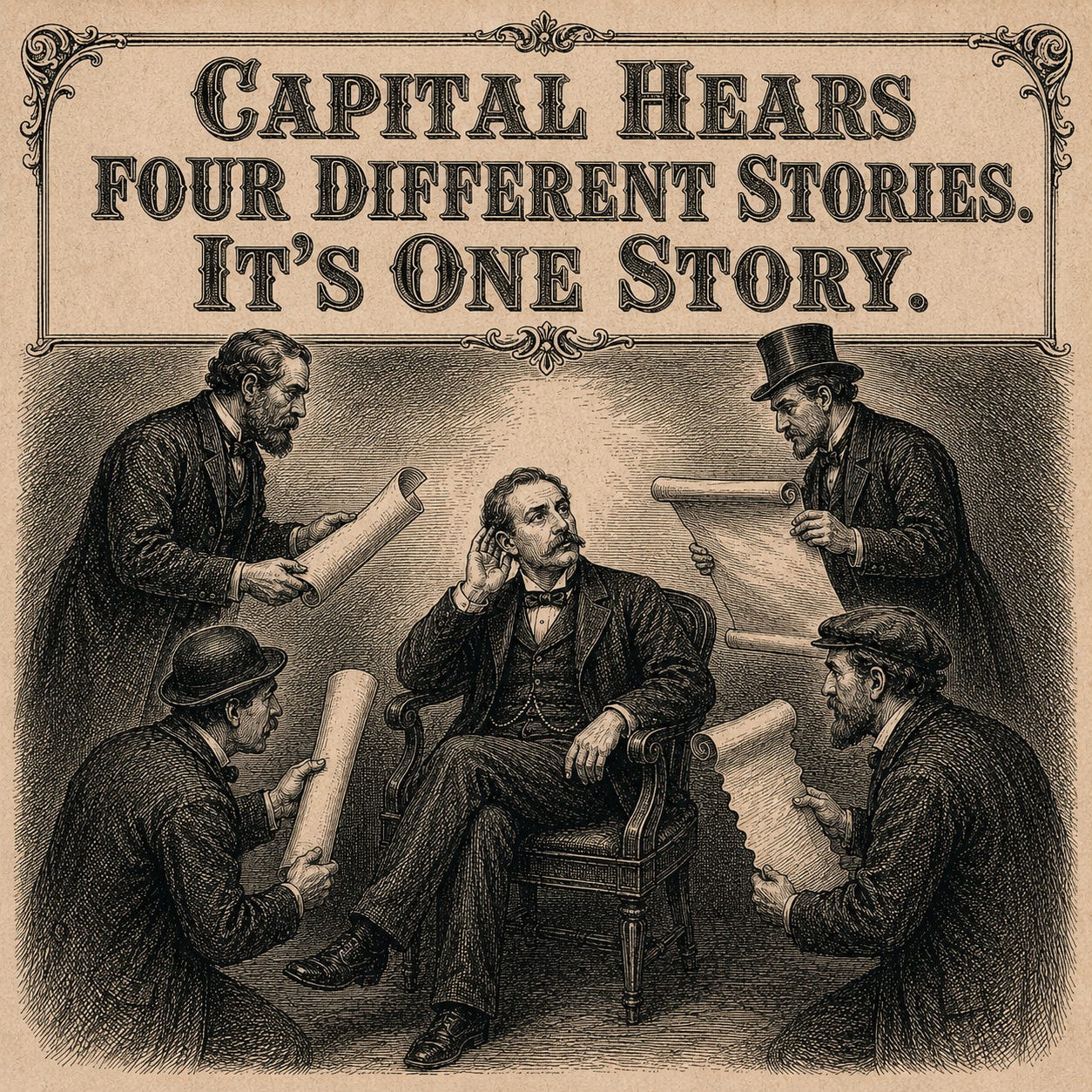
Capital hears four different stories. It’s one story.
II. The Senior End Has Already Priced It
The picture changes once you look at what Tier 1 capital has actually done with the asset in the last 24 months. The category has cleared institutional pricing. The operator-tier gap looks more like infrastructure debt than conviction debt.
Start with the deal everyone in private credit has read. In May 2026, Architect Capital paid $535 million for roughly 17% of Fenix International, the parent of OnlyFans, valuing the company at approximately $3.15 billion. The investment thesis was explicit on the record: developing new financial services and products for the platform’s creators. The deal stack: Moelis ran the sell-side. Skadden Arps represented Fenix. Sullivan & Cromwell represented Architect Capital. Even when the tool is equity in form, the thesis is credit-side logic: build the financial infrastructure for creators at scale. That’s a specialty credit firm bringing a bulge-bracket-grade advisor stack to a deal whose stated purpose is building creator credit infrastructure.
Step back to the policy layer. BNP Paribas, a Tier 1 European bank with more than $2 trillion in assets, publicly designated the creator economy as a fully fledged economic sector in February 2026. The bank co-hosted Paris Creator Week and positioned itself as the financial services partner for content creators. Alexandre Jacquemin of BNP Paribas, on the record: “It’s an economy that’s rapidly taking shape with a business model that functions and generates profit.” The bank sized the European creator economy at $32.8 billion in 2025, projecting $157.3 billion by 2032 at a 25.1% CAGR.
The research desks confirm the trajectory. Goldman Sachs sized the global creator economy at roughly $250 billion in 2023, projecting a near-doubling to $480 billion by 2027. Market.us projects the global figure to reach $1.07 trillion by 2034 at a 21.8% CAGR, with the US sub-segment alone projected to reach $297.3 billion by 2034 at a 19.3% CAGR. Precedence Research extends the trajectory toward $2 trillion by 2035. The sizing isn’t speculative anymore. Bulge-bracket research desks reserve that kind of category sizing for established asset classes.
Tier 1 capital priced the category. The deals are landing. The instrument for the operator tier still hasn’t been built.
What none of those proof points represent is the instrument that lets the operator middle class participate in the same asset class that the senior end has already priced. Banks can’t underwrite the operator-tier asset because Tier 1 capital frameworks are built around audited financials and conventional sector codes. Specialty credit underwrites the entity. The cash flow stream that drives a creator company sits outside the frame. Equity capital is structurally mispriced because the working-capital cycle and platform-timing dynamics don’t match what a public-market comparable assumes.
The gap is the rails. Standardized underwriting documentation. Behavioral covenant architecture (covenants tied to retention curves, posting cadence, platform concentration, audience cohort durability). Score-driven surveillance (monitoring those metrics in real time, with covenant triggers if they break thresholds). Recovery playbooks for cash flows that don’t liquidate the way physical assets do (stepping into the catalog and the platform receivables rather than auctioning a factory floor). Capital is present. Conviction is present at the top of the market. The originators who build those rails write the documentation standards for the operator layer that follows.
The senior end has priced the asset. The operator middle class is waiting for the instrument. That’s the next section.
III. The Frameworks Are Broken Because the Asset Changed and the Apparatus Didn’t
The reasons capital mishears at the operator layer come down to structure. Nobody’s stupid. The frameworks were built for a different asset. They never got updated. And the field has reached a point where the most credible voices on the operator side are saying so out loud.
The frameworks were built for a different asset. They never got updated.
Chris Erwin runs RockWater, an M&A and strategy shop focused on the creator economy. He spent his first decade on Wall Street as a deal banker, then ran COO at one of the first YouTube MCNs, then sold it. He’s a practitioner who has tracked every meaningful creator-economy transaction for the better part of a decade. Ben Odell’s Open Gardens profile of RockWater earlier this year framed the diagnosis directly: projections in the creator economy “feel closer to intuition than to models you would want to underwrite with conviction.” Erwin’s own framing in the same piece: deal-making in the creator space “is more informal, faster, and looser than traditional media. But without proper frameworks, that actually holds the industry back.”
Those two sentences are doing a lot of work. They admit, from a chair that Wall Street respects, that the apparatus most allocators bring to creator deals isn’t actually built for the asset they’re underwriting. The market is starting to admit out loud what’s been visible from the operator side for years. That admission opens space for three specific failures to come into focus.
The legacy comp problem.
Public-market comparables drag valuations toward studio-era multiples priced for a distribution model the audience has already left. The Paramount-Warner-Netflix triangle showed how capital reads that gap in real time. Paramount Skydance’s hostile bid for Warner Bros. Discovery eventually cleared at roughly $111 billion. Netflix withdrew its earlier $82.7 billion offer, collected a $2.8 billion breakup fee, and watched its stock rise 7% the next day, while Paramount’s fell 3%. That trade was covered in The Market Just Priced Durable Attention. The market rewarded the operator with durable behavioral cash flow and punished the operator absorbing legacy scale. Closing certainty, financing credibility, and balance-sheet honesty decided the outcome. The headline price was almost incidental.
The Last Studio Standing and When Attention Becomes Financeable mapped this in detail. The headline is straightforward: capital is starting to price scale as a financing risk rather than an asset, but only when the underlying behavior is rented rather than owned. Substack scaled narrowly and aggregated infrastructure rather than audience. Vice scaled broadly and aggregated reach. One survived stress. The other didn’t. Comparables built on the second model still pull down valuations for businesses built on the first one.
The projection problem.
Most creator-economy projections still extrapolate from view counts. View counts don’t predict durability. Retention does. Watch-time half-life does. Return-without-prompting does. Capital that underwrites view-count growth is underwriting fuel. Capital that underwrites repeat behavior is underwriting infrastructure.
The Jellysmack-versus-Spotter contrast is the cleanest live evidence the market has produced on this distinction. Jellysmack raised a $500 million catalog licensing fund in 2022 to buy YouTube back-catalogs and optimize them across platforms. The thesis required Jellysmack to outsmart the platforms at their own game. When CPMs compressed and Facebook deprioritized video, the model broke. The company restructured, laid off staff, and pivoted toward owning its own IP-driven YouTube channels. Spotter took a different approach. By September 2024, the firm had deployed more than $980 million to YouTube creators, underwriting against the historical retention behavior of established channels. The portfolio worked through the same ad market that broke Jellysmack. Both firms had capital. They were underwriting different things. Spotter behaved like a factor of receivables, advancing against documented forward cash flow on existing catalogs. Jellysmack behaved like growth equity, betting on its own ability to outsmart Facebook’s distribution algorithm. The first model survives stress. The second one doesn’t. That distinction is the whole instrument honesty audit in miniature.
The diligence-checklist problem.

The standard credit checklist asks for collateral, recovery, fixed-asset coverage, debt-service ratios. None of it scores audience quality. None of it asks whether the audience comes back without being chased. None of it asks whether the catalog generates revenue from videos uploaded three years ago, or whether the email list survives a platform change, or whether the operator owns the contact path to the audience.
What a credit committee actually asks about a creator deal: “Where’s the EBITDA?” “What’s the platform concentration?” “What’s the founder going to do if they get hit by a bus?” These are useful questions. They’re also incomplete. The questions the next generation of credit shops will need to add: “What’s the retention curve at the 30-day mark?” “What percentage of revenue comes from owned channels versus rented ones?” “What does the catalog generate per month from content older than a year?” “What does the audience do when the operator takes a three-month break?”
That gap between what credit committees ask and what they should ask is the next 10 years of work. The discipline to do it properly is the next frontier for capital allocators. The methodology to score it is a conversation for a different setting.
The cost of leaving the gap unfixed is already visible. Operators who could absorb meaningful production credit are funding new content from retained earnings because the diligence apparatus that would let them borrow doesn’t speak their language. Allocators sitting on dry powder are choosing not to lean in because their underwriting templates don’t fit. Both sides know the asset works. Both sides are waiting for the rails. The cost of that wait shows up in the same place every cycle: in the spread between what an operator could be producing if properly capitalized and what they’re actually producing while bootstrapping. Multiply that gap across the operator middle class and the missed value is significant.
The frameworks were built for a different asset. They never got updated.
IV. From Extractive to Structured
The creator-capital relationship is migrating from extractive to structured. Each instrument has a place. The question is whether anyone is matching the right instrument to the right operator. Most aren’t yet. A handful are starting to.
The instrument honesty audit.

Venture has a place. True zero-to-one bets, businesses that don’t yet cash flow, founders making a bet on category creation; this is the deal venture was designed for. Anti Fund, the $30 million Fund I closed in December 2025 with Logan Paul as a general partner, and a portfolio that includes OpenAI, Anduril, Ramp, and Polymarket, is a creator-led venture vehicle aimed at exactly that profile. It’s the right instrument for those bets. It’s the wrong instrument for the mid-tier creator middle class that already runs at studio scale and already cash flows. The Case for Non-Dilutive walked through the math. Equity is a claim on your future. Credit is a tool for building it.
Equity and co-production carry a soul-tax. Both look like partnership. Both end as control transfer. The Try Guys priced this and refused. Zach Kornfeld told CNBC the company had been operating at a loss for essentially two years because the cost of producing what their audience wanted exceeded the revenue YouTube returned. The Try Guys’ response was 2nd Try TV. A standalone subscription service that hit roughly 20% of company revenue within three months. Equity itself works fine in many places. Equity priced for control of a cash-flowing business at studio scale is the most expensive capital an operator can take.
Credit is the instrument that lets a business stay a business. Attention, Collateralized walked through the historical precedent: Bowie Bonds in 1997, slate financing in the 2000s, Marvel’s $525 million character-backed credit line in 2005, music royalty securitizations across the 2020s. Each one took an attention-based cash flow and structured it as collateral. None of them required the operator to give up the relationship with the audience.
Translate that to the operator middle class and the structure becomes obvious. The catalog is a cash-flowing bond. Videos uploaded three years ago that still generate views are a yield curve. The platform partnership is a contractual receivable. The brand-deal pipeline with documented historical pricing is a forward order book. The community is a working-capital reserve. Email lists with delivery history, SMS opt-in audiences, direct-channel relationships; all of it underwrites the same way receivables underwrite a SaaS facility.
A properly structured creator credit facility advances production capital against the incremental cash flow the new content is expected to generate, with the historical catalog as the floor. The covenants reference behavioral metrics. Posting cadence. Platform concentration thresholds. Retention curves at the 30-day mark. Recovery in a default scenario steps into the cash flow streams, manages the IP, and either operates the business or hands it to an operator who can. The framework exists in other contexts. SaaS lenders use a version of it. Music catalog lenders use a version of it. The work is calibrating the framework for an asset that compounds through repeat audience behavior. The mechanics translate. The covenants don’t.
The arithmetic works the same way it worked for music. The infrastructure to do it at institutional scale for creator companies hasn’t been built yet. It will be. That’s the whitespace.
The live proof markets.
Brazil’s creator economy clears roughly $1.65 billion in annual activity. Mexico’s figure sits closer to $480 million, despite roughly comparable daily social media consumption in both countries. The gap comes from infrastructure. Both countries have the audience. One country has the apparatus around the audience.
Bia Granja co-founded youPIX in the mid-2000s, in the first year of the YouTube era. She ran it for nearly two decades and built it into the largest consultancy, accelerator, and conference for the creator economy in Latin America. The work has included AB-InBev, Nestlé, Unilever, Google, Procter & Gamble, and Meta. The most ambitious build came through a partnership with Itaú, one of Brazil’s largest banks. The bank treated creators as institutional collaborators. Stakeholders with shared upside in the broader media economy, building businesses the bank could underwrite later. The Creator Academy program reached thousands of creators on the fundamentals of running an actual business. An institutional balance sheet decided that a creator class was worth building the operating infrastructure for. That decision is more important than any single creator the program produced.
Bedford Media represents the parallel posture on the US side. The holding company acquired i-D Magazine from Vice Media, brought back print issues in the fall, and relaunched LIFE Magazine with Joshua Kushner as Publisher and Karlie Kloss leading the operation. The strategy banks away from ubiquity and reach toward quality and depth. The bet is the same one Itaú is making in a different vocabulary: durable cultural attention is worth assembling the operating apparatus around. Bedford wasn’t modeled on youPIX. The two operate in completely different markets with completely different stakeholders. They’ve arrived at the same posture from opposite directions. That convergence is what’s interesting.
Whalar Group launched Lighthouse Studios in March 2026 as an entertainment production arm to sit alongside its Lighthouse content development hubs in Brooklyn and Los Angeles. Akshay Mehta, an alum of CAA Media Finance and Bron Ventures, runs the operation. The first major bet is a joint venture with Cole Bennett’s Lyrical Lemonade, a digital media operation with more than 24 million YouTube followers. The deal calls for Lighthouse to provide “capital, production infrastructure, and strategic support” to build out a video network around Lyrical Lemonade’s mix of music, culture, and lifestyle.
Neil Waller, Whalar’s co-founder, described the bet as building “a human-driven algorithm, rather than a computer-driven algorithm”. The framing matters. The operator is the curation engine. The audience is the asset. The capital and the production infrastructure serve as fuel. Ownership stays with the people who built the audience. That’s the structural shape of the new studio system being built on creator infrastructure. The IP comes second. It looks more like what Hollywood was in 1925 than in 1995.
The through-line across all of these is the same question. What does capital look like when it stops trying to own the asset and starts trying to underwrite the behavior?
The operator is the curation engine. The audience is the asset. The capital provides fuel. Ownership stays with the operator.
The answer is starting to take shape. Holding companies built around durability. Joint ventures that route capital and production to operators who already have the audience. Bank-led education programs that build creator businesses from the bottom up. Venture vehicles that take their proper role on early bets where category creation is the asset. Specialty credit shops underwriting the catalog and the cash flow streams. And, underneath all of it, the recognition that credit, properly structured, is the instrument that does the most work without taking the most ownership.
V. The Migration Is Permanent
Every few years, some allocator decides creator-economy exposure is a trade for one or two quarters and packages it that way. The framing is wrong. The migration the canary tracked is a permanent shift in the underlying physics, and the capital structure has to follow whether it wants to or not.
Three reasons.
The behavioral architecture is already laminated.
More than 20 years of platform-native consumption have shaped how people decide what to watch, what to buy, who to trust. No board memo reverses that. The canary essay made this case for the audience’s side: as the edges go, so goes the center. The same logic applies to the asset side. The mid-tier creator company isn’t reverting to a network development deal. The audience won’t sit through a 30-second pre-roll on linear TV because the streaming app is right there. The advertiser who has watched CTV deliver attributable conversions on YouTube for the past two years isn’t moving the budget back to broadcast. The pattern hardened. The reset isn’t coming.
The capital structure is starting to express the migration.
Section II already covered institutional pricing. BNP, Goldman, the Architect Capital deal, the independent market research. The Paramount-WBD outcome is the negative-space version of the same point: the market rewarded Netflix for walking and punished Paramount for absorbing legacy scale, because durable behavioral cash flow priced higher than consolidated reach. Music royalties took about 15 years to be underwritten as an asset class. The vehicles, the documentation standards, the recovery frameworks, the secondary market. None of it existed in 2010. Blackstone launched a $1 billion partnership with Hipgnosis in 2021. Apollo backed multiple Concord music ABS issuances across 2022 and 2023. KKR turned its Kobalt catalog acquisition into asset-backed bonds the same year. The same arc is starting in creator-attention credit. It’s earlier on the curve. The shape of the curve is identical.
The asset profile changed.
Catalogs compound for years. Audience relationships can be modeled with retention math. Cash flows behave more like utilities than like entertainment. The United MileagePlus financing in 2020, the $10 billion American Airlines AAdvantage financing in 2021, the music catalog deals across the 2020s, and the COVER Corp and ANYCOLOR public-market valuations on the Tokyo Stock Exchange all priced behavioral cash flow as an asset. That work is done. The remaining work is building the apparatus to price attention properly at the operator level, which is the layer where the creator middle class actually lives.
Put those three together, and the picture becomes hard to argue with. Behavior doesn’t revert. The capital structure is starting to follow. The asset is already understood at the senior end of the market. The remaining question is who builds the underwriting infrastructure for the next layer down.
The financeability turn.
Durable attention is underwritable. That’s the sentence that opens the next decade of allocator work. Score it, structure around it, underwrite the behavior, and the rest of the apparatus follows. The discipline to do that work properly is what separates the next generation of credit shops from the last one.
What the discipline looks like, what triggers a covenant breach, what the recovery scenarios look like in a default, how the surveillance gets structured, all of that is the work of operators inside the discipline. It’s not a public conversation yet. It will be. The piece you’re reading is about why the discipline matters. The specific apparatus that does the work isn’t the subject of this essay. That apparatus exists. It’s being built. The next generation of allocators will either license it, replicate it, or hire the people who built it.
Durable attention is underwritable. The frameworks for scoring it haven’t been built at an institutional scale yet.
The allocators who develop the literacy first will set the terms. The allocators who wait for the market to be obvious will inherit whatever framework someone else built. That dynamic has played out in mortgage-backed securities, leveraged loans, music royalties, and every other asset class that crossed from specialist into institutional. It’s playing out in attention credit now. The literacy is rare. The window for setting terms is closing every quarter.
The institutional precedent is the most useful guide. The leveraged loan market was a roughly $30 billion specialist niche in 1990. By 2024, it cleared more than a trillion dollars in outstanding paper. The investors who developed credit literacy early set the documentation standards, the rating frameworks, the secondary-market protocols. The investors who waited paid up for access and inherited terms someone else had written. Creator-attention credit is in the year-1990 version of that arc, with the senior end of the market already pricing the asset and the operator-tier rails being assembled in pieces. The next 24 to 36 months are the window.

Closing
A canary in a coal mine reads the air. For 10 years, the air in the creator economy has been thinner than the rest of the mine. The audience knew. The operators knew. The platforms knew. Capital mostly didn’t. That’s starting to change, in pieces, in vehicles like Lighthouse, in holding companies like Bedford, in institutional partnerships like the Itaú-youPIX work, in specialty credit shops learning to underwrite behavior instead of inventory.
The canary kept singing. The audience answered the song question years ago. The operators answered it the moment they started running studios at scale without a financing partner who understood the asset. The senior end of the market has now answered as well, with BNP’s declaration, with Goldman’s sizing, with Architect Capital’s check, with the music-royalty rails the previous decade built and the next decade has to extend.
The question on the table now belongs to the operator middle class and the lenders learning to serve it. Who’s finally listening. What they’re going to build with what they hear. Whether the next allocator class arrives in time to set the terms, or arrives late and inherits the framework someone else built.
The window for setting the terms is open. The canary has held the note long enough. Someone will write the apparatus. The only thing left to decide is who.
Why Subscribe
Because the creator-capital relationship is rebuilding itself in real time, and the apparatus to underwrite the next layer of media gets set inside the current window.
Every week, Attention Capital tracks the deals that decide it. The institutional pricing at the senior end. The operator-tier infrastructure assembling itself in pieces. The frameworks that separate underwritable attention from rented hype. The structural arithmetic that makes durable audience behavior financeable for the desks willing to do the structuring work.
If you work in credit, this is where the diligence apparatus for the next asset class is being mapped in real time. If you operate inside a creator-led business, this is where the structural arithmetic of the deals on your table gets honest. If you allocate to private credit, this is the playbook for an asset class that already cleared at the senior end and hasn’t yet been built at the operator tier.
Get the SOS. Brief
The sharpest streaming intelligence, delivered to your inbox.