The Fall Paradox: Why Streamers Slashed Linear Ad Spend to Buy the NFL
With the fall television season kicking off, the streaming industry has made a glaringly obvious pivot: they are no longer trying to buy the entire linear ecosystem. They, like so many others, are ready for some football.
According to recent estimates from iSpot, streaming platforms have significantly pulled back their overall national TV marketing spend. But beneath the surface of a seemingly dramatic contraction lies a highly calculated efficiency play. Streamers have realized that broad, ambient brand awareness on traditional television is largely a wasted expense. The new mandate is surgical precision—and placing massive bets on singular, culture-dominating events.
The Math Behind the Pullback
The data paints a picture of an industry rapidly maturing its customer acquisition strategy. Over the 30-day window leading up to the fall season (August 23 to September 22), national TV ad spend by streamers dropped 29% to $115.3 million, down from $163.6 million during the exact same period last year.
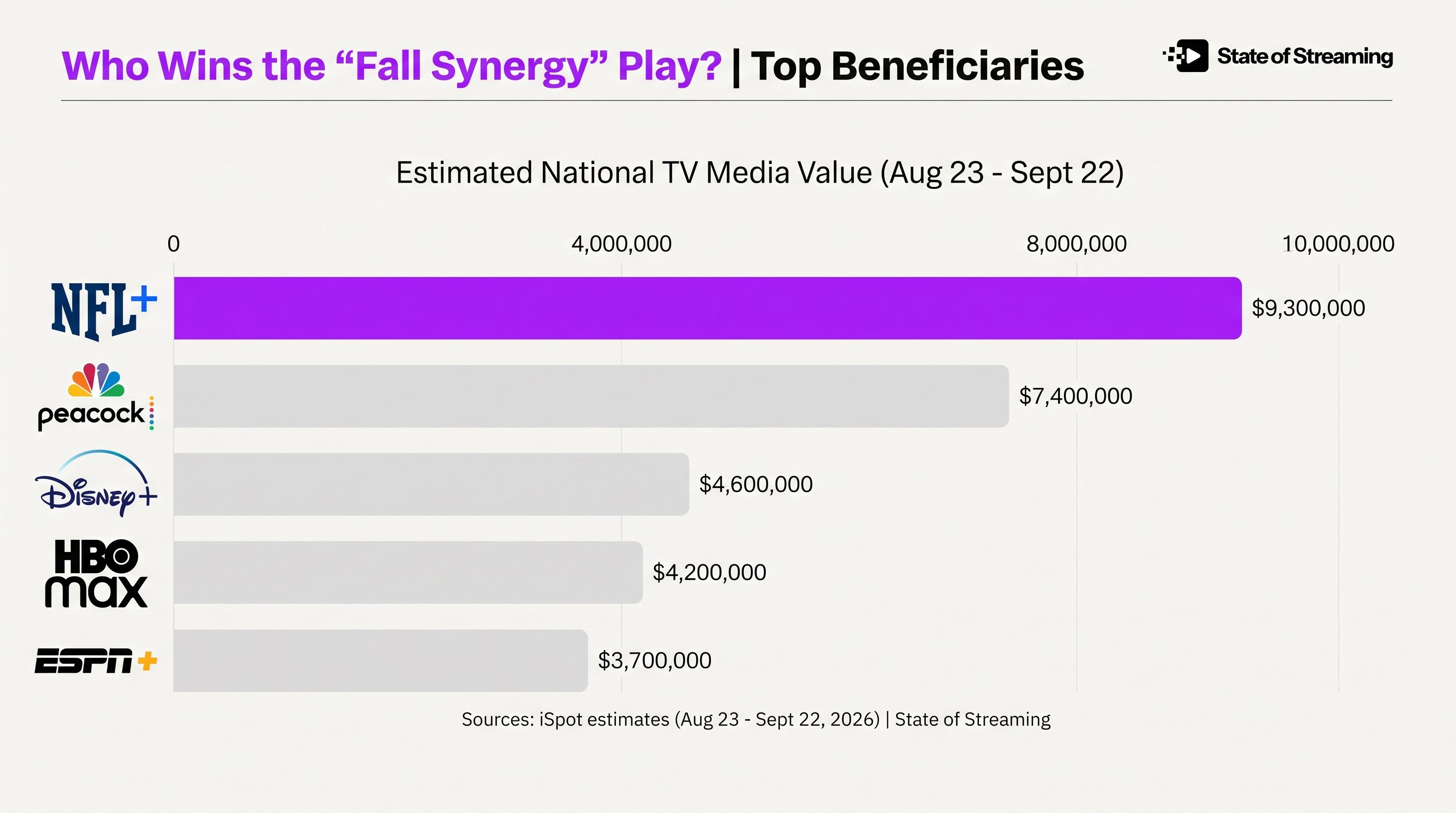
It isn’t just external ad spend taking a cut. The "media value" of internal cross-promotion—where platforms place messaging on corporate-owned linear networks—also plummeted to $44.3 million, a steep drop from last year's $71.3 million.
The top beneficiaries of this synergy play reflect a clear hierarchy of priority:
The Live Sports Exemption
If streamers are still spending heavy capital on linear TV, they are spending it almost exclusively to capture the attention economy of live sports.
YouTube TV continues to lead the industry in national TV ad spend, allocating a massive $42.8 million over the last month. The target? A relentless marketing push for its "NFL Sunday Ticket" out-of-market package. (Even this, however, reflects the broader industry tightening, down from $58.1 million a year ago).
Amazon Prime Video is mirroring the strategy, throwing $23.2 million into marketing its exclusive "Thursday Night Football" broadcasts.
This isn't a branding exercise; it is direct-response marketing at the highest possible level. Streaming giants know that core cord-cutters don't need to be reminded that YouTube TV or Prime Video exist. The ad spend is entirely focused on forcing the hands of the final linear holdouts—the die-hard sports fans—to make the digital leap.
The Fall Acquisition Engine
The 29% drop in ad spend might suggest that the fall TV window is losing its luster for streamers. The reality is the exact opposite.
For decades, the television business organized itself around a single economic engine: "The New Fall Season," driven by upfronts, new show premieres, and the kickoff of football. According to a new report from subscription research firm Antenna, that rhythm hasn't disappeared in the streaming era; it has simply changed shape.
Antenna dubs this period "The NEW, New Fall Season." Their data reveals that a staggering 40% of the streaming industry's annual gross subscriber additions now land precisely between September and December.
This hyper-consolidation of customer acquisition is driven by a three-pronged attack:
The NFL Embrace: The migration of tentpole football packages natively to streaming platforms.
Shortened Theatrical Windows: Summer blockbusters hitting SVOD platforms just in time for the fall viewing surge.
Black Friday Promos: Aggressive, discounted annual lock-ins that convert holiday momentum into long-term retention.
As Antenna notes in the report:
"Fall is no longer just when the industry premieres, it is when the industry acquires."
Renting the Streaming Stage
This is the ultimate paradox of the current streaming wars. The fall season is the most consequential window of the year for subscriber acquisition, yet platforms are spending less on linear marketing to achieve it.
We saw this exact dynamic play out earlier this year when Netflix traded zero production costs for the exclusivity window of the Grand Theft Auto VI trailer, driving massive acquisition without traditional ad spend. The broader streaming ecosystem is now deploying a similar logic: you don't need to blanket the airwaves with promos for your back catalog if you own the cultural gravity of the NFL or a massive promotional window.
The days of streamers spending wildly to build general brand awareness on linear TV are effectively over. The new moat isn't omnipresence; it's the tactical monopolization of the moments that matter.
Get the SOS. Brief
The sharpest streaming intelligence, delivered to your inbox.