How MLB Teams Will Gain Revenue After Cable - Amoh Sports Media | A Column by Nana Kofi Amoh
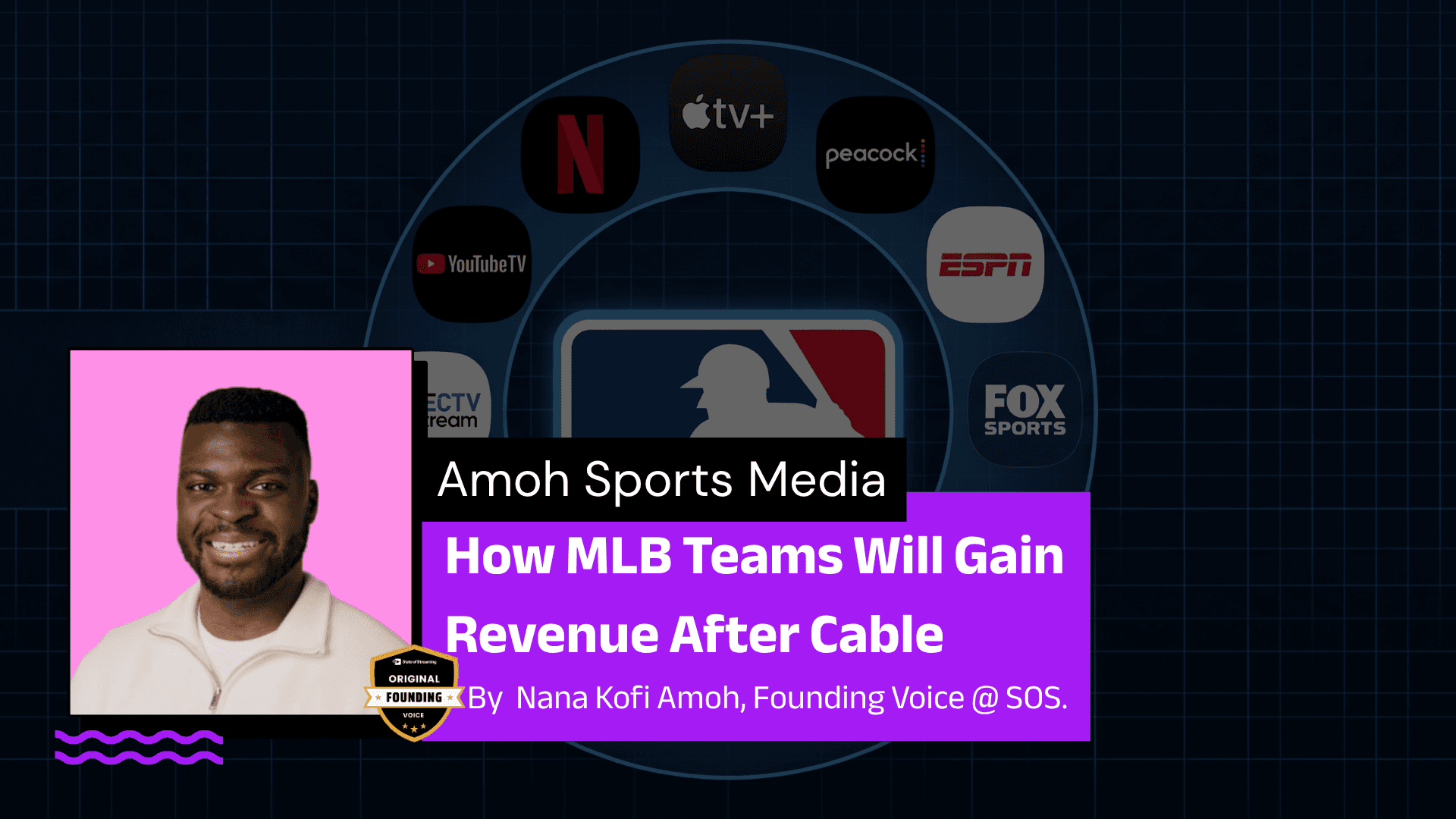
Major League Baseball has a unique issue to address in the near term: how will the league maintain its local media business?
To put in perspective, one MLB season holds 162 games for 30 teams. This means for every regular season, there are a total of 2,430 games between late March and late September. Because there are so many games within a six month span, the league has an advantage compared to the National Basketball Association (NBA), National Hockey League (NHL) and the National Football League (NFL) to reach its desired audience. Fans can watch their local team almost every day for roughly six months, making baseball one of the strongest sports for sustained local media engagement and advertising opportunities.
Where it gets tricky for the league is there are big-market, mid-market, and small-market teams across the country. Teams like the Los Angeles Dodgers, New York Yankees, and Boston Red Sox have larger fan touchpoints than say the Milwaukee Brewers, Miami Marlins, and the soon-to-be Las Vegas Athletics.
National Rights Shift: Moving Away from Traditional Cable
Before the 2026 season, MLB has agreed to a three-year rights deal with Peacock, Netflix and ESPN with the league slowly shifting away from ESPN after 39 straight seasons for national games throughout the regular season. MLB commissioner Rob Manfred’s long-term vision is to have “one place to watch your team, and every team, wherever you are.”
Currently, due to the collapse of FanDuel Sports Network for local games, the league has taken the rights back to themselves while working on a permanent place to store local rights. For instance, if Kansas City Royals fans wanted to watch live, on demand Royals games for the 2026 season, Royals.TV would have them covered through the MLB.TV package.
This model is actually the short-term solution to MLB’s local media saga. With MLB’s recent rights deal set to expire at the end of 2028, there is a sense of urgency across the league office to find the right place for local games across the league to reside.
Manfred's 30-Team Package vs. $500M Local RSN Juggernauts
Manfred believes that the league could generate interest not only from traditional outlets but from streamers such as Apple, Peacock, Paramount and Netflix. The exclusivity of one package would generate more collective revenue than the combination of 30 individual team deals.
But this puts teams like the Dodgers, Yankees, and Red Sox in a unique situation. Big-market teams run on their local revenue, in particular the Dodgers. They have a local rights deal with Charter Communications, the parent company of Spectrum, with its annual rights fee topping $500 million by the end of the Charter contract in 2038. In addition, the Dodgers also own SportsNet LA, their dedicated regional television network.
The New York Yankees are on the YES Network and their local rights deal lasts until 2042 averaging between $200 to $300 million a year, while the Boston Red Sox are on the New England Sports Network (NESN) and although their rights agreement is long term, the estimated annual rights fee is around $120 million per year.
International Superstars & The Small-Market Revenue Gap
In theory, small-market teams like the Brewers, a former FanDuel Sports Network team, would get significantly more than $35 million per year in annual rights fees if the teams split the pot evenly. Through a salary cap, small-market owners could be guaranteed players that would receive a guaranteed but limited percentage of league revenue. That cost certainty, coupled with the potential of increased revenue from a 30-team broadcast package, probably would win over small-market owners.
But with international talent like the Dodgers have in Shohei Ohtani, Yoshinobu Yamamoto and Roki Sasaki, they would demand greater revenue from international broadcast rights, which are now shared equally among teams. Unfortunately, international talent does not come as simple for other teams, especially when their contracts are just as much if not more than an entire team’s salary cap.
Beyond the Dodgers: Controlling Local Fan Retention
The reality is the Dodgers are the standard across everything baseball related, even in local media revenue. With the future of MLB local media still in the air, teams should use this three-year period to look in-house to build a diversified revenue ecosystem centered on fan relationships. Personalized experiences help fans feel included in the long marathon that is the MLB season and retained in the process. Other teams may not have big salary caps like the Dodgers do, but what they can control is maintaining their fan base to ensure consistency and loyalty to their brand.
Local media for MLB is still in the air in regards to its future. For now, teams need to be smart about how to keep their fans engaged in the interim especially with streaming while awaiting the future of where the league as a whole is heading in terms of where games will be hosted.
Read More From Nana Kofi Amoh and Others Here:
Why Agencies and Advertisers Should Be Buying More Local Sports
Are Regional Sports Networks Actually Dying—or Just Evolving?
Get the SOS. Brief
The sharpest streaming intelligence, delivered to your inbox.