How Shoulder Content Changes the Price of Football Advertising
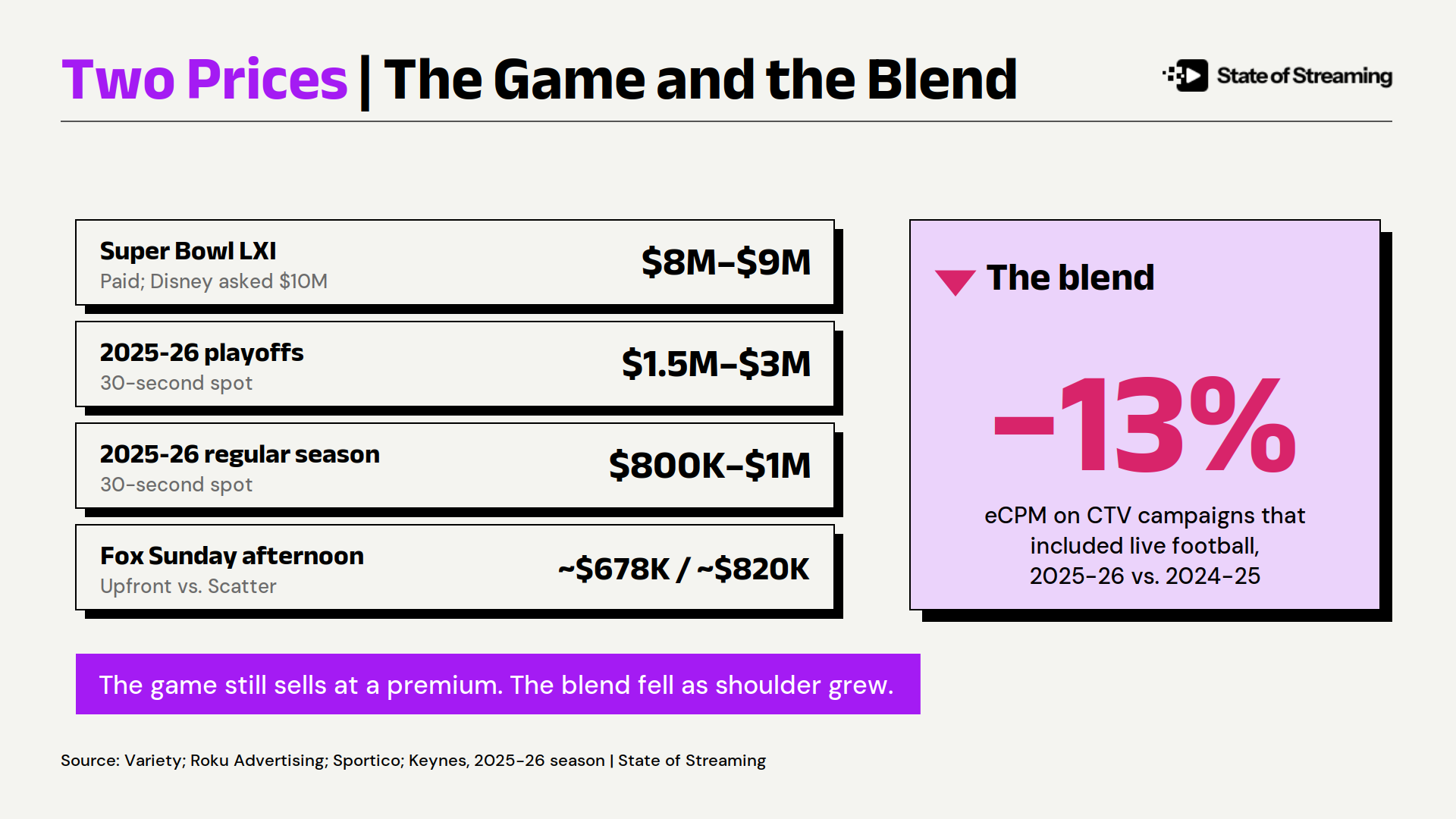
In the 2025-26 NFL season, the price of a 30-second spot in a live game went up, and the average price of a connected TV (CTV) campaign built around football went down 13%. Both numbers are correct. The difference comes from shoulder content: the programming that surrounds the game.
This explainer covers what shoulder content is, why it lowers average prices without lowering live prices, why there is more of it every season, and how two current examples, The Fan Zone on DAZN and Super Bowl LXI on Disney's networks, put it to work.
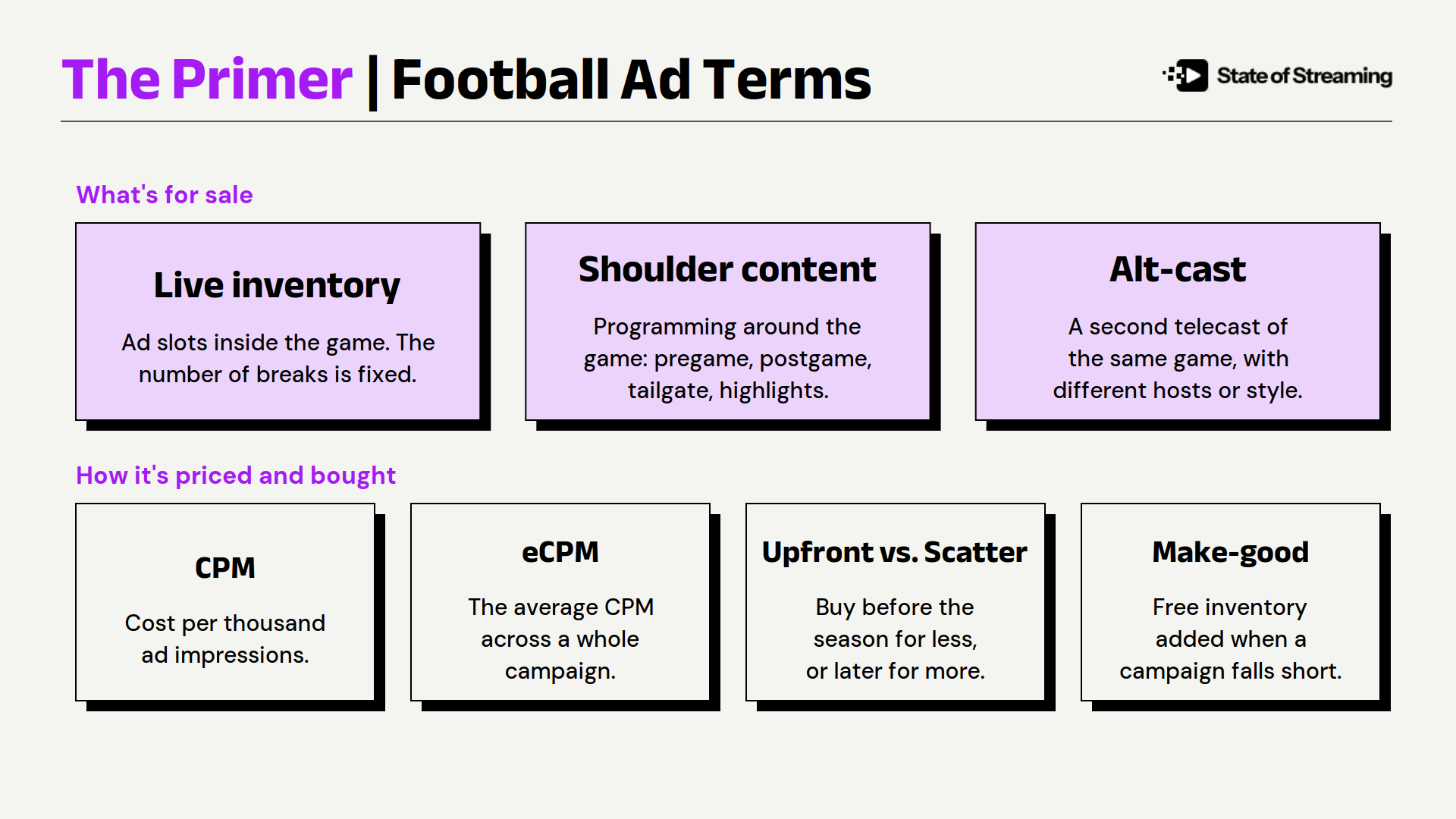
Key Terms To Know
Two prices: the game and the blend
Football has two prices that are easy to confuse. One is the price of an ad slot during a live game. The other is the average price of a campaign that includes live games plus the programming around them.
How a blend falls while live rises (illustrative numbers)
Say live impressions cost $60 CPM and shoulder impressions cost $20.
Season one: half the campaign runs in live games, half in shoulder. Blended eCPM is $40.
Season two: live rises 5% to $63, but more shoulder is available, so the mix shifts to 40% live and 60% shoulder. Blended eCPM is $37.20, down 7%.
No one cut a price. The mix changed. That is the effect behind the 13%.
Why there is more shoulder content every season
The short answer is rights economics. A network pays the NFL a fixed fee for a fixed number of games, then sells ads to cover it.
Broadcast partners recoup about half of their NFL rights fees through advertising (Guideline via Sportico).
Early projections put fee increases in the next rights cycle above 50%. The NFL can opt out of its current deals after the 2029 season.
Pure-play streaming services took 12% of NFL ad revenue last season (Guideline via MediaPost).
A game has a set number of ad breaks, so a rising rights bill can't be covered by adding more live slots. Shoulder content adds impressions that are tied to football but not limited by the game clock. That makes it the main way a rights holder can grow ad inventory around a fixed schedule.
Case study: The Fan Zone on DAZN
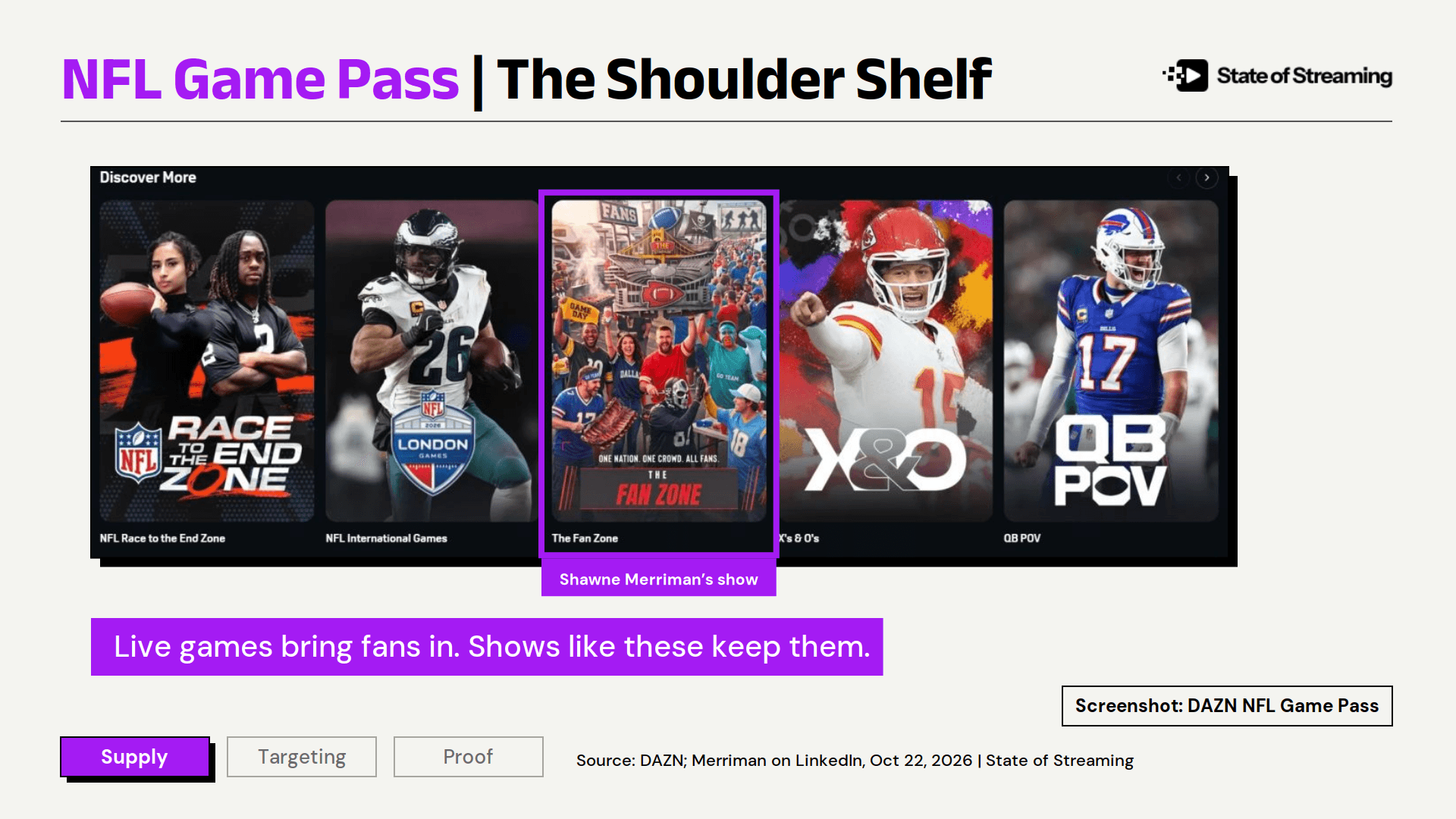
The Fan Zone is a tailgate show hosted by former NFL players. It launched in 2024 as a live pregame show from SoFi Stadium on Lights Out Sports TV. This season it covers 14 NFL markets, with three former players for each team. In October it began streaming on DAZN's NFL Game Pass, which is available in more than 200 countries and territories.
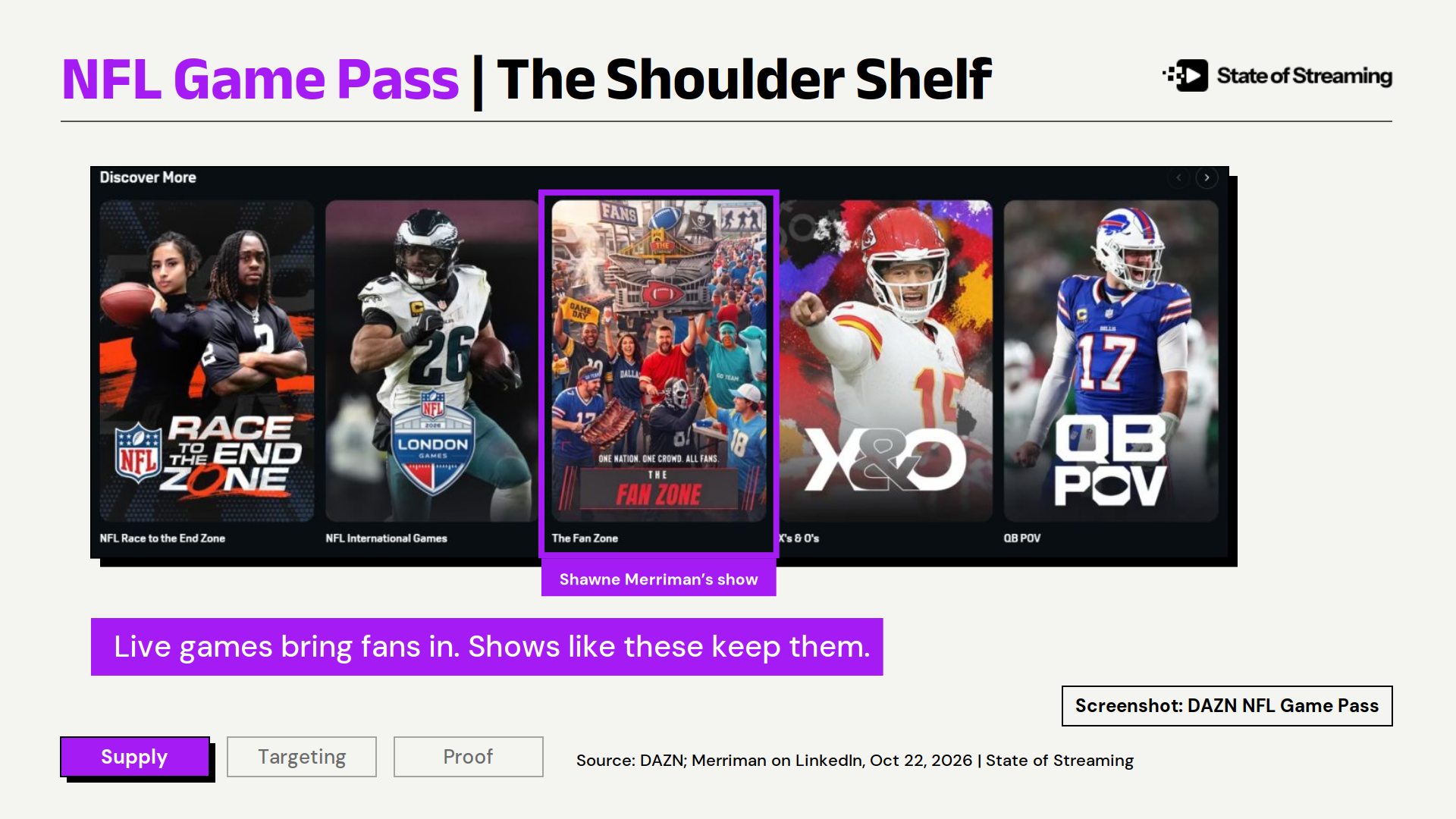
The arrangement shows two ways to hold content. DAZN licenses NFL games under a 10-year international Game Pass deal; it pays for the rights but doesn't own the games. Lights Out Sports TV owns The Fan Zone outright. The licensed games draw viewers to the app. The owned show gives them something to watch around the games.
Lights Out Sports TV Founder and CEO Shawne Merriman described the economics on the SOS. podcast (that you can watch or listen here):
"If you can pay for the content that's gonna bring in the traffic and have a trickle-down effect, that's where you make your money at."
His example was Paramount+: NFL and UFC bring viewers in, and originals like Landman and Tulsa King keep them watching. He also said direct-sold advertising matters more than programmatic for this kind of inventory.
Case study: Super Bowl LXI's six feeds
Shoulder content can also run inside the game. ESPN's first Super Bowl, on February 14, 2027, will run as six feeds across ten Disney outlets:
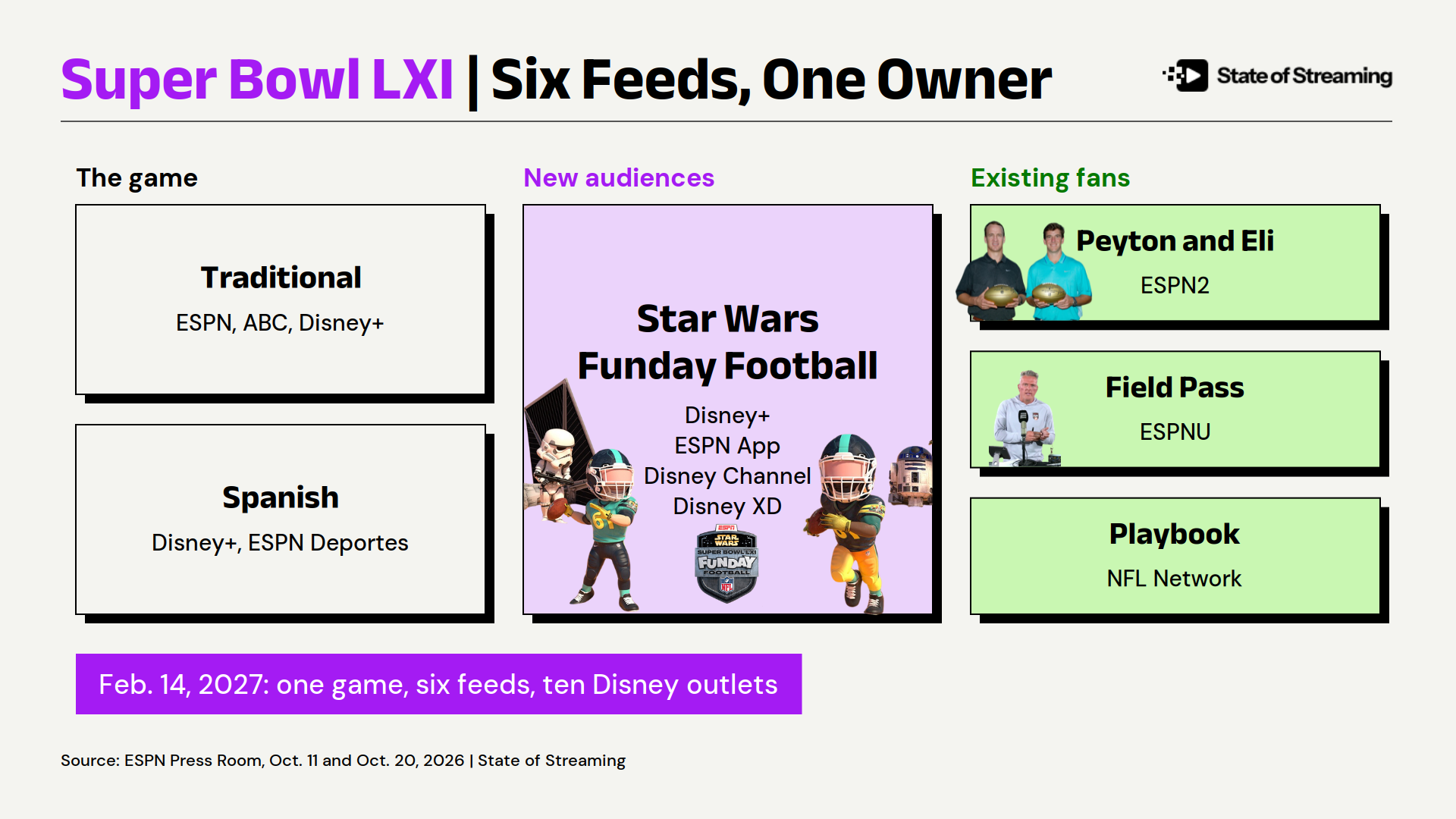
The feeds serve two different goals:
Acquisition: Star Wars Funday Football runs on Disney+ and Disney's kids channels, reaching households that may not watch ESPN.
Retention and engagement: Peyton and Eli, Field Pass and Playbook give existing football fans more ways to watch, and more minutes to spend.
All ten outlets belong to one company. Disney took about 14% of NFL ad revenue last season: 12% for Disney itself and 2% for NFL Network, which ESPN acquired in February 2026 (Guideline via MediaPost). Univision carries a separate Spanish-language broadcast outside the Disney lineup.
Putting it into practice
Because live and shoulder inventory carry such different prices, the most useful habit is to look at them separately.
For media buyers
Ask for live and shoulder impressions as separate line items, in the insertion order and in post-campaign reports.
Compare apples to apples. A blended eCPM mixes two products.
Consider buying live units upfront. On Fox's Sunday afternoon window, scatter ran about 21% higher than upfront.
For multi-feed events (like Super Bowl LXI) confirm which feeds the buy covers and how each is reported.
For sellers and rights holders
Shoulder can be priced and packaged as its own product, or bundled with live. Reporting them separately helps buyers see the value of each.
Licensing owned formats, like The Fan Zone, is an alternative to producing every shoulder hour in-house.
For producers
Shows built around the game, rather than on game rights, can be licensed to rights holders that have more hours to fill than games: international rights holders, Game Pass products and team apps.
Dates to follow: the January 2027 playoffs, Super Bowl LXI on February 14, 2027, and the NFL's 2029 opt-out, which sets the next rights cycle.
Sources
Shawne Merriman on LinkedIn — The Fan Zone on DAZN NFL Game Pass
Business Wire, Sept. 2024 — The Ultimate Fan Zone launch at SoFi Stadium
DAZN Game Pass subscriber growth — 23% paid subscriber increase in 2024
EMARKETER's "US Football Advertising 2026" Report
ESPN Press Room, Oct. 20, 2026 — Super Bowl LXI feeds and Star Wars Funday Football
TheWrap — ESPN's NFL Network acquisition closes
Get the SOS. Brief
The sharpest streaming intelligence, delivered to your inbox.