Starz Revenue Grows During Q3 As Streaming Offsets Linear Declines
Editor's Note
TheDesk.net on State of Streaming is a syndicated partnership featuring reporting by Matthew Keys — founder and editor of TheDesk.net, covering media technology, streaming platforms, and corporate entertainment finance. This report examines Starz’s third-quarter financial results: net losses narrowing to $34.8 million on $322.4 million in revenue, streaming gains (+1.7%) offsetting linear TV erosion, record Pay-1 viewership for Lionsgate's "Michael," and media mogul Byron Allen liquidating his entire 10.7% stake for a roughly $20 million net profit following Starz's adoption of a poison-pill defense.
Premium multiplex movie network Starz saw a narrower financial loss and modest revenue growth during the third quarter (Q3) of the year, according to regulatory filings that also showed one of its biggest shareholders sold their stake and abandoned a takeover offer..
During the three-month period that ended in September, Starz generated $322.4 million in revenue, an increase of 0.5 percent compared to the prior year. Its net loss narrowed to $34.8 million from $52.6 million, while the diluted loss per share was $2.02, compared to the $2.96 loss expected by Wall Street analysts.
Revenue from over-the-top streaming services increased 1.7 percent to $226.6 million from $222.8 million. In a statement, Starz Chief Financial Officer Scott Macdonald said streaming revenue would have increased 3.2 percent after accounting for changes to the company’s Canadian business, which shifted to a content licensing arrangement late last year.
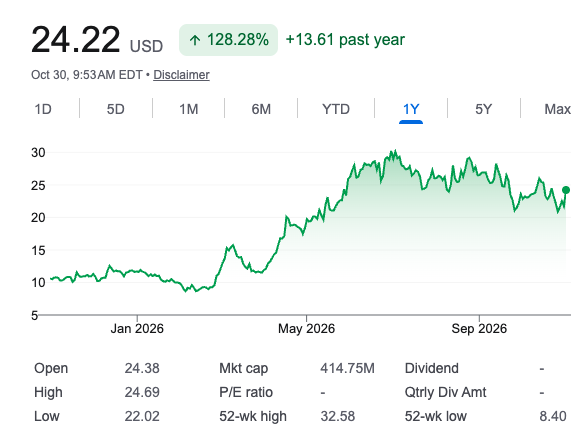
Revenue from traditional television distribution and other operations declined to $95.8 million from $98.1 million, although the company benefited from additional distribution revenue associated with “Fightland,” its first wholly owned original series.
Starz also reported strong viewership for the Lionsgate film “Michael,” which debuted on the service August 10 and became the most successful Pay 1 movie release in the network’s history.
In regulatory filings with the U.S. Securities and Exchange Commission (SEC), Starz said media mogul Byron Allen liquidated his entire 10.7 percent ownership stake in Starz between early August and late September. The valuation of Allen’s original buy was around $25 million; the sale netted him $45 million, suggesting a net profit of around $20 million.
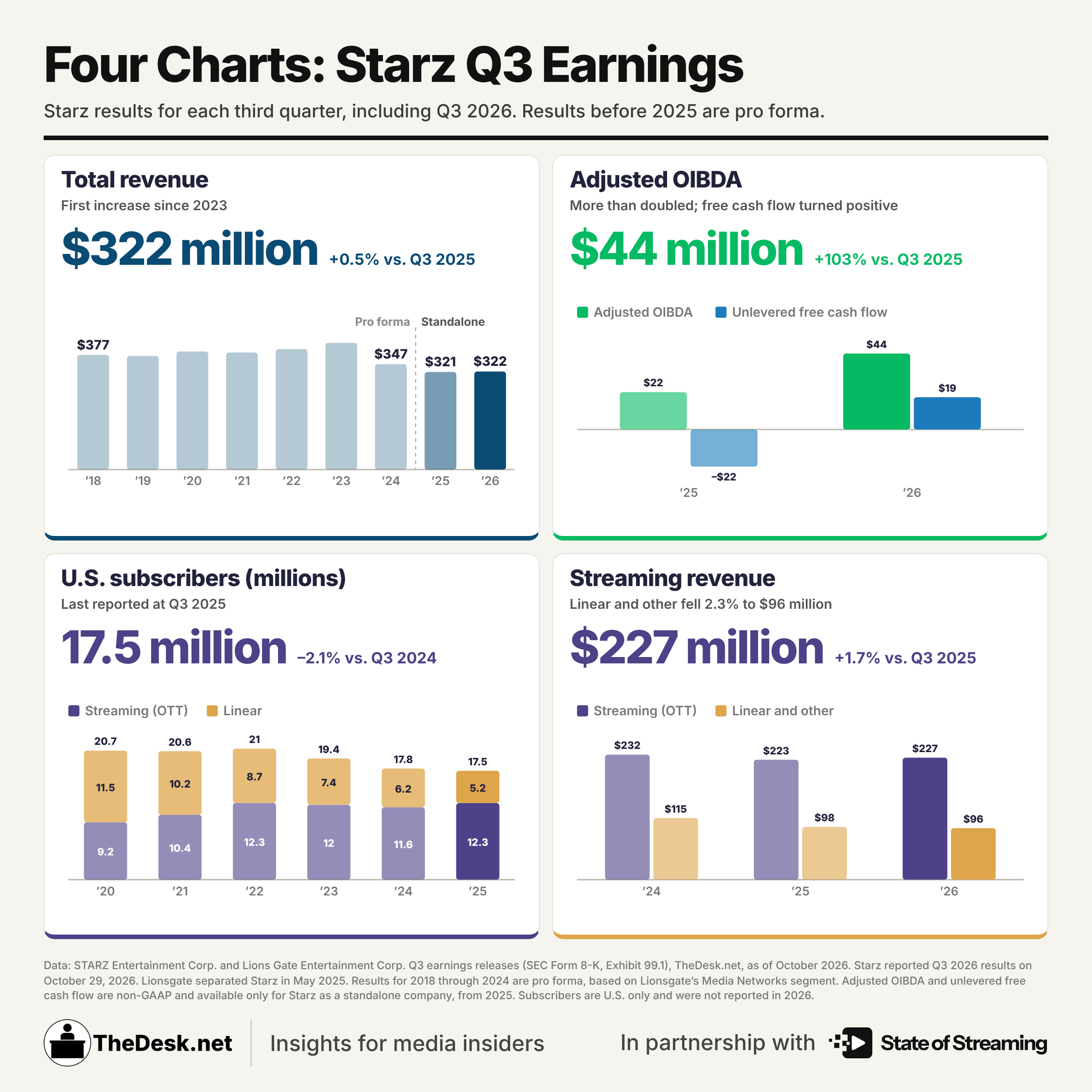
(Infographic by Matthew Keys for The Desk and State of Streaming. Note: Infographic uses pro forma data reported by Lionsgate prior to the Starz spin-off.)
Allen acquired around 1.8 million shares in March, telling reporters he was interested in making a play for the entire company. Starz subsequently adopted a so-called “poison pill” that would have diluted his holdings and voting power if he increased his stake in the company or made a hostile takeover offer.
In an earlier interview with trade publication The Wrap, Allen said the defensive measure would not prevent him from pursuing an acquisition.
“When I’m ready to buy the company, I will buy the entire company,” Allen said at the time.
His decision to sell the shares ends his disclosed ownership position, although the filing did not indicate whether he has abandoned his previous acquisition ambitions.
On Thursday, Starz President and CEO Jeffrey Hirsch said the company’s business strategy remains focused on expanding content ownership, strengthening its existing distribution partnerships and reaching subscribers through traditional television providers, standalone streaming subscriptions and bundled services.
Hirsch also indicated that Starz would remain selective about potential corporate transactions, saying any deal would need to deliver greater value than the company could generate independently.
Starz separated from Lionsgate in mid-2025.
Why Subscribe
Because the survival of mid-tier, independent premium streaming services depends on mastering wholesale bundling, Pay-1 window monetization, and balance-sheet defenses.
State of Streaming and TheDesk.net unpack how standalone platforms navigate linear erosion, fend off activist takeovers, and protect content margins in a consolidated media world. If you manage content distribution, negotiate carriage agreements, or track streaming M&A, this is where the industry's real leverage points get unbundled.
ADDITIONAL RESOURCES:
Starz Q3 2026 Press Release:
https://investors.starz.com/static-files/8ccabf1a-1ff6-4bac-9b95-cedf97e7c0ad
Starz Q3 2026 Trending Schedule:
https://investors.starz.com/static-files/5699f28b-a609-491c-a20c-b222d7c2780a
Starz 2026 Proxy Statement:
https://investors.starz.com/static-files/48e6c002-126f-45c1-a583-7186083dee38
Get the SOS. Brief
The sharpest streaming intelligence, delivered to your inbox.