Why Outcomes Matter More Than Dashboards: An Interview with Josh Hudgins, CPO @ VideoAmp
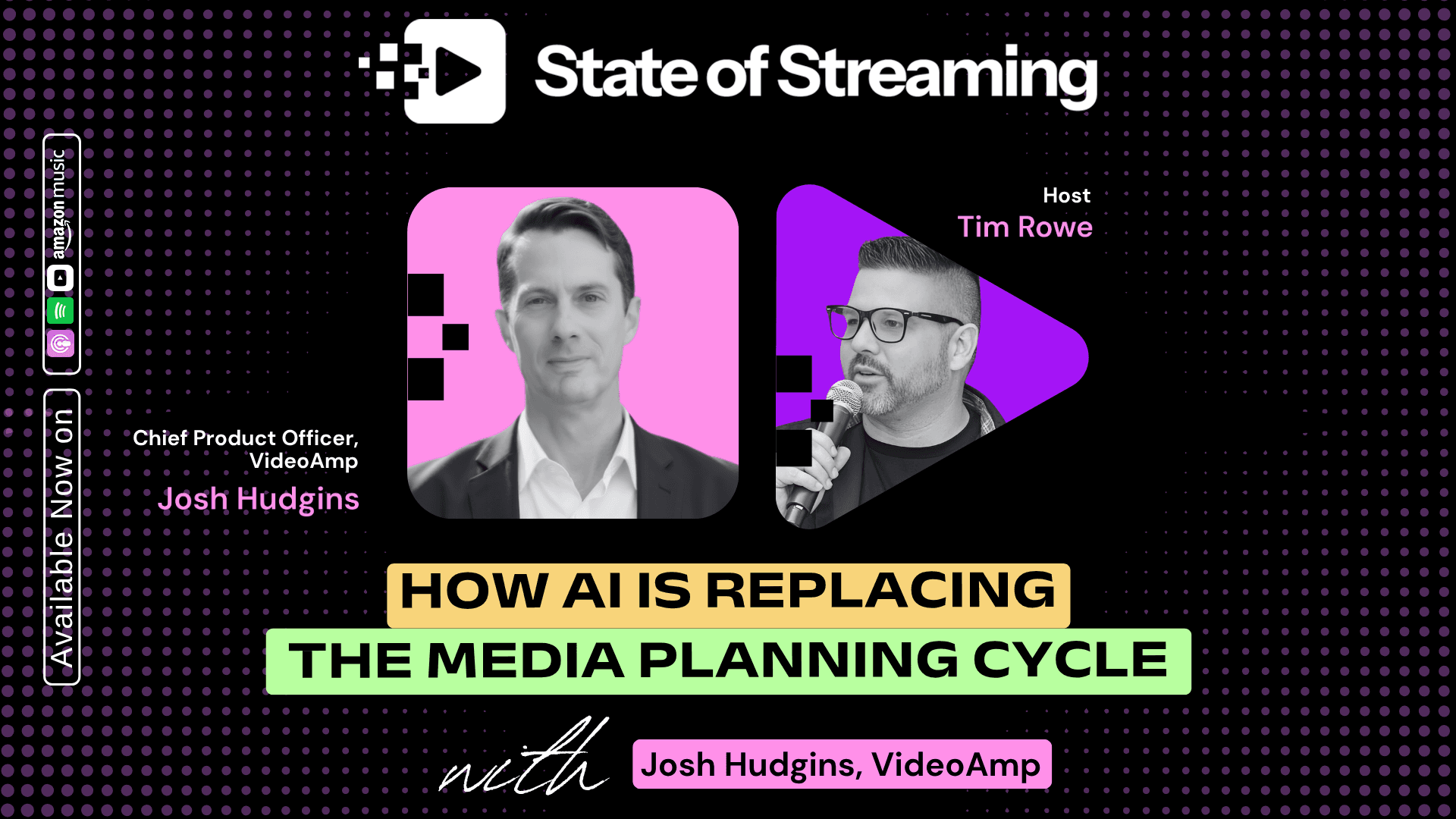
"People are drowning in information. We want to help them distill it down into the insights that they really need to do their jobs more effectively." — Josh Hudgins
In this conversation, we sat down with Josh Hudgins, Chief Product Officer at VideoAmp. Josh unpacks how the VideoAmp performance media platform connects ad exposure directly to real-world outcomes like store visits and purchases. We discuss how AI acts as a semantic layer to reinvent reporting and media planning, why agent-to-agent architectures are replacing brittle API integrations, and how granular viewership signals can inform supply-chain logistics.
What VideoAmp Is Built to Solve
Tim Rowe: We were chatting a little bit about "AI native," which feels like a buzzword, but you're doing interesting work as it relates to performance media. Who is VideoAmp, what problem do you solve, and who do you solve it for?
Josh Hudgins: VideoAmp is primarily a performance media platform. What we do is help folks both on the buy side and the sell side understand, plan, optimize, and run media in a way that demonstrably drives outcomes in the real world. If you're running media somewhere, ultimately what you want to understand is how much change or impact does that media drive. That’s fundamentally our focus: helping everyone understand the connections between consumption of ads and content and then what actually happens in the real world. Do they buy products? Do they go to stores? Do they search for things? That loop helps people make advertising more effective.
Tim Rowe: You use the keyword there demonstrably—the ability to demonstrate that this is closing the loop. How do you do that?
Josh Hudgins: From the very beginning at VideoAmp, we've been about large data assets. Rather than trying to run these things out of different panels and small-scale data assets, we started from a foundation of first building an enormous linear data asset by combining data from set-top boxes and smart TVs to understand linear viewership.
Over time, we've added streaming data assets to that by working directly with streaming platforms and publishers to get log-level information. We use clean rooms to preserve privacy, complementing our original linear data asset with these large-scale streaming data assets. So we can understand deduplicated viewership across all platforms at the household level. Now what we've been investing in is linking that at the household level all the way through to outcomes—whether purchase information, store visits, or subscriber signups—helping people understand in a deterministic, deduplicated way the effects seeing an ad is having in the real world.
Tim Rowe: So much conversation is about reaching an incrementally new or unique audience. Am I delivering strictly inside streaming, linear, or all things video?
Josh Hudgins: If you're an advertiser, you're trying to figure out how to reach people who will do the thing you're trying to accomplish. We've been at the forefront of understanding advertising not in historical age and gender demo buckets, but measuring discrete, purpose-built audiences and figuring out where you can uniquely and efficiently find them. Ultimately this starts to look like a media planning problem across all of these different platforms to drive the outcomes you want.
One Workflow From Plan to Performance
Tim Rowe: When we think about that applied to the media planning workflow, where does VideoAmp layer in?
Josh Hudgins: That's why we've started to talk about VideoAmp more as a performance media platform as opposed to planning or measurement. Historically, we've had a planning solution and we do a lot of measurement. But increasingly, people want to connect all of these things in an integrated workflow.
You build this ambitious plan, execute it, pace it as it runs, understand if it's doing what you wanted, optimize against it where you can, and ultimately measure how well you accomplished your objectives. The big focus for us has been connecting all of those pieces so you can drive advertising campaigns end to end across planning, optimization, and performance measurement.
AI Reporting That Surfaces Real Insights
Tim Rowe: Let's go to the AI piece. How is VideoAmp using AI?
Josh Hudgins: We just launched a product that is going to reinvent how you do performance reporting. Today, you are inundated with measurement data from tools that give you complex dashboards. Your challenge is not getting data; it's making sense out of the picture and finding the insights you need to improve or optimize going forward.
We’ve built a new reporting experience where, instead of monolithic dashboards with visualization after visualization, an interactive experience tells you what's important: what performed well, what didn't, and invites you into a dialogue about how to understand what's happening.
Tim Rowe: What does the data start to reveal when you're applying that?
Josh Hudgins: Once you combine granular audience information, you can report performance at the creative level all the way through to outcomes. We built a semantic layer across all of these things that allows LLMs to understand what's happening at an atomic level without it actually being the creator of the numbers. We still apply our rigorous measurement methodologies that make us a currency provider. What the AI does is interpret the data, separate noise from signal, and point you in directions.
Where we're going in the future is you'll be able to follow that AI journey through into: "Now create me a media plan based on this set of learnings." You're orchestrating that workflow agentically through AI, removing the manual labor of shipping spreadsheets around and pulling data from six different measurement and BI vendors.
Faster Learning Through Midflight Optimization
Tim Rowe: What you're describing sounds like a paradigm shift. How fast can we go, how smart can we be, how well can we execute?
Josh Hudgins: It's really going to accelerate the cycle. If you think about running in quarterly or annual cycles out to media mix models, you're compressing the speed at which you learn and respond. As an advertiser, you can constantly adjust in almost real time. We're working on that with several publishers where mid-flight optimization occurring through to outcomes can be acted upon in near real time.
When Media Signals Shape Supply Chains
Tim Rowe: Could this intimate understanding inform supply chain planning for an advertiser, like an automotive OEM?
Josh Hudgins: That's where it gets really interesting. Auto has a famously long sales cycle that takes months between seeing an ad, visiting dealerships, researching online, and test driving. With what we're doing, linking media exposure to upper and lower funnel signals, we can see in real time: did it drive dealership visits? Is it driving site search on auto research sites?
You can connect that back to media exposure and optimize weekly. What signals are going to flow back into what we need for supply chains and inventory? That's the new frontier—signals you need to logistically run your business, resulting in a lot less guesswork.
Agent-to-Agent Integrations Take Off
Tim Rowe: What are you most excited about looking ahead?
Josh Hudgins: Watching how AI tools are transforming how systems integrate. Agencies, holdcos, streaming platforms, and traditional media companies are thinking about integrating workflows with agent-to-agent integrations. In the past, you built brittle, highly structured API integrations that took a long time to build and were an ordeal to change.
Now, different entities have their own agents making inventory available or buying inventory, and their agents talk to our platform via our agents. You can hook these up in a matter of weeks and unlock new use cases at lightning speed.
Tim Rowe: It sounds like more time to be human, less time filling out spreadsheets or replying to emails.
Josh Hudgins: That's exactly how this looks to me. It lets us dive further into the human part of the experience: focusing on what content is engaging, what creative or brand positioning resonates, and taking out the busy work of blocking, tackling, and targeting. Nobody wants to just email spreadsheets around all day. We want to deal in what drives connection.
Want to watch or listen to the entire conversation?
Get the SOS. Brief
The sharpest streaming intelligence, delivered to your inbox.