The Middle Class of Sports Is Struggling — Does It Have a Path Forward? | A Column by Russell Fink

Every week brings another story about the fragmentation of sports. Games are aired across broadcast television, cable, streaming, and countless digital platforms. It has not just become a source of fan frustration but even the government has started to get involved with a current proposal to counteract this trend with a June 2026 House Judiciary Committee report arguing that “for consumers to watch broadcast NFL games, they must navigate a complicated and expensive web of television agreements and rules.” Following my favorite teams is no longer as simple as just turning on the TV anymore. Watching the New York Jets can require nine different platforms and more than $600 a year. And my New York Mets and New York Knicks aren't far behind.
It's an understandable concern. But I don't think fragmentation is the enemy or the problem. I think it is a symptom. The real issue is that attention, not distribution, has become a much more valuable and scarcer asset. We're stuck in the economics of sports rights and distribution when the conversation should really evolve to the economics of attention.
The biggest sports properties continue to thrive. The NFL continues to dominate television, with the 2026 Super Bowl drawing nearly 125 million viewers, making it the second most-watched broadcast in U.S. history. The NBA Finals averaged 20.6 million viewers, its most-watched Finals since 1998, and the FIFA World Cup is also surging, with the U.S. men's match against Belgium becoming the most-watched soccer broadcast in U.S. history, drawing more than 30 million viewers.
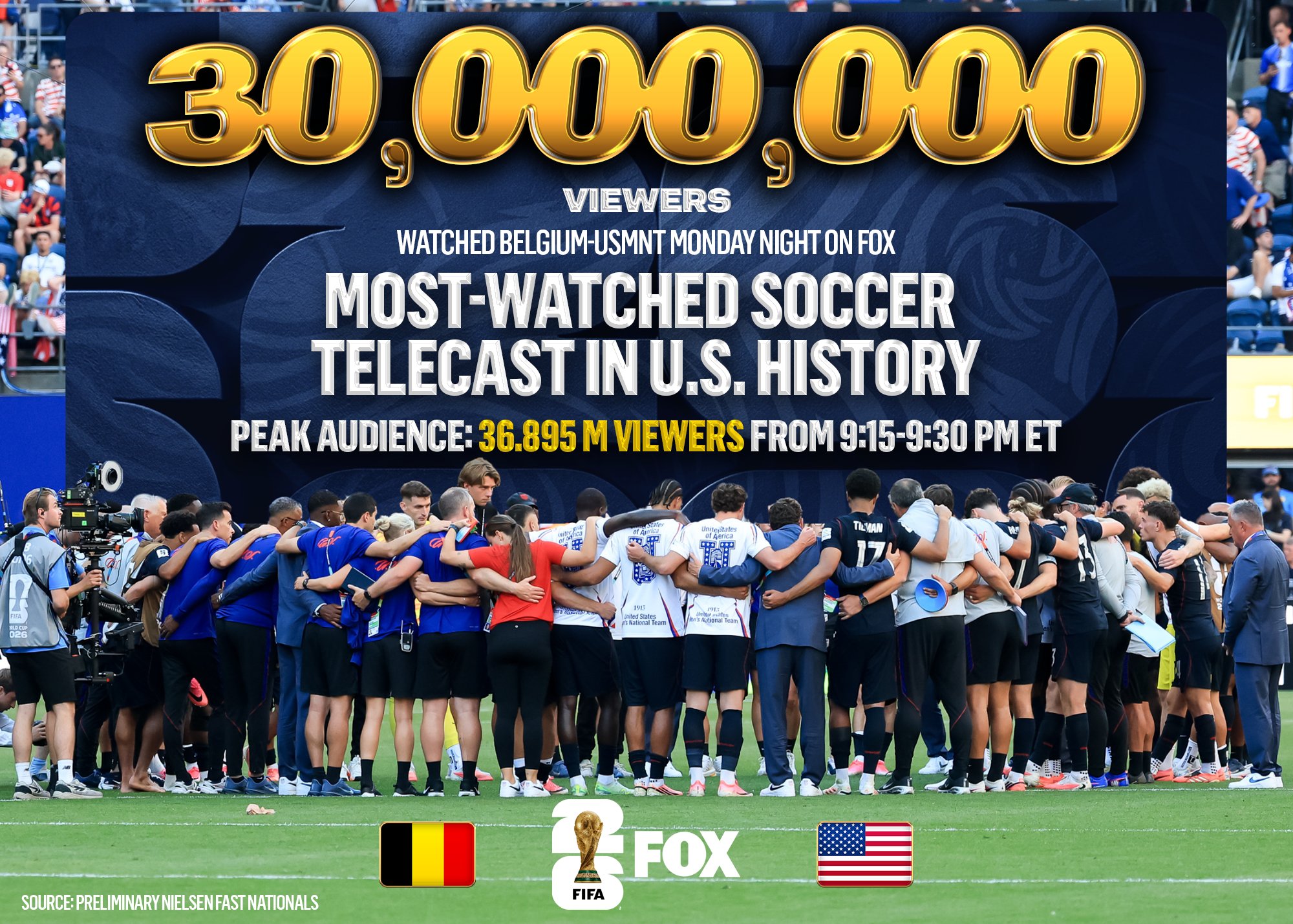
(Image credit: FOX Sports)
Defining the "Middle Class"
Meanwhile, there's another group of sports, the middle class, that's having a much harder time proving its value. At first glance, it looks like fans are simply losing interest. I'm not convinced that's true.
This middle class includes the leagues, teams, conferences, and properties that have the loyal and passionate fan base, but they don’t have the NFL-like attention. They are too big to be called niche but not big enough to dominate.
My son is 14 and loves the Knicks. But you'd never hear him say, "I watched the Knicks game last night." As part of Gen Alpha, the generation born after 2010, he is part of the first generation that is interconnected with technology. Social media, smartphones, streaming, and even AI are part of their framework rather than newer innovations. He tells me about a dunk he saw on TikTok, an Instagram debate about whether Jalen Brunson is really a 1A player (spoiler alert - he is), clips from Madison Square Garden on Snapchat, or a YouTube breakdown before breakfast. He's consuming Knicks content all day. It’s just not in the same way that my generation did.
The Fight for Attention
Never before have sports had more competition for our time. We have more ways than ever to prove value, yet it has never been harder for sports properties to prove they're valuable. They are competing against TikTok, YouTube, Netflix, creators, gaming, podcasts, social media, and an endless stream of personalized content. Every minute of every day is a fight for attention.
For years, our industry has rewarded scale. Average audience, ratings, reach — those metrics still matter. But many sports don't create value through massive one-night audiences. Even Nielsen Media Research is making updates to the measurement of sports for an incredible third time in under two years (from changes to out-of-home measurements, Big Data, and now expanded Co-Viewing).
Today we can measure cross-platform engagement, streaming, social conversation, and other metrics that didn't exist a decade ago. Maybe the answer isn't trying to make every sport look like the NFL. The middle class of sports can’t work that way and has to fight for time and attention every single day.
We need to stop measuring everyone the same way. Different sports should prove different value propositions. The middle class isn't disappearing because fans don't care. The qualities like loyalty, passion, communities, and engagement are much harder to measure and far too often, they're discounted. And maybe the biggest challenge facing the middle class of sports isn't fragmentation. It's that the next generation has less disposable income, more entertainment choices than any generation before it, and no loyalty to how previous generations consumed sports.
Here's the Path Forward for the Middle Class
Rights still matter. They'll always matter. But too much of the industry is still trying to monetize fandom before it's earned. If your business model depends on asking a 22-year-old to buy another subscription, you've probably already lost.
That's why the future of the middle class of sports won't be determined by who can imitate the biggest leagues. It'll be about winning the most attention and eventually turning that attention into fandom. Gen Alpha consumes differently but still loves sports. They won’t be the deciders on whether sports wins, but they will decide what sports winning looks like. The leagues and teams that become part of someone's daily routine, not just their game-day schedule, will build the next generation of fans.
That's the path forward. The middle class of sports doesn't need to become the NFL. It needs to become indispensable in fans' daily lives through highlights, creators, communities, and experiences that extend far beyond game day. The winners won't necessarily be the leagues with the biggest audiences, they'll be the ones that consistently earn attention and convert it into lifelong fandom.
The middle class isn't disappearing. It's being asked to compete under rules that were built for someone else.
See More From Russell Fink Here:
Too Much of a Good Thing? Sports’ Measurement Problem
Sports Has a Measurement Problem. Russell Fink Has Been Living It for Two Decades.
Get the SOS. Brief
The sharpest streaming intelligence, delivered to your inbox.