How Amy Scheer Turned A Career in Sports Into the Fastest League Launch in Decades

Amy Scheer cried at ten PWHL games during its inaugural season. She says she's not embarrassed about it and she shouldn't be. The league she helped build had no team names when she arrived. By the end of its inaugural season, it had 40+ corporate partners and had already hit Year 4 of its financial plan.
But the thing about Scheer that most coverage misses is that the PWHL isn't an outlier in her career. Every job she's held has been some version of the same assignment: take something undersized, underloved, or not yet built, and make it commercially viable without losing the fans who showed up first. No pressure.
The Full Stack
Scheer graduated from UMass Amherst's sports management program in 1986 and walked into the New Jersey Nets as a content producer. For 15 years she built the franchise's media infrastructure from the inside: two New York Emmy-winning TV shows, a team magazine called InnerNets, a youth radio program, and a game-day publication. She learned what fans respond to before she ever had to sell them anything.
That matters. Most sports executives start in sales or sponsorship and learn content later (or never). Scheer started in content and learned sales later. By the time she joined the WNBA's New York Liberty in 2001, she understood both what made people care and what made them buy. The result? Ticket sales up 130%, renewals above 80%, and a decade of league-leading attendance and marketing partnerships.
She also staged basketball's first outdoor regular-season game at Arthur Ashe Stadium in 2008 and produced six Liberty games at Radio City Music Hall. Events that sound like PR stunts but were actually distribution experiments — putting a product in front of audiences who would never walk into Madison Square Garden on their own.
The PWHL's Takeover Tour, where 80% of attendees are first-time viewers, is the same play. She's been running it for 25 years.

The Lateral Moves That Weren't
On paper, Scheer's career looks like this: (NBA) to Liberty (WNBA) to NYCFC (MLS) to Red Bulls (MLS) to a consulting firm she founded to the Connecticut Whale (PHF) to the Connecticut Sun (WNBA) to the NFL league office to the PWHL. Six leagues. Nine organizations. No linear climb up a single corporate ladder.
Each move added a different operational layer. At NYCFC she learned what it takes to launch an expansion franchise inside an existing venue (Yankee Stadium). At the Red Bulls she ran revenue as Chief Commercial Officer — tickets, partnerships, youth programs. At the NFL she oversaw the league's Ticket Network across all 32 clubs and partnered with the Kraft Analytics Group on fan experience initiatives. Each role deposited a different skill into the same account.
The consulting years between 2018 and 2021 are the most underrated. Through her firm Game Ready, Scheer wrote business plans for Rugby United New York, the Connecticut Whale, Madison Square Garden properties, and the Connecticut Sun. She was essentially doing startup-stage sports operations at scale — multiple clients, multiple sports, all underbuilt. When Stan Kasten, the PWHL advisory board member and former Dodgers president, described her as someone who "knows how to build," he wasn't being generic. Amy Scheer has been building her entire career.
From the NFL to the PWHL
In late 2023, Scheer was at the NFL — the most commercially sophisticated sports league on the planet. She left for a women's hockey league that didn't have team names yet.
She joined November 1, two months before the first puck drop. That timeline alone tells you something about the operating speed. Within that window, she had to stand up sponsorship, media, marketing, communications, licensing, and event operations for a six-team league playing its first games in January 2024.
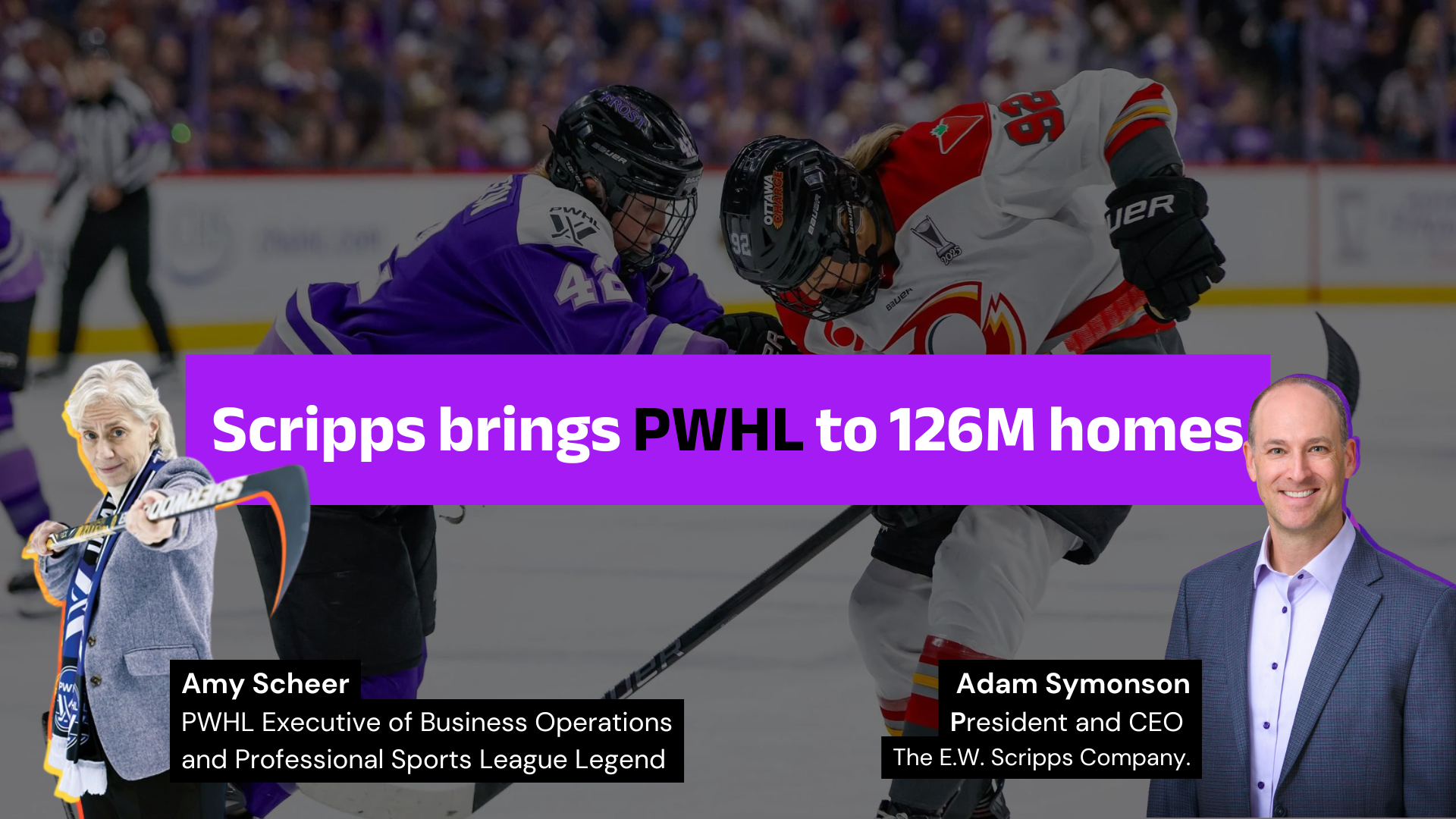
Three seasons later, the PWHL has expanded to eight teams, is approaching two million fans, has posted 20% year-over-year attendance growth, doubled merchandise sales, added 75-plus brand partners, sold out Madison Square Garden and TD Garden, and just secured its first national U.S. broadcast on ION through Scripps Sports — reaching 126 million households.
Scheer told CNBC Sport in December that if she were betting, the league would add four teams next season, expanding to twelve. She described a weighted evaluation model with roughly ten factors: arena quality, practice facilities, youth hockey market, women's sports community, NHL presence, government support, travel logistics, and partnership landscape. That's not a hunch. That's a franchise selection framework borrowed from the leagues she's already operated in.
The Playbook
Start with the audience, not the revenue model.
Scheer built content and fan experiences at the Nets for 15 years before she ever owned a P&L. "Understand the fan first, monetize second" — runs through every role.
Lateral moves compound.
Vertical promotions build depth. Lateral moves build range. Scheer's cross-league fluency is why she could stand up a hockey league in 60 days.
Consulting is a cheat code for builders.
The Game Ready years gave Scheer access to multiple startup-stage operations simultaneously. When the PWHL call came, she didn't have one playbook. She had five.
The best career move can look like a step backward.
Leaving the NFL for a league without team names requires a specific kind of confidence — the kind that comes when you've already done the hardest version of the job, albeit in a different sport.
Events are distribution.
From Radio City Music Hall to Arthur Ashe Stadium to the Takeover Tour, Scheer understands the tool of tentpole events as audience acquisition vehicles.
Scheer named one of her cats Billie before she'd ever met Billie Jean King, who now sits on the PWHL's advisory board.

Get the SOS. Brief
The sharpest streaming intelligence, delivered to your inbox.