The Viant Streaming Ad Stack: Context, Identity, Attention At The Household Level
Viant Technology is acquiring TVision Insights for $40 million. The deal closes this month. And if you listened to the State of Streaming podcast last fall, you already knew it was coming.
Not the acquisition specifically. The logic underneath it.
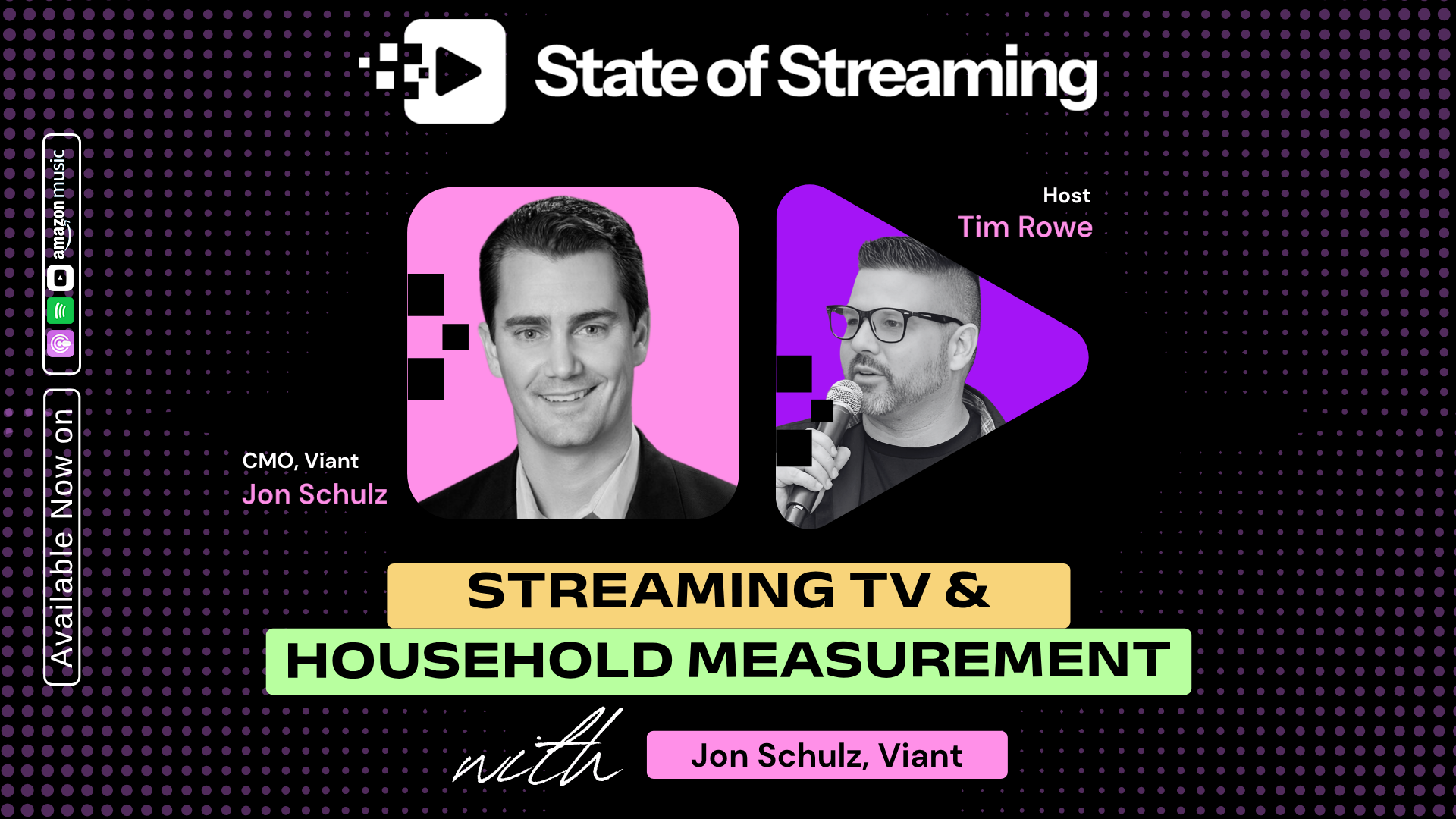
In October 2025, Viant Chief Marketing Officer Jon Schulz sat down with Tim Rowe to explain why streaming attention was systematically undervalued by the industry's existing measurement stack. He named co-viewing multipliers — two, three, four people per screen — as an undercounted signal that made the cost per thousand impressions (CPM) look expensive only because the denominator was wrong. He said branded search spikes follow connected television (CTV) ad exposures by minutes, not days, and that last-touch attribution was burying the evidence. He described watching live sports as "leaning in pretty hard" versus Shawshank Redemption running as background noise.
The problem Schulz identified wasn't creative or strategic. It was structural. The industry couldn't prove what it already knew to be true: that attention on streaming television, especially during live sports, was worth more than the price tag implied.
TVision measures attention. Second by second. Eyes on screen. Using computer vision and Automatic Content Recognition (ACR) technology across a nationally representative panel. It captures co-viewing behavior, in-room presence, and engagement levels across linear television, streaming platforms, and digital video. It is, operationally, the instrument Schulz described needing.
Viant paid $40 million for it — $22.5 million in cash, $17.5 million in Class A common stock.
The self-attribution problem has a name now.
Every advertising platform currently measures its own performance. YouTube measures YouTube. Amazon measures Amazon. Netflix, increasingly, measures Netflix. The data each platform produces is accurate in the narrow sense and useless in the comparative sense, because the methodology optimizes for the platform's own inventory.
Viant CEO Tim Vanderhook put it bluntly:
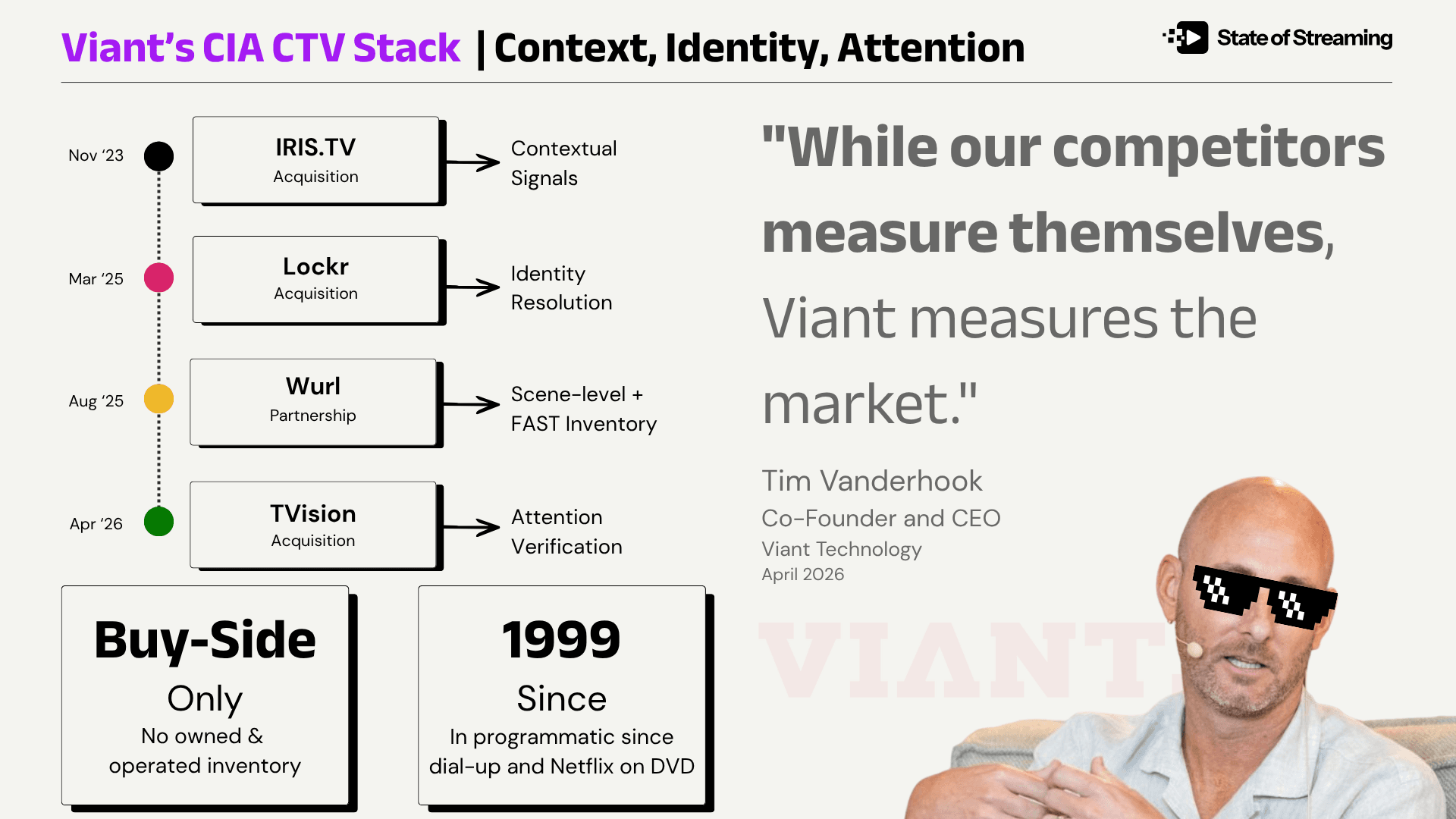
"While our competitors measure themselves, Viant measures the market."
Viant operates as a buy-side-only demand-side platform (DSP) — no owned inventory, no sell-side revenue, no algorithmic incentive to route spend toward its own supply. Schulz made that distinction explicit on the podcast: platforms with owned inventory use their DSP as a gateway to their supply, not as a neutral optimization engine. Viant's independence isn't a marketing claim. It's a business model constraint that makes independent measurement credible in a way it cannot be for a Google or an Amazon.
TVision inside Viant's stack is a different product than TVision as a standalone research vendor. As a standalone, TVision sold insights. Inside Viant, those insights close a loop: attention data informs planning, buying, optimization, and post-campaign measurement inside a single platform. The attention-adjusted CPM Vanderhook described — a metric that weights impressions by whether viewers actually watched — is now a live signal in the buying workflow versus a slide in a research deck.
What the Schulz conversation predicted.
Schulz described the measurement gap using the language of demand generation versus demand capture. Search, social, and retail media — roughly 70% of total ad spend by eMarketer estimates — capture demand that already exists. Last-touch attribution assigns credit to the capture event, not the generation event, which systematically underfunds CTV relative to its actual contribution to outcomes.
The TVision acquisition is Viant's answer to that attribution problem. With second-by-second attention data integrated into the buying stack, Viant can now show a buyer the full buyer's journey. From streaming ad exposure on a connected television, attention verification, to downstream search and purchase behavior. The attention-adjusted CPM becomes the connective tissue between the generation event and the capture event.
This matters most in live sports, where Schulz identified the highest-attention environment in television. The fragmentation of sports rights across Amazon Prime Video, Netflix, Peacock, Paramount Plus, and ESPN creates a cross-platform reach problem that Viant's direct access integrations were already designed to solve. TVision adds the attention verification layer on top of that reach management capability. A buyer can now manage frequency across Thursday Night Football on Amazon, Christmas Day games on Netflix, and Sunday Night Football on NBC — and verify, independently of any platform's self-reported numbers, that the ads were actually watched.
What happens next.
Viant's acquisition of IRIS.TV unlocked contextual targeting and integrations with Wurl added scene-level placement and free ad-supported streaming television (FAST) channel inventory. TVision completes a measurement stack that now runs from content context through identity resolution through attention verification. Each acquisition addressed a different point of failure in the streaming supply chain. The pattern is deliberate.
The question the industry should be asking is what an attention-adjusted CPM does to pricing power across the streaming ecosystem. If Viant can demonstrate that attention on live sports is two or three times higher than on on-demand content — which the TVision panel data is positioned to do — the CPM premium for live inventory becomes defensible against the CFO's spreadsheet in a way that "audiences are leaning in" never was.
Get the SOS. Brief
The sharpest streaming intelligence, delivered to your inbox.