QVC Files Chapter 11: The Evolution Of Shoppable TV
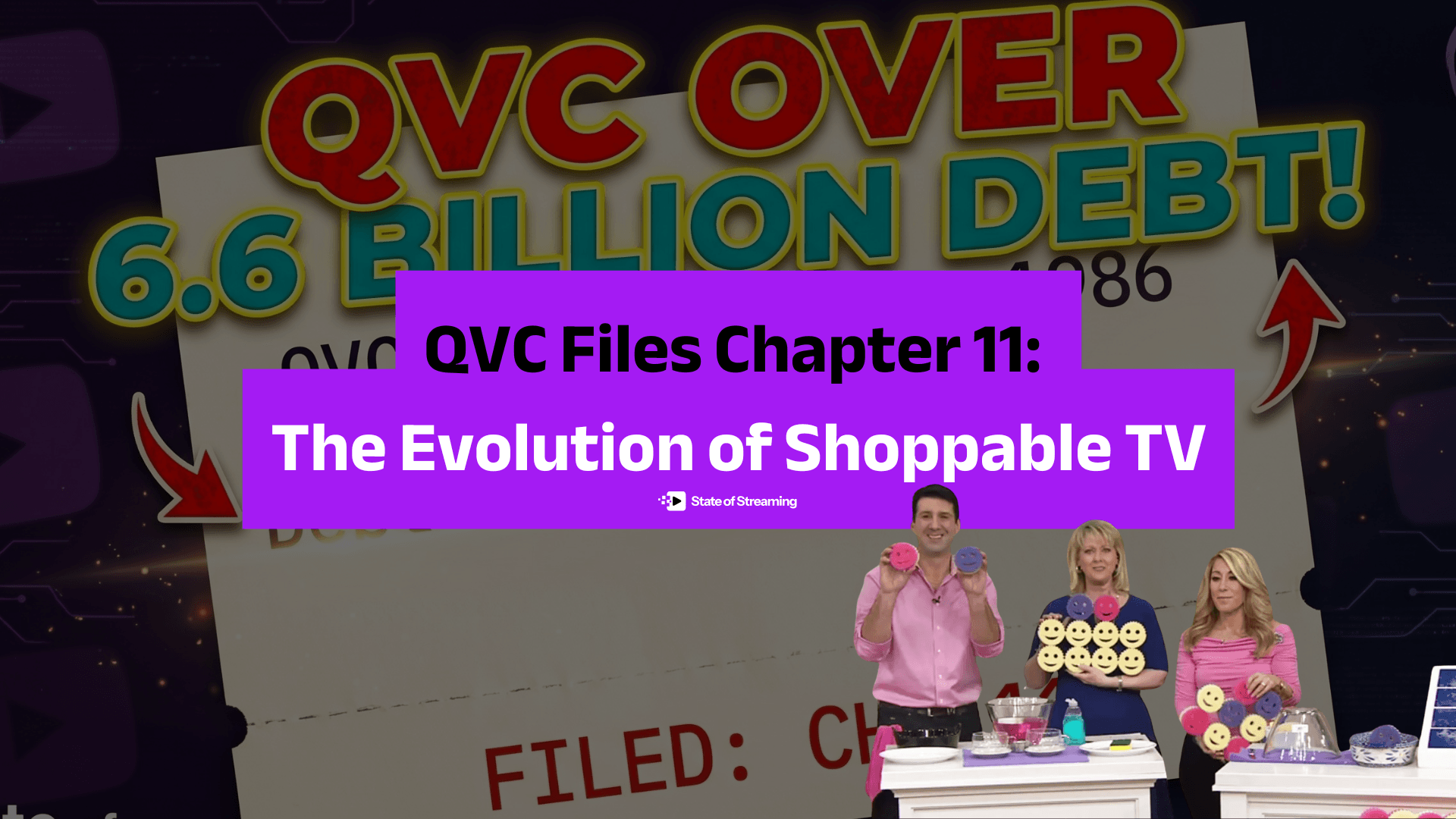
QVC Group filed for Chapter 11 bankruptcy protection this week, targeting emergence within 90 days under a restructuring plan that would cut its debt from $6.6 billion to $1.3 billion.
Two Different Businesses
QVC and HSN were always TV commerce. The product was transactions, the channel was the pipe and when the pipe started leaking viewers, the transactions went with them.
Daniel Thompson, co-founder of shoppable television platform Spincast, draws a distinction the industry has been blurring for years. "TV commerce is like walking through Costco and there's a demo going on — it's just on your TV," Thompson told State of Streaming in an exclusive interview.
"Shoppable TV is something different. It's removing the barriers between the audience and the message so that people can act on it."
As linear fractured and digital-everywhere emerged, TikTok Shop has successfully rebuilt the pipe around the purchase. Users show up for entertainment, stick around and end up buying — one session, no redirect, no 1-800 number, Apple Pay at checkout and two-day free shipping.
TikTok Shop By The Numbers
$15.1 billion in U.S. gross merchandise value (GMV) in 2025 — 68% year-over-year growth — with $64.3 billion globally
$5.4 billion of that driven by TikTok influencers alone
$33.2 billion in global GMV — more than tripling year-over-year
The Pickleball Pivot
A year ago, QVC Group laid off 900 staffers and pivoted toward live shopping on TikTok and other social platforms. It pursued pickleball broadcast rights as a content adjacency play. CEO David Rawlinson says QVC has since become a top seller on TikTok Shop U.S. None of it was enough to service $6.6 billion in debt accumulated over two decades of cable-era acquisitions.
The pivot worked tactically and failed structurally. Getting good at TikTok Shop is not the same as owning the stack TikTok Shop runs on.
The Test Every Streaming Platform Is About to Face
Thompson's diagnosis of why shoppable TV experiments consistently underperform applies beyond QVC. "The problem is only a small subset of the audience even knows it's happening," he said.
"For shoppable to really take off and drive consumer behavior change, it has to be part of the whole entire offering — available across all the shows and everything."
That is the standard no streaming platform has met. Roku's partnership with Shopify, Walmart's streaming commerce integrations, and Netflix's early shoppable experiments are all single-show tests dressed up as strategy. They generate press releases but they driving behavioral change is a different task entirely.
Amazon is the only platform that built in the opposite direction — starting with the transaction graph and adding video on top. That inversion is why Amazon's commerce-to-advertising closed loop compounds while everyone else runs overlay experiments in pursuit of progress.
What the Stack Actually Requires
QVC had 40 years and a captive cable audience to solve the friction problem. It built a business on top of the friction instead. Thompson's Spincast is betting that AI changes the calculus — that real-time content tagging and session-level bookmarking can finally deliver frictionless commerce inside entertainment, without requiring a live host selling cookware.
The technology is more credible than the QVC model. The distribution problem is the same one QVC never solved: shoppable has to be everywhere, or it doesn't change behavior anywhere.
QVC had 40 years to become the platform. It remained the channel. The streaming platforms now making overlay bets have less time than that to figure out which one they are.
Get the SOS. Brief
The sharpest streaming intelligence, delivered to your inbox.