NCAA Men's VS. Women's Basketball Conference Championship Viewership: A Comparative Analysis

March Madness is underway and if you're reading this analysis then you're likely tuning in, advertising during, or looking for a competitive advantage. If so, you're in the right place. This was prepared with Josh Matthews as a topping for your StreamScoop Sunday, enjoy. 🍨
For the power conferences (SEC, Big Ten, ACC, Big 12), the men's basketball conference championship game outdraws the women's game by roughly 3x to 5x. A few years ago that gap was much wider. So the trend is moving in the right direction, and the audiences are large enough that advertisers and networks should be building dedicated ad packages around them.
Insight 1: The Power-Conference Gap Is Narrowing
The four power conferences in women's basketball (SEC, Big Ten, ACC, Big 12) drew between 730K and 1.396M viewers for their championship games. Their men's counterparts drew between 2.6M and 4.7M. That's a 3x–5x multiplier at the top — meaningful, but far smaller than it was.
The "multiplier" is just the ratio of how many times larger the men's audience is compared to the women's audience for the same conference. "At the top" means the power conferences — the SEC, Big Ten, ACC, and Big 12.
So when the Big Ten men's championship draws 4.7M and the Big Ten women's championship draws 980K, you divide 4.7M by 980K and get roughly 4.8x. That's the multiplier. It means the men's game drew about 4.8 times as many viewers as the women's game in the same conference.
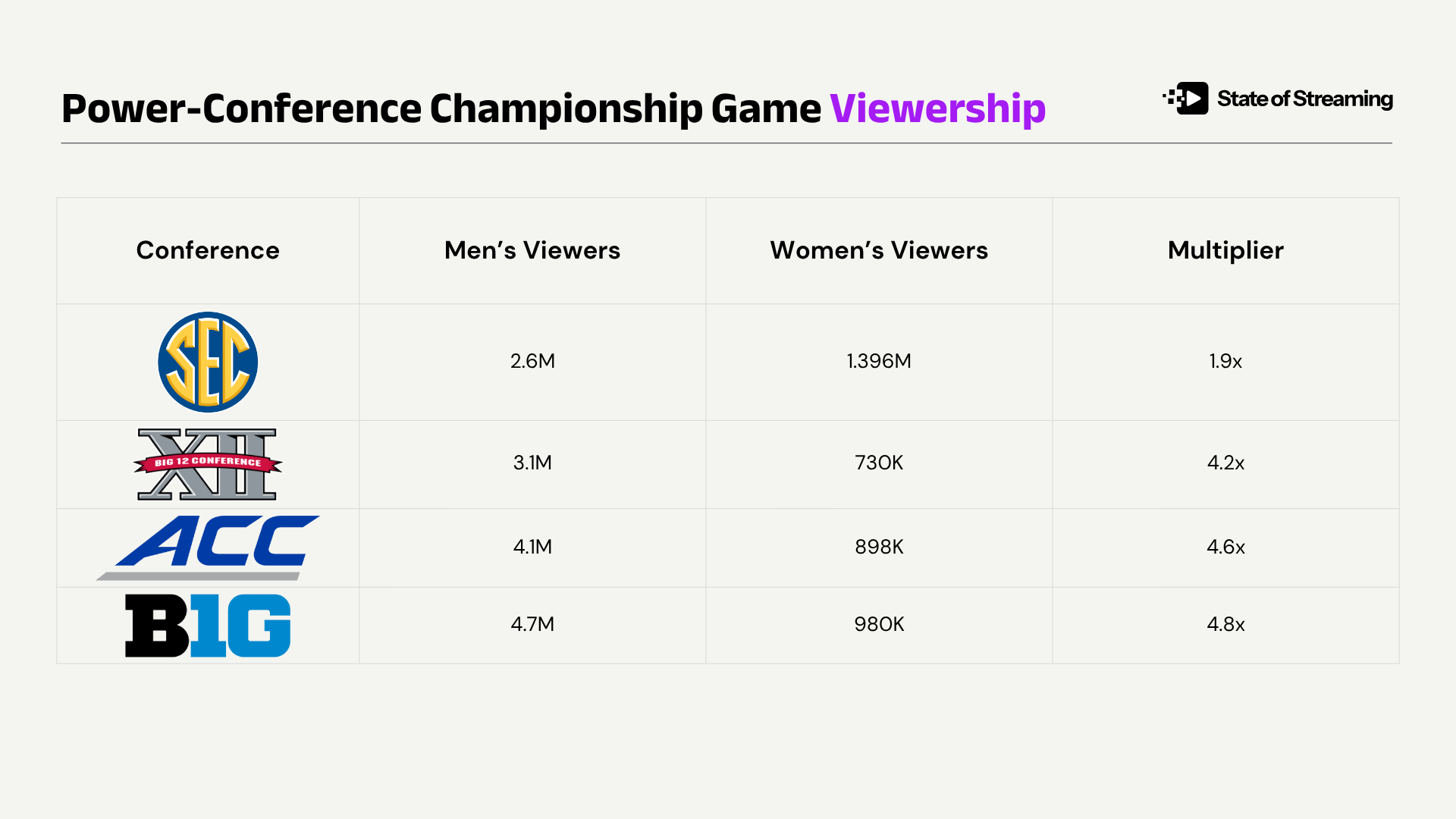
Across the four power conferences, that multiplier ranges from about 1.9x (SEC) to 4.8x (Big Ten). The phrase "3x–5x multiplier at the top" is summarizing that range. The point is that even though the men's game still outdraws the women's game, the gap at the power-conference level is small enough that the women's coverage is becoming a scaled commercial product in its own right. A 2x gap is a lot more manageable for ad pricing than a 10x or 20x gap, which is what you see further down the conference hierarchy.
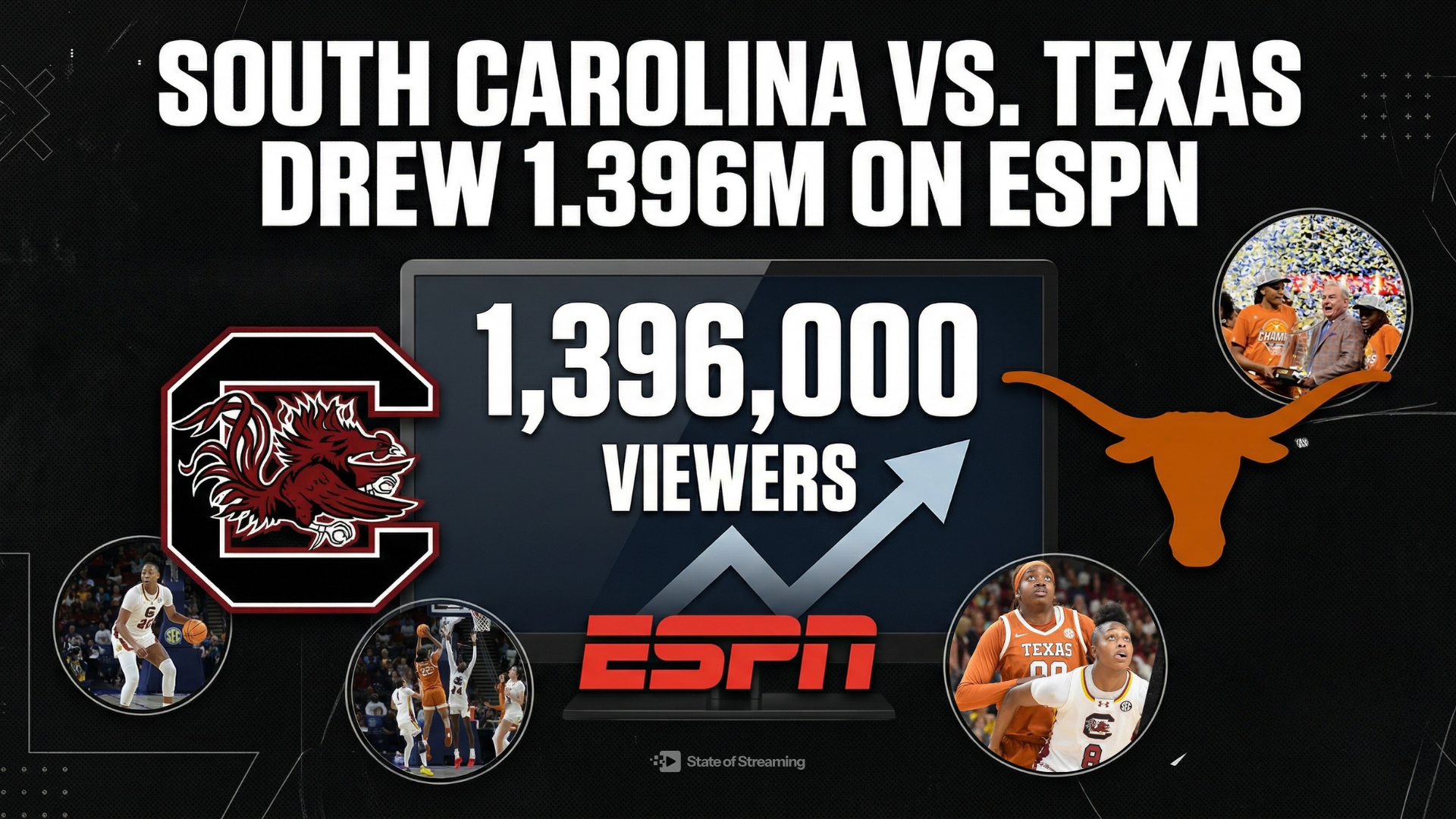
The SEC women's conference final remains the standout: South Carolina vs. Texas drew 1.396M on ESPN, lowering the multiplier to just 1.9x — the closest to parity of any conference in the dataset. That number is driven by program-specific gravity (South Carolina) rather than conference brand alone.
Insight 2: Women's Hoops Has a Top Tier but Missing the Middle
Men's basketball has nine conferences clearing 500K viewers. Women's has four — and then a cliff. After the Big 12 at 730K, the next women's basketball conference is Big South at 149K. That's a 5x drop with nothing in between.
On the men's side, the middle tier is deep and commercially viable: the American (1.236M), Atlantic 10 (1.19M), Missouri Valley (931K), West Coast (864K), and Southern (617K) all pull audiences that would rank in the top five on the women's side. This middle tier is where the bulk of men's basketball total ad inventory lives — and it has no equivalent in the women's coverage.
Men's basketball conferences above 500K: Big Ten, ACC, Big 12, SEC, Big East, Mountain West, American, Atlantic 10, West Coast — 9 total.
Women's basketball conferences above 500K: SEC, Big Ten, ACC, Big 12 — 4 total.
Insight 3: Network Placement Is a Structural Advantage
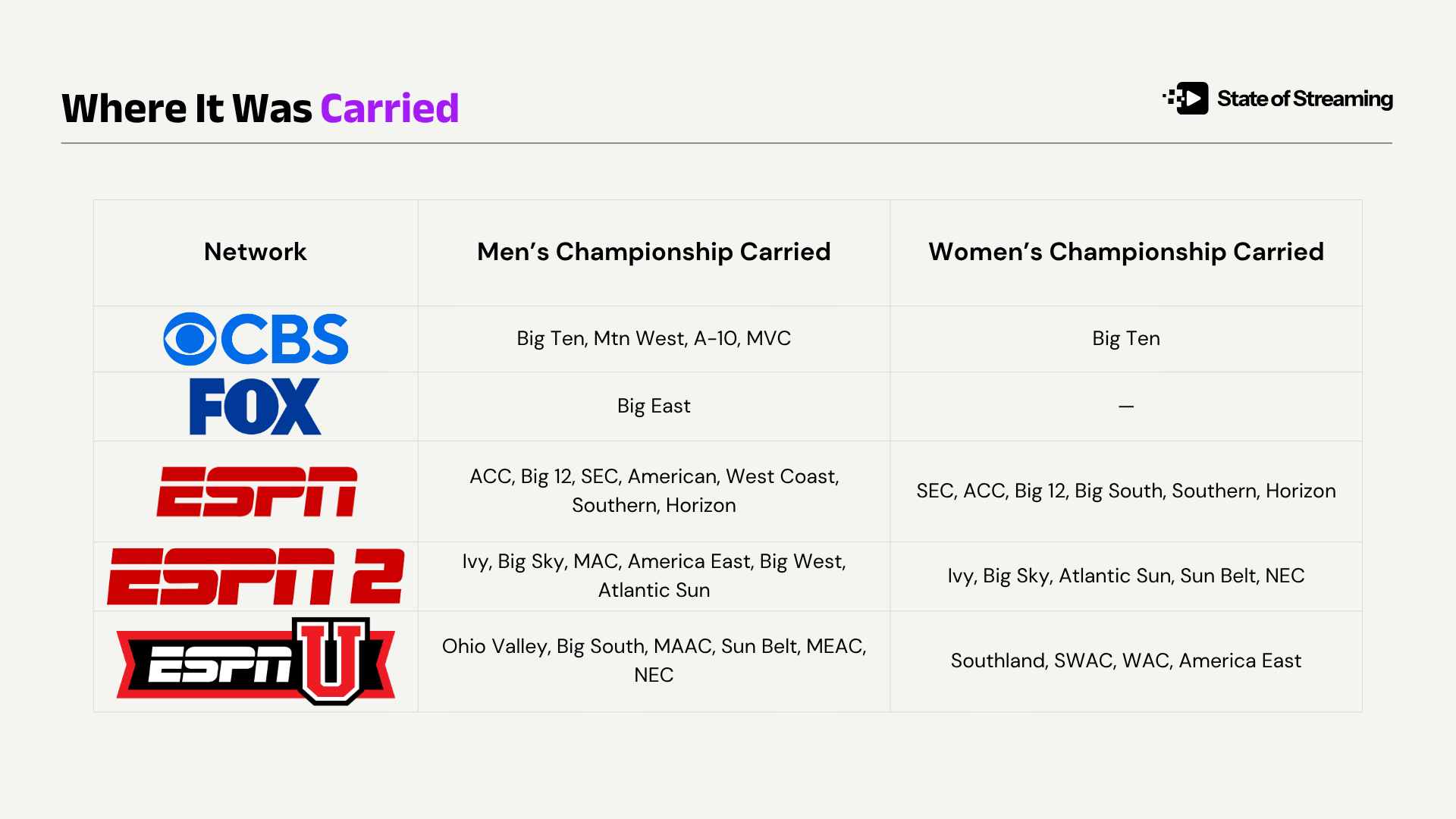
CBS consistently pulls stronger men's basketball numbers. Big Ten on CBS: 4.7M. Mountain West on CBS: 1.4M. Atlantic 10 on CBS: 1.19M. Missouri Valley on CBS: 931K. The Big East on FOX drew 1.8M. These networks offer broader household reach than ESPN's cable footprint.
Women's coverage, by contrast, is almost entirely on ESPN, ESPN2, and ESPNU. CBS carried only the Big Ten women's championship (980K). If the women's game wants to close the viewership gap further, broader network distribution — broadcast windows, not just cable placement — is likely part of the answer.
Insight 4: The SEC and Big Ten Have Flipped Positions Between Sports
Big Ten leads all of men's basketball at 4.7M (Michigan/Purdue on CBS). SEC leads women's basketball at 1.396M (South Carolina/Texas on ESPN).
South Carolina is doing for SEC women's basketball what the Big Ten's roster depth does for men's — functioning as the demand engine for the entire conference window. This is a story about star power and program identity driving viewership, which has implications for how conferences negotiate rights packages. A women's-specific carve-out anchored by South Carolina is a different product than a conference-wide bundle.
Insight 5: The Bottom of the Table Tells the Harder Truth
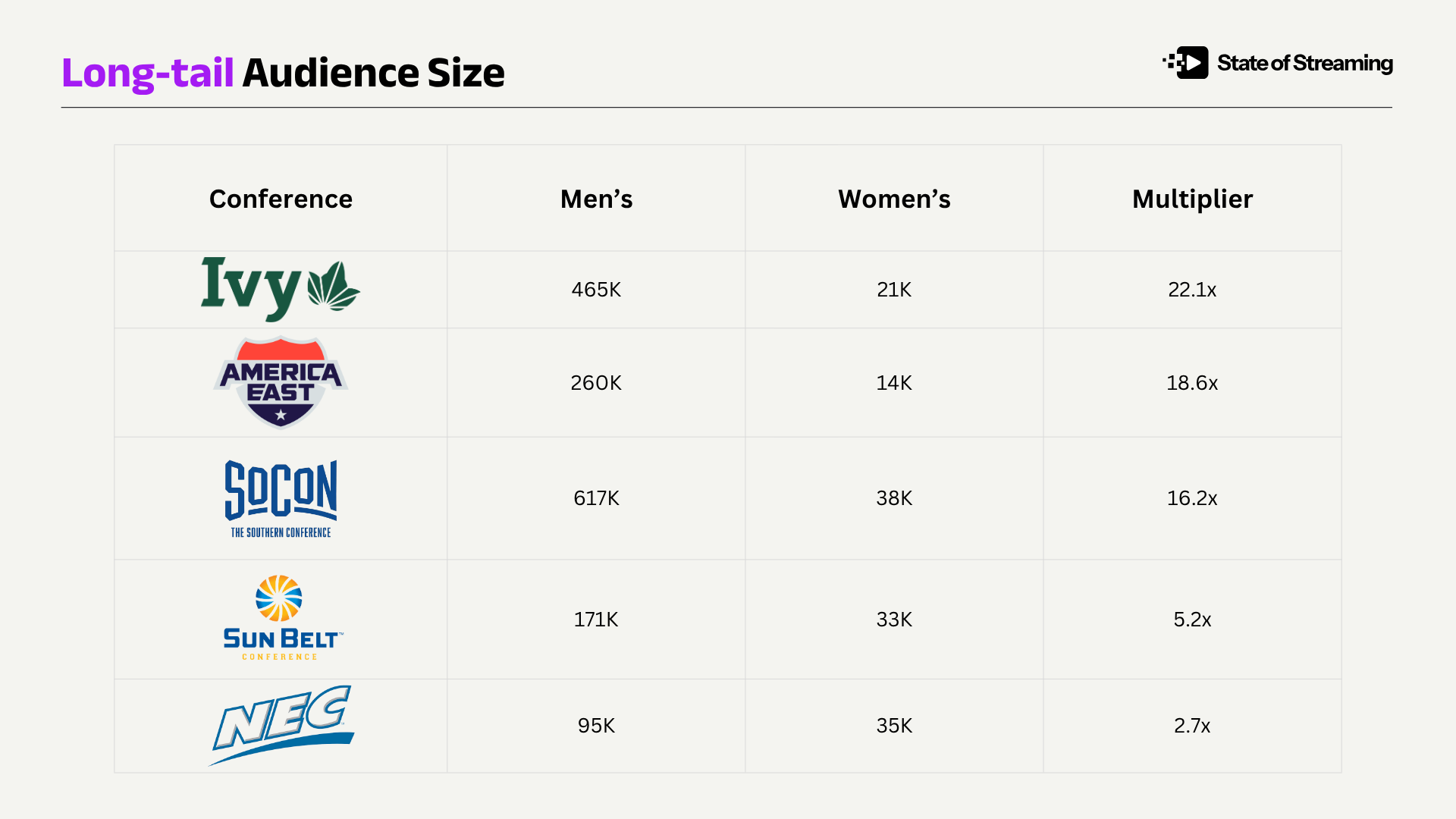
The bottom of the MBB table still outperforms the bottom of the WBB table by 5x–22x:
This is where the "women's sports is growing" narrative needs precision: it's growing at the top, meaningfully, but the base of the pyramid hasn't moved much. The audiences that show up for South Carolina and Iowa prove the interest exists. The question is whether networks will invest in mid-major women's programming the way they have in mid-major men's.
The Strategic Takeaway
The data supports three conclusions for anyone in ad sales, programming, or rights negotiations:
1. WBB's top four conferences are a real ad product. The SEC, Big Ten, ACC, and Big 12 women's championships command audiences between 730K and 1.396M. These are inventory numbers that justify dedicated packages and thinking strategically about creative and supporting activations.
2. The depth gap is a distribution problem, not a demand problem. Women's mid-major conferences are overwhelmingly placed on ESPN2 and ESPNU, which caps their ceiling. Men's mid-majors on CBS and FOX routinely clear 900K+. The question isn't whether mid-major women's college basketball audiences exist — it's whether or not someone is willing to put them on a bigger stage. (Pssst, Scripps)
3. The growth curve favors the women's game, but the timeline is longer. The SEC's 1.9x multiplier shows what's possible when a dominant program meets consistent investment. Replicating that across conferences requires the kind of scheduling and promotion commitments that networks haven't yet made outside the power four.
Get the SOS. Brief
The sharpest streaming intelligence, delivered to your inbox.