Every Dollar You Spend on Programmatic Advertising Has a Hidden Tax. Who's Collecting It?
For every dollar an advertiser spends in programmatic media, a significant portion never reaches a publisher. It gets extracted by the technology stack in between — the pipes, platforms, and cloud infrastructure that move the money from buyer to seller. Some of that extraction is visible. A lot of it isn't.
Last week I joined the partners at First Party Capital — a venture firm that invests specifically in ad tech and media infrastructure — to talk about where those hidden costs live, who's collecting them, and which companies are building the infrastructure to collapse them.
The REAL Tech Tax
Start here, because everything else connects to it.
Amazon, Google, and Microsoft are the dominant cloud infrastructure providers for the streaming and ad tech industry. Media companies run on AWS. Ad tech platforms run on AWS. The pipes that move programmatic dollars run on AWS.
Those same companies — Amazon, Google, Microsoft — are also three of the largest and fastest-growing advertising businesses in the world.
Ciarán O’Kane, General Partner at First Party Capital put it plainly:
"The hidden cloud taxes that Google, Microsoft, and Amazon heap on the industry — and then leverage to fuel their own ad businesses."
Here's what it looks like in practice. A startup ad tech vendor charges a media company $40,000 a month but the Chief Product Officer at said media company does the math.
"I know that $10K, $20K, maybe even $30K of that $40K monthly fee is basically paying Google or Amazon credits. I'd rather pay them $20K, tell them to containerize their software in my cloud, and then we're both winning."
The model is emerging in response. Software that lives inside a customer's existing cloud infrastructure rather than on separate servers. No pass-through cloud cost. No embedded tax flowing back to a platform that's also your competitor.
That's not a future scenario. It's already the architecture of several companies actively reshaping the market.
The Deal That Proves It
Last month, Bedrock — a newer, modular demand-side platform built for advertisers — announced it would run as a containerized application inside Index Exchange's cloud infrastructure.
In plain terms: the technology an advertiser uses to buy media now lives inside the technology a publisher uses to sell it. The separation is gone. And with it, the latency, the duplicated infrastructure cost, and the margin extracted to support two separate stacks.
For context: a demand-side platform (DSP) is what advertisers use to bid on ad impressions across the web and streaming. A supply-side platform (SSP) is what publishers and streaming services use to sell that inventory. Historically they communicate through a standardized auction protocol, each taking a cut. Every hop adds delay and cost.
When Bedrock runs inside Index Exchange's cloud, auction latency drops to roughly two milliseconds. If you've watched ads load late or not at all on a streaming service, that's what's being solved.
Ciarán on the economic logic:
"Whoever can lower the take rate will win business. Margin compression will happen, and it's inevitable."
This is what margin compression actually looks like. Not a pricing negotiation. A structural architectural change that removes the cost entirely.
Why Software Stopped Being a Moat
The reason a deal like this is possible now — and wasn't five years ago — is that the competitive advantage of building ad tech software has largely evaporated.
Kevin Flood, General Partner from First Party Capital:
"Software has lost its moat somewhat because of AI. OpenRTB and lots of other standards have been around for a long time. It might cost millions to get to table stakes but there's very little differentiation even at that point when you've invested five, ten million."
OpenRTB is the open protocol that governs programmatic auctions. It's been standardized long enough that building a DSP is now a commodity exercise. A new generation of cloud-native competitors can replicate what took incumbents a decade to build — and start from better architectural foundations while they're at it.
Kevin drew the parallel directly:
"It kind of mirrors what's happening in search, with AI companies challenging Google. The big incumbent ad tech platforms are now facing challenges from the faster-moving edge of the industry."
What hasn't commoditized: proprietary first-party data. Privileged infrastructure access. And the ability to run the stack at a lower cost than anyone else in the room.
What Netflix Is Actually Measuring
Netflix launched its advertising business less than three years ago. The question it has been trying to answer ever since: how do I prove that my inventory is worth more than a cheaper alternative?
The answer it's reaching for is attention.
Lumen — another First Party Capital portfolio company — just announced a partnership with Netflix in the UK to measure actual human attention to advertising. Not impressions. Not viewability. Whether a real person looked at the screen while the ad played, for how long, and with what degree of engagement.
Lumen generates this data through its own panel hardware. The data is genuinely proprietary — nobody else holds it.
Ciarán:
"Nobody can do what it can do. That's where it generates all the value."
Read 'Lumen Embeds Into Netflix's Ad Measurement Layer' next
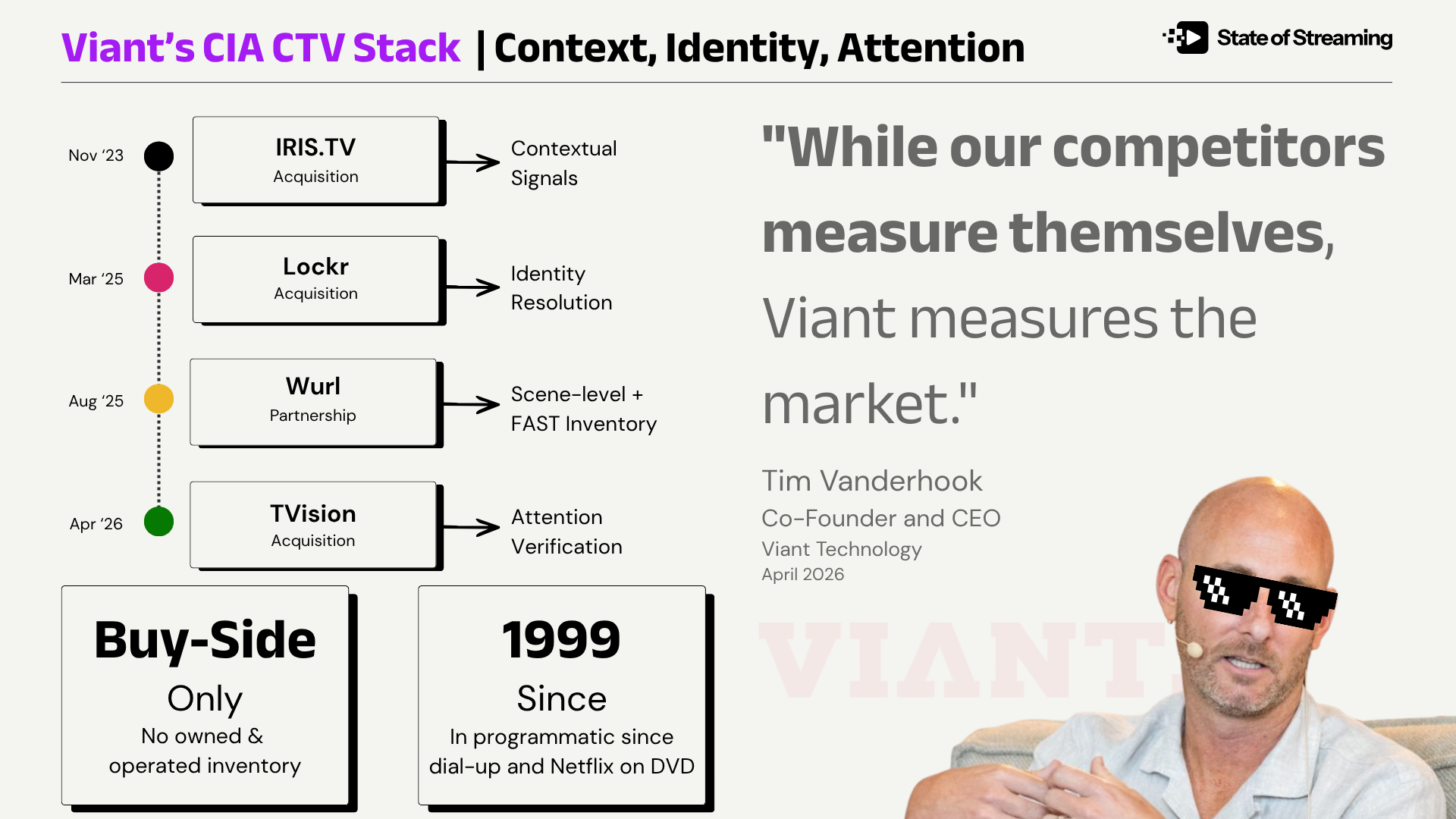
The competitive context matters here. TVision was doing adjacent work — measuring attention to linear TV — before Viant acquired them earlier this year. Lumen extends across the full CTV landscape: Netflix, Prime Video, Meta, Google.
Read about Viant's CIA CTV Stack next
Where this goes is the more important story. Rich on the next evolution:
"Not all attention is created equal. Working backwards from whatever the KPI is — a sale, incremental brand lift — how much attention do you actually need, and on which channels? We can do that predictive modeling in advance of you running the campaign."
If you can model outcomes from attention signals before a campaign runs, the CPM conversation changes. Premium inventory can be priced on predicted outcomes, not historical averages. That's the argument Netflix needs to make — and Lumen is how it makes it.
The Unsolved Problem: Live Sports
Everything above matters more in live sports than anywhere else. Sports are the number one advertiser ask in streaming. Every major brand wants to be on live sports. The problem is execution.
A common misconception: a lot of sports viewership on streaming apps is actually a linear broadcast feed delivered through the streaming stack — not a native streaming production. The distinction matters for how ad inventory is structured and served.
The harder problem is the moments that fall outside the plan. The fourth quarter of a close game. Extra time. Overtime. Hundreds of thousands of concurrent viewers hitting an ad break simultaneously — and the ad tech stack either holding or failing under that load.
The latency improvements from collapsing the DSP and SSP infrastructure aren't abstract. They're pointed directly at this failure mode. The industry hasn't solved live sports advertising at scale yet. The architecture being built right now is correctly aimed at it.
The Unsexy Bet That Keeps Winning
First Party Capital's portfolio is internally consistent: infrastructure over format, data over distribution. Bedrock for the buy-side layer. Lumen for measurement. Audiences — a data activation company that runs inside a brand's existing cloud rather than on its own servers — for the data layer.
Ciarán O’Kane on the investment thesis:
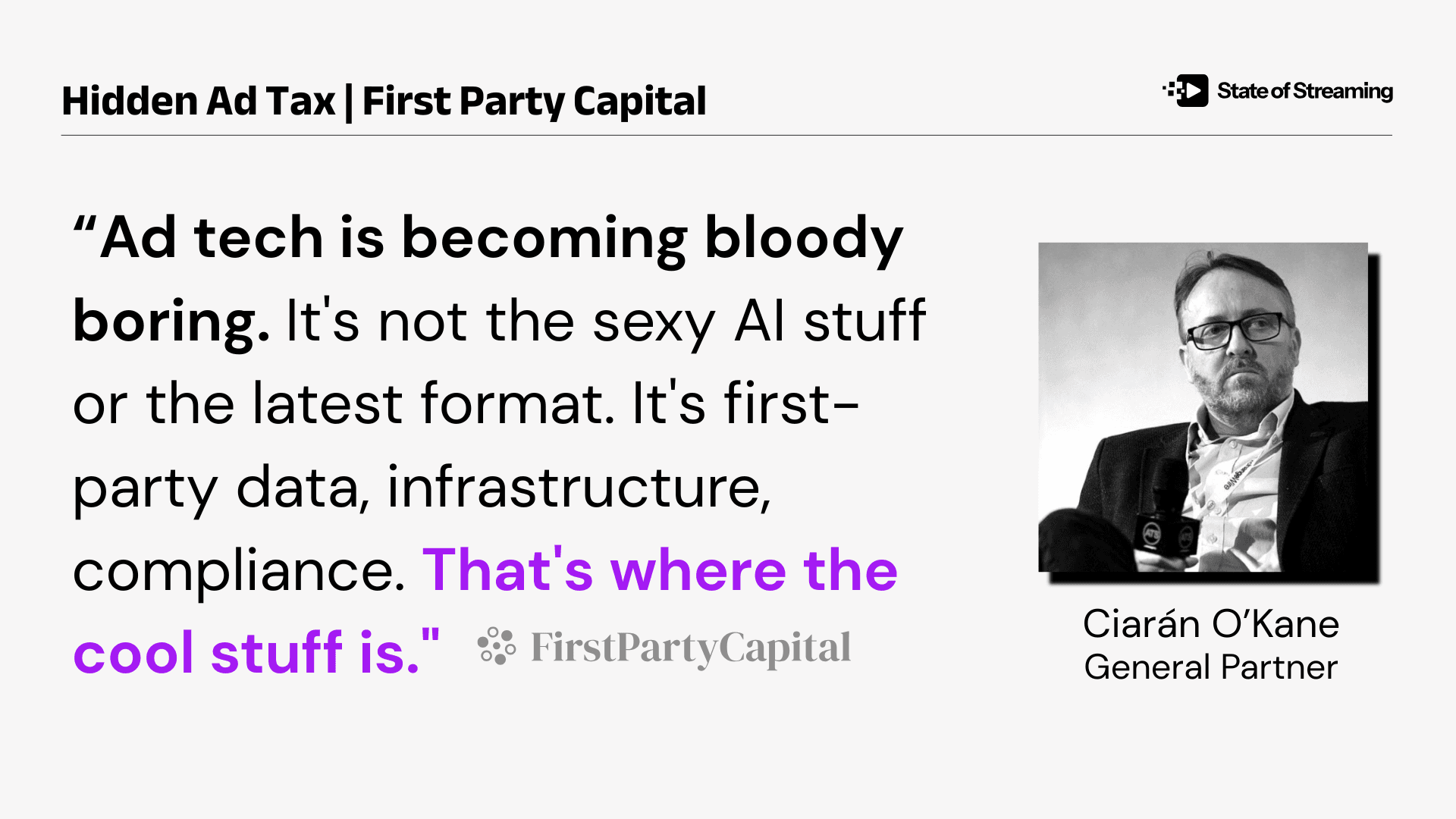
"We're the guys behind the guys behind the guys. Ad tech is becoming bloody boring. It's not the sexy AI stuff or the latest format. It's first-party data, infrastructure, compliance. That's where the cool stuff is."
The hidden costs in programmatic media are getting found. The infrastructure extracting them is being replaced. The companies doing the replacing don't have names most marketers recognize yet.
They will.
Listen to the podcast on:
Spotify: https://open.spotify.com/show/1IKRkTDLr06XGQ496Dk4nG
Apple: https://podcasts.apple.com/us/podcast/the-fpc-podcast/id1779275536
Get the SOS. Brief
The sharpest streaming intelligence, delivered to your inbox.