The Small Business TV Problem Just Got Smaller. The Measurement Problem Didn't.
Two products launched on the same day this week and made the same promise: television advertising is now accessible to any brand, regardless of size.
Roku launched Curate, a bundled product pairing its first-party viewership data with purchase signals from Kroger, Instacart, and four other retail partners. Comcast's Universal Ads added linear TV inventory to its self-serve stack. A local furniture retailer or regional auto dealer can now run across cable and streaming with no agency, no insertion order, and no minimum spend.
The access problem is real. Both products genuinely address it. Television was structurally inaccessible to small and mid-sized advertisers for forty years. That wall is coming down.
But access and unification are different problems. And confusing them is expensive.
Platform-First Buying Leaves Audience Behind
Roku Curate reaches Roku households. Universal Ads reaches Comcast households. A buyer activating both still has no mechanism to identify overlap, deduplicate reach, or connect a single person's exposure across both platforms to a downstream outcomes.
Amber Daniel, Chief Revenue Officer at Cognition, put it directly during a LinkedIn Live conversation last week about the 2026 guide that we published together:
"It's not necessarily about reaching everyone every time on a premium platform. Let's reach our customers where they are versus where we want them to be."
That reframe cuts to the structural problem with platform-first buying. Roku Curate starts with Roku inventory and asks which audiences it can attach. Universal Ads starts with Comcast inventory and asks the same question. A unified strategy inverts that logic: start with the audience, then follow them wherever they watch.
Daniel's client base illustrates why the distinction matters at the local level. Cognition's partners are largely franchise businesses — automotive retailers, furniture chains, local service providers — running localized campaigns against budgets that cannot absorb waste. "When you talk about localized budgets, you're typically talking about a smaller amount of investment," Daniel said.
"When we have this lens on publishers and premium, that can really impact the effective reach for a local advertiser."
What the Budgets Actually Are
The budgets Roku and Comcast are targeting are not television budgets. They are the Meta and Google search allocations that small businesses have defaulted to for a decade because television was too complicated to buy. The open internet will capture $96 billion in ad investment in 2026, per Jounce Media's State of the Open Internet report. Every dollar of that has a simpler buying interface than television.
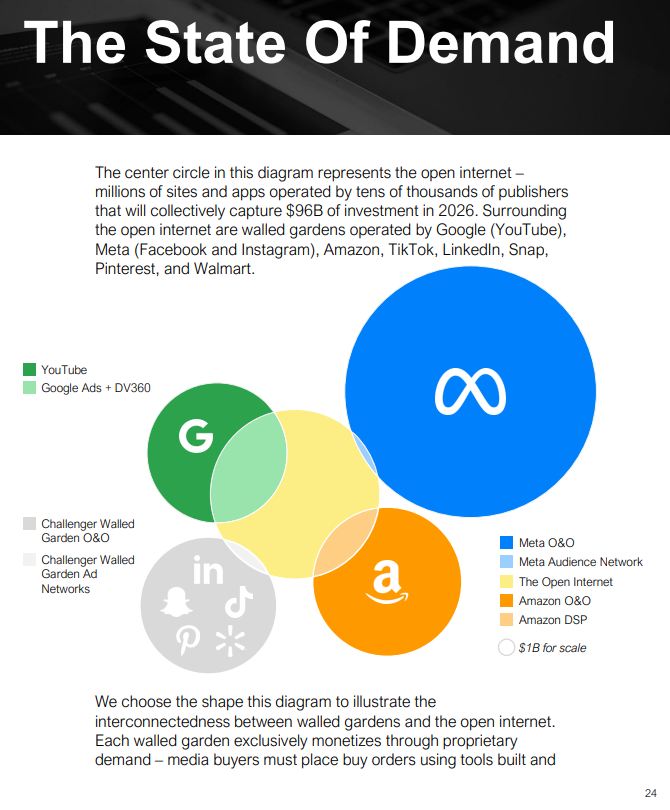
Meta Ads Manager has one login, one attribution model, one measurement surface. Google another and DV360 adds one more considering the use case. A small business looking to add streaming via Roku Curate and Universal Ads ends up with a few of everything — and no way to measure all of them.
What 'Unified' Actually Delivers
The guide's central argument, reinforced by Daniel on the LinkedIn Live, is that measurement is a symptom, not the root problem. Fragmentation is. Self-serve access at the platform level adds inventory but it does not add visibility.
It is precisely why State of Streaming publishes the Unified Streaming Power Index (USPI). Today we release the April update, benchmarking the top fifteen streamers offering scaled addressable household reach, cost per thousand impressions, ad load, and content heat against a fixed denominator of United States broadband households — not platform-reported impressions, not siloed reach figures. It is the baseline every buying decision should be measured against before a single dollar moves to a self-serve interface.
The access era just opened. The unification era is the next product cycle. The buyers who treat them as the same thing will spend the next two years rebuilding the spreadsheet problem at a smaller budget size.
Get the SOS. Brief
The sharpest streaming intelligence, delivered to your inbox.