Walmart Buys Vibe.co and the Self-Serve Future of CTV Just Got a Retail Spine
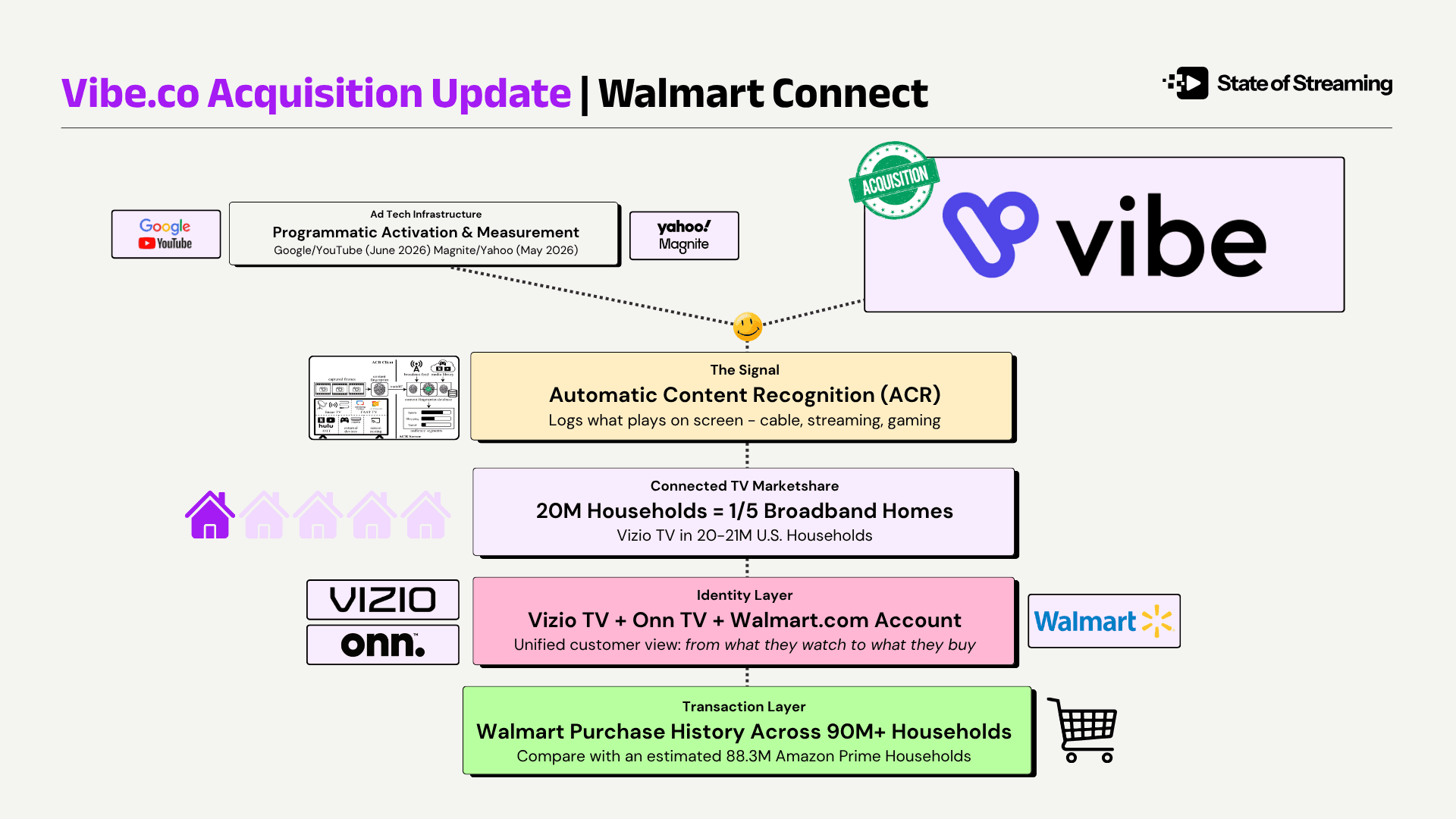
Walmart announced today it has entered into an agreement to acquire Vibe.co, a connected TV advertising platform built for small and mid-sized businesses. The deal extends what the original piece described as Walmart's toll booth model downmarket — to the 10,000+ advertisers who want CTV reach but don't have trading desks to buy it.
The market read is that Walmart just solved its demand-side distribution problem
First-party data and closed-loop measurement are only as valuable as the number of advertisers activating against them. Enterprise buyers were already at the table. Marketplace sellers, growth-stage brands, and SMBs weren't — not because they didn't want CTV, but because the entry cost in complexity and minimum spend kept them out. Vibe.co is plug-and-play demand. Walmart didn't build it. They bought the on-ramp.
Vibe.co's value proposition is blunt: run streaming TV the way you run paid social. Self-serve activation, direct supply integrations, AI optimization, performance measurement. CEO Arthur Querou announced the deal with characteristic directness:
"We unlocked Performance TV. Now it's time to make it as big as Search & Social. And we couldn't have dreamed of a better home than Walmart to do so."
Search and Social scaled because self-serve made them accessible to any advertiser with a credit card and a conversion goal. Streaming has never had that. The programmatic pipes existed; the UX didn't. Vibe.co's platform — more than 10,000 advertisers, purpose-built for ecommerce and growth-stage brands — is the closest thing the industry has produced to a streaming equivalent of Google Ads or Meta Ads Manager.
Now consider what this does to the two players who thought they owned the commerce media future
The Trade Desk built its entire enterprise on being the independent alternative — the buyer's agent, unaffiliated with any walled garden, trusted precisely because it didn't own the data or the supply. Walmart Connect dropping its exclusivity with TTD was the first signal. This is the second. Walmart isn't outsourcing demand aggregation anymore. It's internalizing it.
Vibe.co gives Walmart a direct relationship with 10,000+ advertisers who previously needed a DSP to reach CTV inventory. Every SMB that activates through Vibe.co is a buyer The Trade Desk didn't capture — and a measurement event that doesn't flow through TTD's reporting stack. The independent buyer's agent thesis gets harder to defend when the retailer builds its own front door.
Amazon is the more instructive comparison — and the more dangerous one
Amazon Ads scaled to a $70 billion (trailing 12-month basis) business by making self-serve advertising native to its seller ecosystem. Every product listing was a potential campaign. Every purchase was a closed-loop signal. The genius wasn't hiding in purchase data. It was the distribution itself: sellers already lived inside Amazon's infrastructure, so advertising was the next logical step.
Walmart's 100,000+ marketplace sellers now have a self-serve streaming ad platform connected to 90 million verified purchase households, Vizio's 20 million ad-supported homes, and closed-loop attribution. Walmart has watched the playbook for a decade. Vibe.co the latest move in simplifying that stack.
Walmart is building proof of what you watched and what you bought
Walmart Connect SVP Ryan Mayward framed the access challenge this way:
"Connected TV is one of the most exciting channels in media, but it can also be one of the hardest to activate. That is especially true for small and mid-sized businesses, mid-market brands and marketplace sellers that want the reach and storytelling power of streaming TV, but may not have large media teams or specialized buying resources."
More advertisers in the system means more closed-loop measurement events. More measurement events make the data asset more valuable to the enterprise buyers already paying for access. The flywheel closes — but only if demand scales. Vibe.co is how Walmart scales demand.
Walmart CCO Allyson Park positioned the acquisition as infrastructure:
"As the ways customers engage with content and brands evolve, we're continuing to invest in capabilities that help advertisers of all sizes connect with audiences in more relevant, measurable ways."
That language is deliberate. "Advertisers of all sizes" is the new competitive surface. Until today, Walmart Connect was primarily an enterprise product with enterprise economics. Vibe.co changes the addressable market entirely.
The competitive implication extends across the full streaming stack
Every platform selling reach without purchase-data measurement is already playing defense. Now every platform without a self-serve SMB layer is playing it on a second front. Netflix, Disney+, Paramount+, and Max can sell a premium demo but none of them can hand a Walmart marketplace seller a self-serve dashboard, a closed-loop attribution report, and 90 million verified purchase households simultaneously.
Walmart now can. The Trade Desk has to negotiate for the privilege. Amazon has the seller base but not the living room. Everyone else is selling reach into a measurement vacuum which is why more streamers (like Netflix) will default to the retailer's as data partners for audience targeting and to create value around their content.
The transaction is subject to regulatory approval and expected to close by end of fiscal year 2027. Financial terms were not disclosed.
Read 'Netflix Just Handed Amazon the Keys to Your Living Room' next
Get the SOS. Brief
The sharpest streaming intelligence, delivered to your inbox.