ATTN CAP
Attention Capital is a syndicated column exploring the intersection of culture and capital. Based on the original work of Josh Stein, the column decodes the economics of media, sports, and platform ecosystems. Check out the Attention Capital Substack for more.
WWE spent a decade trying to become Netflix. Then it stopped.
What TKO built in the 24 months that followed is the cleanest working prototype of live-attention IP as a credit-grade asset class anyone has produced. Four counterparties. Four contracts. One audience class. Roughly $2.2 billion in annual coupons. No customer service organization on the IP owner’s balance sheet. The market read this as media rights. It looks more like infrastructure.
In The Sports Bond, we argued that $300 billion in committed league media rights through 2033 belongs on credit desks rather than media spend lines. In How Lionsgate Won the Streaming Wars by Not Playing, we read a pure-play IP owner as the credit story the streaming wars never wrote. In The Behavioral Bid, a behavioral data system priced a content library and walked away with $82.7 billion. League rights. Pure-play IP. Behavioral pricing. Three pieces of one machine.
The machine has a working prototype. It is publicly traded under the ticker TKO.
For the Attention-Constrained
The asset: Live combat and sports entertainment audiences inside the TKO portfolio. WWE Raw, WWE SmackDown, WWE Premium Live Events, and the full UFC programming engine. Raw alone draws roughly 1.5 to 2 million weekly US live viewers. WrestleMania 40 in April 2024 generated a two-night gate of approximately $38.5 million, the largest in company history at the time.
The platform: TKO Group Holdings (NYSE: TKO). The April 2023 merger of WWE and the Endeavor-owned UFC. Trading began on September 12, 2023, at a combined enterprise value of approximately $21.4 billion. Endeavor took 51%. WWE legacy shareholders kept 49%. Ari Emanuel chairs. Mark Shapiro presidents.
The trade: Four rights deals across four counterparties in 24 months.
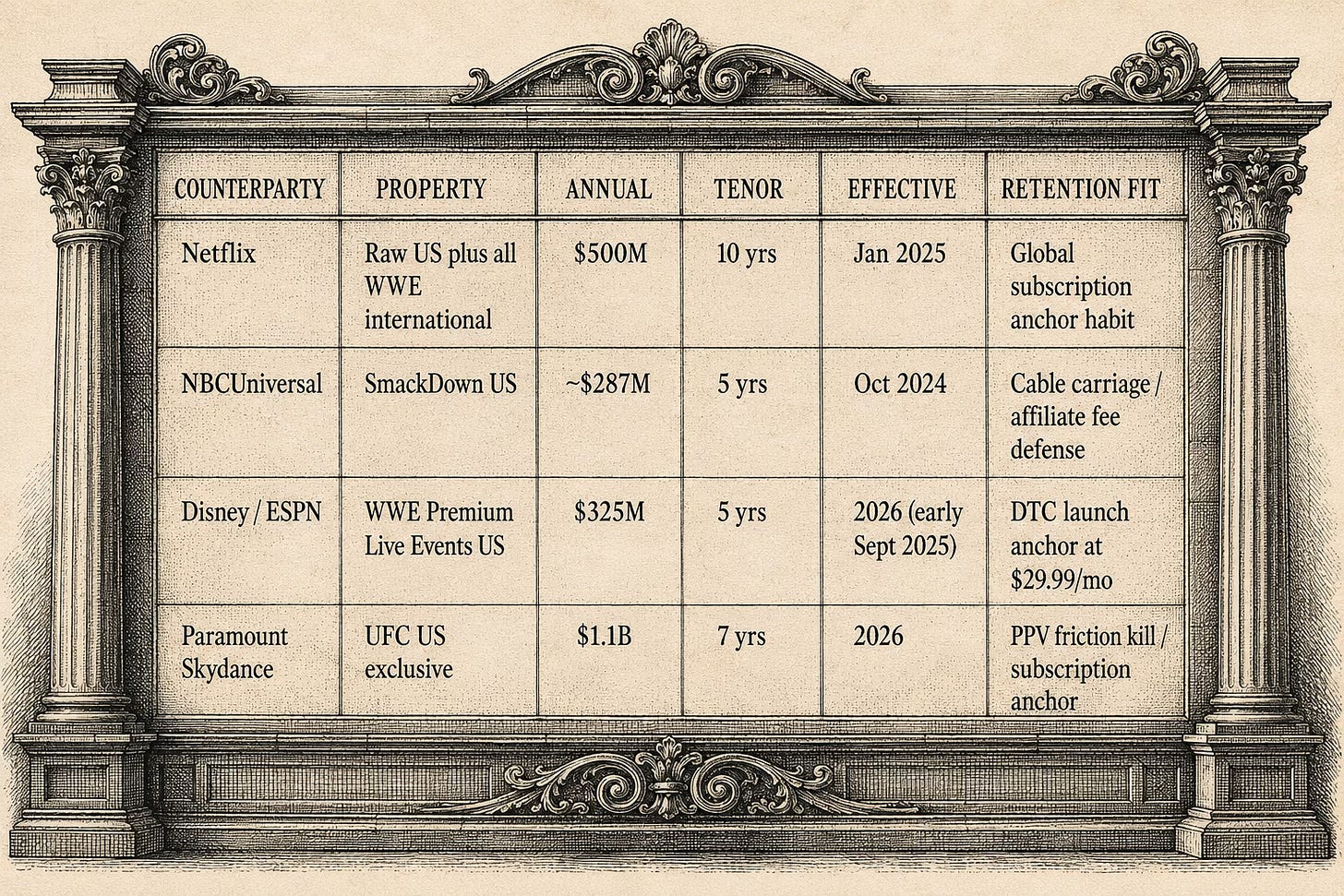
Combined annual coupon: roughly $2.2 billion. Combined contracted forward value: north of $16 billion.
The cap table: Silver Lake closed the $25 billion take-private of Endeavor at $27.50 per share on March 24, 2025, the largest private equity sponsor public-to-private transaction in media and entertainment history. Co-investors: Mubadala, Michael Dell’s DFO Management, Lexington Partners, Goldman Sachs Asset Management, and CPP Investments. The public market would not price the asset correctly. Institutional capital took it private to fix the price.
The credit infrastructure: Apollo launched Apollo Sports Capital on September 29, 2025, with Al Tylis as CEO, building on roughly $17 billion in sports capital already deployed across the firm. Apollo’s firm-wide AUM was $840 billion as of June 30, 2025. The new platform targets credit and hybrid exposure across franchises, leagues, venues, media, and events. TKO’s $2.2 billion annual rights stream sits directly inside that mandate.
If you allocate to credit or own live IP, this is the cleanest working example of how to turn one audience into four investment-grade-equivalent coupons without ever touching DTC margin drag.
The Wrong-Fit DTC Trap
WWE Network launched on February 24, 2014, at $9.99 per month. It was the most aggressive DTC bet any IP owner had taken in live entertainment to that point. The pitch was clean. WWE owned the largest video library in sports entertainment, the most consistent monthly live event slate in cable, and a fan base trained for 30 years to pay monthly for premium live programming. Trade pay-per-view margin for subscription volume. Breakeven sat at around 1 million subscribers. WWE crossed that inside a year.
The service averaged roughly 1.65 million paid subscribers in 2018, peaked at around 2.1 million following WrestleMania 34, then plateaued. The wrestling audience was loyal but not infinite. International expansion did not scale at the rate the DTC model needed. The unit economics turned negative once the cost stack loaded against the line: content production for the service, customer acquisition, billing and payments infrastructure, customer service organization, churn management, and the marketing burden of keeping the line growing.
WWE was running a media company and a payments company simultaneously. The payments company was eating into the media company’s margins.
The wind-down arrived in January 2021. WWE licensed the service to Peacock for roughly $1 billion across five years. NBCUniversal absorbed the subscriber base, the billing system, the churn problem, and the marketing burden. WWE retained the content, the events, the IP rights, and the cash. The decision converted the company from a DTC operator with negative-margin overhead into a pure-play licensor with a credit-grade counterparty paying a flat annual coupon. The numbers got cleaner the same day.
This is the lesson Disney has spent five years and over $10 billion in cumulative DTC losses learning. It is the lesson Warner Bros. Discovery confirmed in Q2 2024 with a $9.1 billion linear-network impairment. It is the lesson Paramount, carrying roughly $14.5 billion in long-term debt against a declining linear cash flow base, is still processing under new ownership.
TKO has not made the mistake again. There is no TKO Network. There is no UFC subscription product owned by TKO. There is no Premium Live Events DTC service rebuilt under a new brand. The IP owner stayed on the IP side and sent every audience slice to a platform that already owned the cost stack for that slice.
The Peacock-WWE deal expires in March 2026. The replacement was not a relaunched WWE Network. The replacement was four deals with four counterparties, each structured around the retention model required by that counterparty.
The payments company was eating the margin that the media company was producing.
The Netflix Raw Trade

On January 23, 2024, Netflix and WWE announced a 10-year, $5 billion exclusive deal for Monday Night Raw, effective January 2025, with international scope covering all WWE programming, including SmackDown, NXT, and Premium Live Events. The structure includes a Netflix option to extend for an additional 10 years, with an opt-out after the initial five.
$500 million per year. Ten-year tenor. Counterparty is Netflix.
This is the textbook instrument-asset-fit case. Netflix owns the most efficient subscriber retention machine in entertainment, sitting on 301.6 million paid memberships globally as of Q4 2024 and a content library priced against churn math measured to the basis point. S&P upgraded Netflix to an A credit rating in July 2024. Operating cash flow exceeds $8 billion annually. The counterparty risk on the $500 million annual coupon is the credit risk of an A-rated public company.
Netflix needed live programming for one specific operational reason. Appointment viewing within a streaming bundle resists the most common churn pattern: the lapsed casual subscriber who opens the app only when a specific show is in season. WWE Raw runs 52 weeks a year on Monday nights. The audience does not break for a hiatus. The audience does not wait for a renewal announcement. Plug that into a streaming subscription, and you have inserted an anchor habit into a bundle whose largest churn vulnerability is the lack of one.
Netflix took on platform-side risk: subscriber acquisition costs against the new audience, the build for advertising integration, technical infrastructure for global live concurrency, and the operational learning curve of weekly live broadcasting at scale. WWE took none of it. WWE collected the coupon and kept the IP.
The IP owner controlled the framing of the asset to the platform. TKO President Mark Shapiro later described the pitch to Netflix directly:
“It’s up your alley. Why don’t you dip your toe in? It’s not really live sports. It’s scripted entertainment. Very serial in nature. Every single week.”
Shapiro sold Netflix on the retention model fit, not the live sports premium. The pitch reframed the asset to align with the buyer’s subscriber-retention math. The premium Netflix paid was for what Sarandos called “the drama of sport,” running 52 weeks a year. Same audience. Same content. Different P&L logic priced against the platform’s actual churn problem.
Read as credit, the deal is a 10-year contracted receivables stream against an A-rated counterparty with a global investment-grade balance sheet. A senior-secured facility against receivables would price tighter than most BB-rated leveraged loans. In plain English: cheaper funding than a typical sub-investment-grade corporate borrower pays.
The deal landed at the moment Vince McMahon was stepping down from TKO’s board on January 26, 2024, amid sexual assault and trafficking allegations. The same week, Dwayne Johnson joined the TKO board with a $30 million-plus stock grant and a service and trademark agreement that transferred full ownership of “The Rock” mark from WWE back to Johnson. The board rotation, the trademark transfer, the Netflix announcement, and the cap table reset all happened inside a 72-hour window. TKO equity priced up materially across the same week and held the print.
What Netflix bought was not Raw. Netflix bought a behavioral anchor that the recommendation engine could not produce on its own. The competition for that anchor was the entire weekly slate of live programming on US cable, none of which Netflix could touch without striking a deal with the rights holder. WWE held the only inventory in that retention category at that price point.
When the rights holder has the only inventory in the category, the rights holder writes the term sheet.
SmackDown and the Parsed Stack
The Netflix announcement gets the headlines. The deal that proved the structure came first.
In September 2023, WWE moved Friday Night SmackDown from Fox back to NBCUniversal’s USA Network at more than $1.4 billion across five years, effective October 2024, a roughly 40% step-up from the prior Fox agreement. Roughly $287 million per year.
Most IP owners running a multi-day weekly programming slate sell it as a bundle. One master license. One platform that takes everything. The platform pays a blended rate based on the bundle, and the IP owner gives up the ability to optimize coupon-by-coupon for what each program block is actually worth to each potential buyer.
WWE refused the bundle. Raw went to a global streamer that valued international scope. SmackDown went to a US linear platform that needed to defend cable carriage economics against the cord-cutting trend. NXT remained within the WWE-owned-and-operated structure as a developmental brand. Premium Live Events went to a separate buyer with a separate retention model. The same IP owner sold each program block independently to the buyer whose P&L incentives most rewarded that specific slice.
NBC paid roughly $287 million annually for SmackDown because SmackDown is a Friday night live event that delivers cable carriage value to USA Network. USA Network’s distribution fees from cable operators are calculated based on the value the network adds to the bundle. A live wrestling event on Friday is a load-bearing show in that calculation. NBC was not pricing SmackDown against subscriber acquisition. NBC was pricing SmackDown against the affiliate fee structure that funds the entire USA Network business.
Netflix paid $500 million annually for Raw because Raw produces appointment viewing inside Netflix’s global subscriber bundle. The two P&L incentives are entirely different. A bundled deal would have left $200 million to $400 million in annual aggregate coupon value on the table because no single buyer values both program blocks equally.
This is the discipline that every major studio has failed at for a decade. Disney bundled. Warner-Discovery bundled. Paramount bundled. Each major studio collapsed the optionality of its underlying IP into a single platform play, and the platform play ran a permanent operating loss against the IP that fed it. WWE declined the bundle and was paid four times for the same audience class.
The bundle is the lazy structure. The parsed stack is the senior structure.
PLEs to ESPN, UFC to Paramount+
In the first 11 days of August 2025, TKO closed two of the largest rights deals in sports entertainment history. Each has over $1.5 billion in committed value. Each pulled a live property off an existing partner. Each landed inside a single business week.
On August 6, 2025, ESPN announced a five-year, $1.6 billion deal for WWE Premium Live Events, including WrestleMania, SummerSlam, Royal Rumble, Survivor Series, and Money in the Bank, with the slate moving exclusively to ESPN’s new $29.99 monthly DTC service starting in 2026. The transition began early on September 20, 2025, with Wrestlepalooza, pulling the PLE slate off Peacock months ahead of the contractual transition. $325 million annually.
Five days later, on August 11, 2025, Paramount Skydance announced a seven-year, $7.7 billion deal for the entire UFC programming engine starting in 2026, pulling UFC off ESPN, eliminating the pay-per-view model, and bundling all 13 numbered events plus 30 Fight Nights into the Paramount+ subscription, with select numbered events simulcast on CBS broadcast. $1.1 billion annually.
Two separate deals against the same TKO IP holder. Two different platforms. Two different live combat audiences. One business week.
ESPN’s deal repositioned its DTC product. ESPN’s standalone streaming service launched in August 2025 at $29.99 per month, and the most acute marketing challenge was justifying that price point against existing pay-per-view consumer behavior. WrestleMania is one of the highest-grossing single live entertainment events in cable history outside the Super Bowl. The PLE slate fills out a year-round calendar of premium live events that historically sold for $50 to $70 each on pay-per-view. Bundling 10+ PLEs annually into a $29.99 subscription is a textbook example of an anchor-event reframing of the subscription value proposition.
For ESPN, $325 million annually buys a subscription anchor that justifies the $29.99 price point and converts the historical pay-per-view buyer into a recurring subscription customer. For WWE, $325 million annually is a coupon against an audience slice it was already monetizing through Peacock at substantially lower terms.
Paramount+’s deal repositioned the entire UFC business model. UFC under ESPN ran a hybrid distribution: Fight Nights on ESPN+, numbered events on pay-per-view at $79.99 each. PPV fees were a constant complaint among UFC fans. Hardcore fans paid for every numbered event, but the conversion of casual viewers and bundled subscribers was low.
Paramount+’s deal eliminates the friction. Every UFC numbered event becomes part of the Paramount+ subscription. No additional PPV charge. Select numbered events get a simulcast on CBS for distribution reach. The $1.1 billion annual coupon is what Paramount+ is paying to convert UFC from a friction-heavy hybrid product into a subscription anchor.
Note the counterparty layer. S&P downgraded Paramount Global to BB+ in 2024, the highest speculative-grade tier. The platform paying the $1.1 billion annual coupon is sub-investment-grade. The receivables stream under the contract is still institutional credit-quality if structured on a cash flow basis, because the cash flow is contractual and the cost basis sits on the platform side of the trade. The credit instrument can outperform the platform’s credit rating when paying the bill.
The audience does not have to subsidize the platform’s repositioning. The platform pays the IP owner for the privilege of being repositioned.
The platform pays the IP owner for the privilege of being repositioned.
WrestleMania moved to ESPN. UFC moved to Paramount+. Same month. Different platforms. Same IP holder. Four coupons against the live-attention asset class.
The Endeavor Take-Private
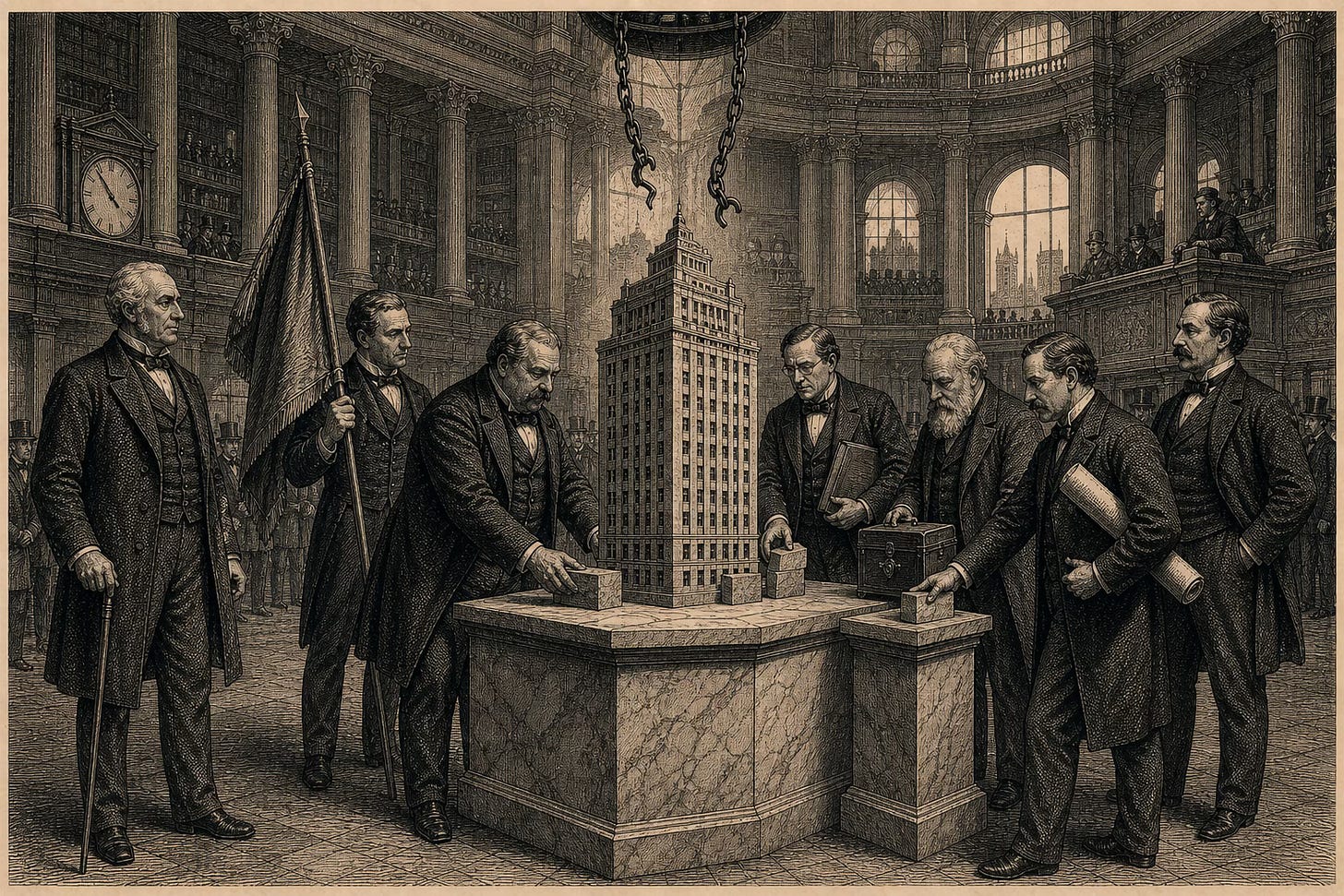
The deals above did not happen against a stationary cap table.
On April 2, 2024, Silver Lake announced an agreement to acquire Endeavor Group Holdings at $27.50 per share. The transaction closed on March 24, 2025, at a total enterprise value of approximately $25 billion, the largest public-to-private buyout in media and entertainment history. The $25 billion is Endeavor’s parent enterprise value, not the $21.4 billion TKO listing valuation referenced earlier. Both numbers matter. The first prices the parent. The second prices the publicly traded IP company underneath it. The co-investor base included Mubadala, Michael Dell’s DFO Management, Lexington Partners, Goldman Sachs Asset Management, and CPP Investments. Silver Lake retained the lead position.
Read that investor list as a statement about how the public market was pricing the asset.
Public markets carried Endeavor at a valuation that priced in a conglomerate discount, sponsor-overhang discount on Silver Lake’s existing minority stake, and the volatility associated with a holding-company structure that touched talent representation (WME), live events (UFC and WWE through TKO), and sports betting infrastructure (IMG, OpenBet). The public market priced this as a sum-of-the-parts conglomerate trading at a discount. Silver Lake’s read was that the discount was structural and that the underlying assets, especially TKO and the rights cash flow stack, would trade higher under a private structure with a long-duration sponsor balance sheet behind it.
Mubadala wrote a check because sovereign wealth funds need long-duration cash flow from politically stable counterparties. Michael Dell’s DFO Management wrote a check because Dell is one of the most disciplined private capital allocators in the country and reads media-rights cash flow the same way Apollo reads infrastructure cash flow. Lexington wrote a check because secondary capital is now an institutional asset class. Goldman Sachs Asset Management and CPP Investments wrote checks because pension and endowment capital have spent a decade trying to find duration assets with credit-like cash flow, and this transaction offered both.
The public market priced the asset as a conglomerate. Private market priced it as a duration asset. The $25 billion transaction is the arbitrage between the two reads.
That different time horizon is what made the four-deal rights stack possible at the terms it cleared. A short-horizon public conglomerate parent would have pressured TKO to bundle the rights into a single mega-deal that maximized headline revenue and minimized contract complexity. A long-horizon institutional sponsor-parent ran the patient version of the trade: four separate counterparties, four separate contracts, four separate retention models, with the IP owner sitting beneath each, collecting four separate coupons.
The same investor base that took Endeavor private is the investor base Apollo Sports Capital was built to serve.
The Rock as Cap Table Position
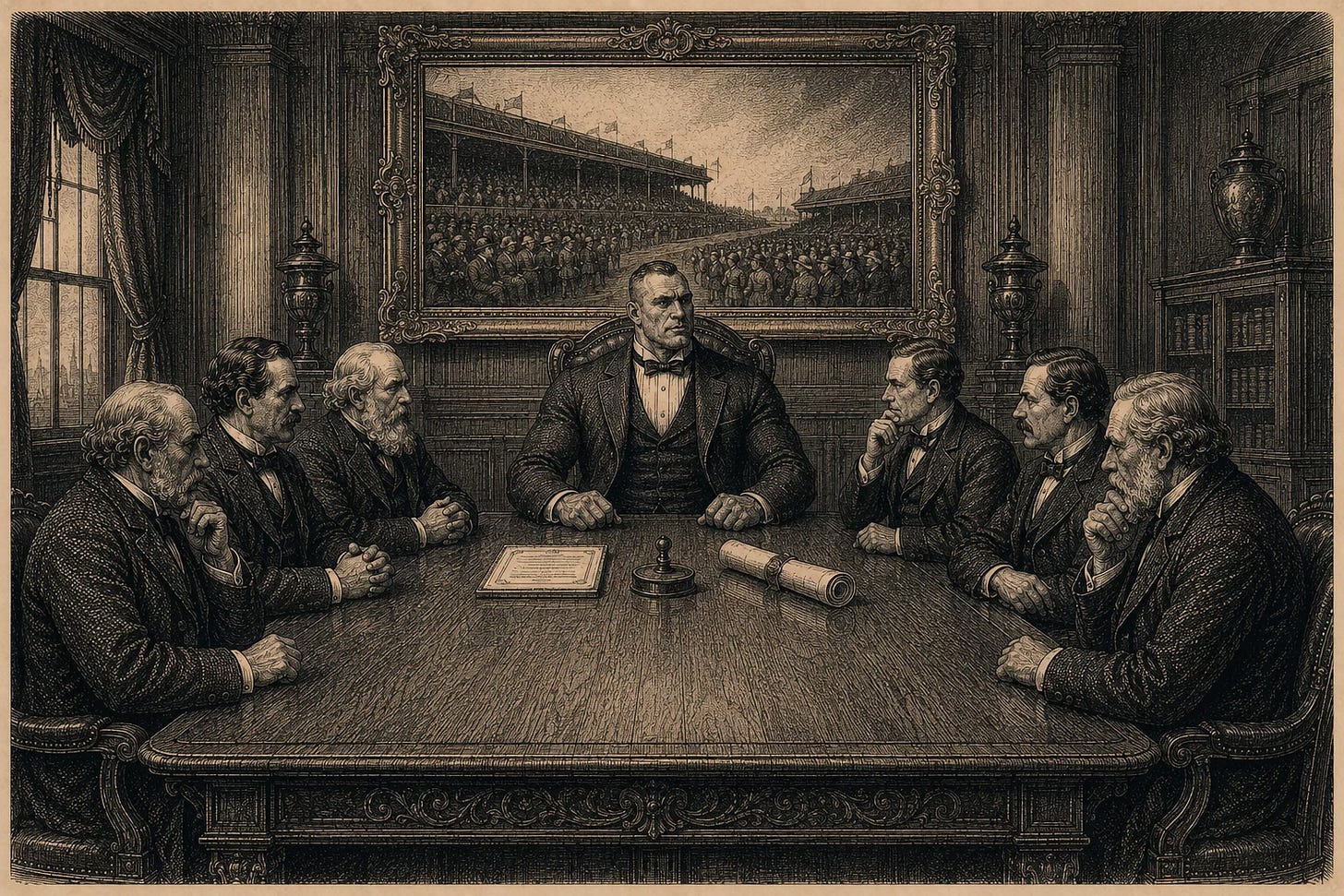
On the same day Netflix announced the Raw deal, Dwayne Johnson joined TKO’s board with a compensation package valued at over $30 million in TKO stock, plus a service and merchandising agreement, and the transfer of full ownership of “The Rock” trademark from WWE back to Johnson.
This was not a talent contract. This was cap table architecture. The trademark transfer means that the “The Rock” mark is now a Johnson-owned asset, licensed to TKO under a service agreement. The stock grant puts Johnson on the IP owner’s cap table alongside Silver Lake. The board seat gives Johnson a fiduciary role in the IP owner’s strategic decisions. Three legs of one relationship: Johnson the licensor, Johnson the equity holder, Johnson the director. Each leg compounds the other two.
We mapped this template in The Playbook Already Built. The athlete is not a talent expense. The athlete is a cap table architect. The IP owner gains long-term access to the athlete’s brand and the audience the athlete attracts. The athlete gets equity appreciation, license-fee revenue, and direct strategic input. Netflix knew when they signed the Raw deal that Johnson was on the board. ESPN knew when they signed the PLE deal. Paramount knew when they signed the UFC deal. The cap table architecture telegraphed to every counterparty that the IP owner had captured one of the most valuable individual brands in entertainment as a structural shareholder, not as a one-off talent contract.
The Rock isn’t a talent line at TKO. He’s a cap table position.
The Apollo Sports Capital Catalyst
On September 29, 2025, Apollo Global Management formally launched Apollo Sports Capital, a dedicated platform investing across credit and hybrid opportunities in franchises, leagues, venues, media, and events. Al Tylis was named CEO, with Rob Givone and Lee Solomon as co-portfolio managers and Sam Porter as Chief Strategy Officer. The firm had already deployed roughly $17 billion across sports and live events as of launch. The new platform is reportedly targeting a $5 billion vehicle inside a firm running $840 billion in AUM.
The mandate language matters. Credit and hybrid investments. Franchises. Leagues. Venues. Media. Events.
TKO is included in the mandate as a fact, not a recommendation. The IP holder generates approximately $2.2 billion in annual rights revenue from four investment-grade-equivalent counterparties. The receivables stream has a duration profile that matches a typical credit fund tenor. The counterparty diversification across Netflix, NBCU, Disney/ESPN, and Paramount Skydance reduces single-buyer concentration risk to a fraction of what most rights cash flows carry. The covenant package would write itself in any standard syndicated lending shop: information rights on platform data, retention-quality triggers (think: if live concurrency falls below X, pricing or advance rate adjusts), cross-default to the counterparty rights agreements. None of this is exotic. It is the toolkit used in covenant-lite syndicated lending, applied through AQS and the broader framework that Attention Capital has built for the live-attention asset class.
The infrastructure to underwrite this exists. The methodology to score it exists. The IP holder exists. The cash flow exists. The counterparties exist. The credit fund exists.
The first term sheet does not.
Why This Could Break
Three risks sit against the thesis.
Audience decay. Live combat audiences could erode faster than the cycles can be renegotiated. The blended duration across the four deals is roughly 6.5 years, shorter than the longest league rights contracts in the market. The countervailing factor is that the parsed structure means TKO renegotiates one slice at a time rather than the entire portfolio at once, which is a defensive feature for the IP owner. The audience is one risk surface. The contract structure is the answer.
Rights repricing. The 2030 cycles arrive with all four counterparties having a different view of what the cash flow is worth than they did in 2024-2025. If linear declines accelerate, NBC’s $287M for SmackDown is at risk. If streaming bundle economics break down, Paramount’s $1.1B for UFC is at risk. The defense is parsed timing: the four contracts roll on different calendars, so the IP owner is never fully exposed to one cycle’s repricing.
Sponsor pressure. Silver Lake’s take-private adds a layer of sponsor capital structure to the cap table. Dividend recap pressure, refinancing windows, and exit-driven decisions can conflict with the patient, long-duration approach implied by the rights deal sequence. The counter is the co-investor base (Mubadala, Dell, CPP, Goldman, Lexington), which is exactly the patient long-duration capital most aligned with the underlying asset’s natural time horizon.
Each risk is identifiable. Each risk has a structural response inside the architecture.
The Structural Lesson
The IP owner who refuses the wrong-fit distribution play captures the coupon stack.
Music ran this 30 years ago. Songwriters and catalog owners stopped trying to own the distribution layer and let labels, publishers, and streaming services run the customer-facing economics. The owner of the catalog collected royalties. The infrastructure to securitize those royalties matured into Bowie Bonds, then Hipgnosis, Concord, and the KKR catalog facilities of the 2020s. The asset class became a credit market.
Sports leagues ran the same play across the rights cycles of the last 20 years. The league sells the rights. The platforms run the distribution. The league collects the contracted coupon. The NBA’s $76 billion print and the NFL’s $111 billion print are coupons against the same structural rule.
Studios are running it. Lionsgate refused to build the streaming stack, let Starz spin off, and stayed a pure-play library and production company. The market started rewarding the structure the day the spin cleared.
Netflix figured it out from inception. Reed Hastings spent two decades arguing that Netflix’s job was to own the platform and rent the content. Same structural rule, run from the buyer’s side.
Live attention is now running it. TKO is the working prototype.
The structure wants to exist in adjacent verticals next. Creator economy IP owners with parsed multi-platform revenue (think MrBeast across YouTube, Amazon Prime Video, and consumer products). Live-service game publishers (Epic with Fortnite live events across PlayStation, Xbox, and PC). Real-time event franchises (Coachella, F1 race weekends, Fashion Week). Each one owns IP with a durable audience habit and parses the audience across platforms whose retention models value the audience differently. The methodology is portable because the structural rule is portable.
The instrument is the variable. The asset is the constant.
TKO is the prototype, not the exception.
The instrument is the variable. The asset is the constant.
What This Means for Capital
For institutional credit allocators. TKO’s $2.2 billion annual rights stream is the cleanest single-issuer comparable in the live-attention credit category. Four-counterparty diversification. Contracted forward duration. A senior-secured facility against receivables should price in line with high-grade media debt. The first manager to write the structure sets the comp. Every other live-attention IP owner reprices against that comp.
For private equity. The Silver Lake-led Endeavor take-private is the template for the next round of media IP owner privatizations. Public markets price IP-owner conglomerates at a structural discount. Private structures price the same assets at a duration premium. Expect more take-privates of IP owners whose public structures are misaligned with the duration of their underlying cash flows.
For athletes and talent. The Dwayne Johnson template is now the visible default for any top-tier athlete or talent whose brand value has outgrown the multi-year talent contract structure. Equity. Trademark. Service agreement. Governance. The Birdies-and-Skims analogs in apparel and beauty already run the same architecture. The athlete commercial cap table position is no longer theoretical.
For rights buyers. Bundling is the lazy structure. Parsing is the senior structure. As a buyer, paying a premium for the slice you actually need is more efficient than paying mid for a bundle that includes slices you do not. The Disney bundle of cable, broadcast, theatrical, parks, and streaming is starting to break apart precisely because the parts are worth more outside the bundle than inside it.
What Comes Next
TKO has already done the difficult part.
The audience exists. The four counterparties signed. The contracted cash flows are scheduled. The institutional sponsor took the parent private to correctly price the asset. The credit infrastructure launched to underwrite exactly this kind of cash flow.
One thing is missing.
The first facility. The first securitization. The first term sheet that treats live attention the way markets learned to treat music royalties 30 years ago.
When that deal clears, TKO stops being a media company example and becomes a comparable. Then everything reprices.
Every IP owner with a durable audience now has a choice: operate distribution or sell duration. The next generation of media credit will start with rights holders that never intended to become lenders.
The contract is signed. The audience is captured. The cash flow is statutory.
The only question left is who writes the term sheet.
Why Subscribe
Because the live-attention asset class has been priced four times higher against the same audience by four investment-grade-equivalent counterparties in 24 months, and most of the capital that should be writing facilities against the cash flow is still reading it as media spend.
Every week, Attention Capital reads the deals other publications miss, applies the AQS framework to the assets that should be financeable, and draws the curves the sell side has not yet drawn. The Netflix-WWE Raw print. The Paramount-UFC reframe. The Silver Lake-Endeavor take-private. The Apollo Sports Capital launch. Each one is a node in the same architecture, and most of the institutional credit market has not yet connected the nodes.
If you work in finance, this is where you see where the next wave of media credit deployment lands before the term sheets get written. If you work in media, live events, or talent representation, this is where you see how capital is starting to price the assets you have been building. If you allocate to private credit, this is the playbook for the asset class that most institutional shops do not yet have a dedicated desk for.
Subscribe to Attention Capital: where attention becomes enterprise value, and the contract behind the cash flow gets priced like the credit it actually is.
Get the SOS. Brief
The sharpest streaming intelligence, delivered to your inbox.