You're Paying Premium Prices for Broken Data. What Your Streaming Buy Is Actually Built On.
You're spending money to reach specific people on streaming TV. Your vendor tells you they can find those people — by household, by income, by purchase history. You're paying a premium for that precision.
Here's what's actually happening.
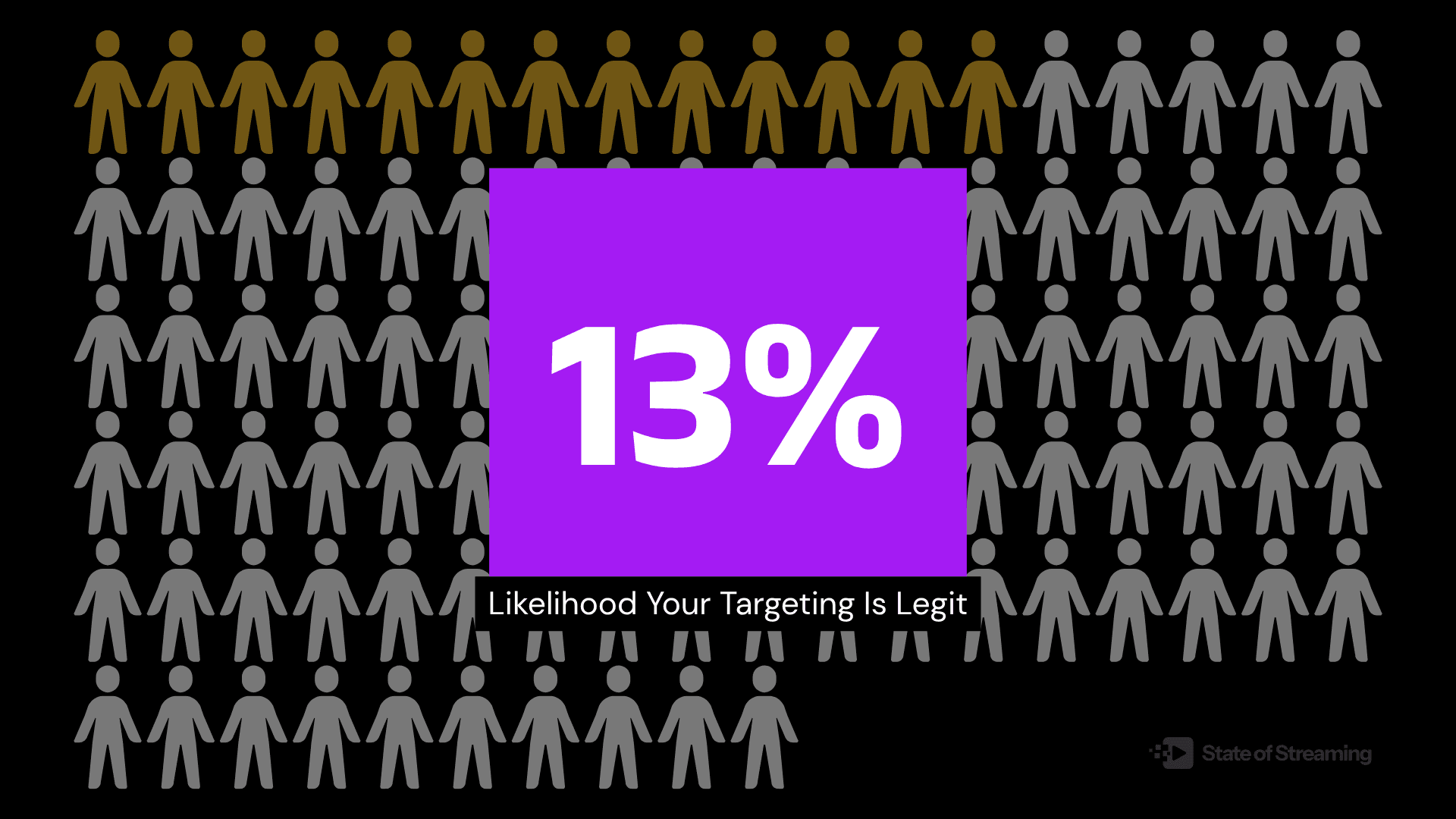
The most common way streaming platforms identify a household is through an IP address — the unique number assigned to your home internet connection. A study of nearly one billion IP records found that IP addresses match a household's physical address just 13% of the time. Six major data providers couldn't even agree with each other on the same match more than 6% of the time.
That's the signal your targeting is built on.
Check Out This Clip 👇
Fraud detection and mitigation expert, Dr. Augustine Fou on protecting against fraud on Connected TV (CTV)
The fix that wasn't
The industry response was to move toward email-based identifiers — the idea being that if a viewer logs into a streaming service with their email, you have a more reliable way to identify and reach them. Sounds reasonable.
The problem is that free, ad-supported streaming channels — the ones that run without a subscription — don't actually have access to those email logins. Sure, the TV manufacturer might. But they rarely pass that data down to the individual channels running on their platform.
So what do those channels do? Many buy email lists from data brokers and use them to generate targeting tokens. You pay premium prices for what gets called first-party addressable inventory. But what you're actually getting is the same third-party data the industry was supposed to be moving away from.
Earlier this year, according to AdExchanger, one streaming publisher was discovered passing broken targeting tokens for three months. The error made the identifiers useless. Nobody caught it. And when it was finally fixed, the publisher saw no noticeable change in revenue — which tells you how much work those identifiers were actually doing.
What it costs
The streaming ad market will hit about $40 billion this year. About $18.5 billion of that moving through open auction programmatic exchanges — the predominant marketplace where most of this targeting happens. Researchers estimate that 40% of every dollar spent in that marketplace is wasted because the underlying data is inaccurate. That's a projected $7.4 billion in lost value in 2026 alone.
What you should do about it
Amber Daniel, CRO at Cognition and a twenty-year veteran of digital advertising: "The strategy is around first-party data — understanding who I should be targeting, who I shouldn't be targeting, and utilizing technology like identity graphs to give yourself a better opportunity to reach those customers."
The immediate practical move is to start treating your media buy as a data collection instrument, not just a way to reach people. Every impression, every click, every form fill is a signal about who responded and why. Over time, that builds an audience profile you own — one that makes your targeting more precise and your budget less dependent on a broken open marketplace.
First-party data means information your customers gave you directly — email addresses from a purchase, a loyalty program signup, a service appointment. That data doesn't depend on IP addresses or broker email lists. It's yours. And it's the foundation that makes every media dollar work harder.
Stop asking what your cost per lead is. Start asking what it takes to add a real, verified customer to your own data asset. That question has a much better long-term answer.
Targeting is a substitute for conviction
The streaming opportunity is real. The waste is real too. But the deeper problem isn't the broken signals — it's the business model around selling confidence in them. The advertisers who figure that out will start building something they actually own.
Get the SOS. Brief
The sharpest streaming intelligence, delivered to your inbox.