Reading the Tea Leaves: Does Apple's Home Screen Already Quietly Favoring the Asset Most People Expect It to Buy?
Editor's Note
This piece pairs new Looper Insights $MPV data on Apple TV's interface redesign with our prior reporting on the NBCU/Peacock spinoff to ask an uncomfortable question about algorithmic neutrality. We're not claiming intent — we're pointing out that nobody can currently tell the difference between intent and noise, and that gap is the story.
In December 2025, CNBC's Alex Sherman reported that top media executives had quietly stopped predicting Apple buys Disney and started predicting Apple buys NBCUniversal. Six months later, Comcast confirmed the NBCU spinoff. We argued Peacock was the most valuable unowned asset left in streaming, and that Apple — sitting on $68.5 billion in cash, with every strategic gap NBCU happens to fill — was the buyer with the least to lose and the most to gain.
Watch that prediction here 📺
That case got stronger this month, not weaker. At the Evercore Global TMT Conference in early June, NBCUniversal Media Chairman Matt Strauss said Peacock will turn profitable this quarter — a firmer claim than Comcast's April framing that the streamer was merely "approaching" profitability. A perpetually money-losing Peacock and a newly profitable one are different acquisition targets. Six months ago, the pitch to a buyer was "this will be worth a lot eventually." Now it's closer to "this already is."
That was a thesis about balance sheets and strategic logic.
Here's the part nobody was watching for:
While that thesis was forming, Apple's own home screen was already rewriting who gets seen.
The Redesign Nobody Priced In
Sometime in the back half of 2025, Apple TV quietly shipped a redesign across its Home and Store pages — moving content cards from landscape thumbnails, where ranking badges and metadata sat awkwardly beside the artwork, to portrait posters with the ranking and metadata built directly into the card.
The outcome?
Cleaner. More legible. A better showcase for anyone with premium key art.
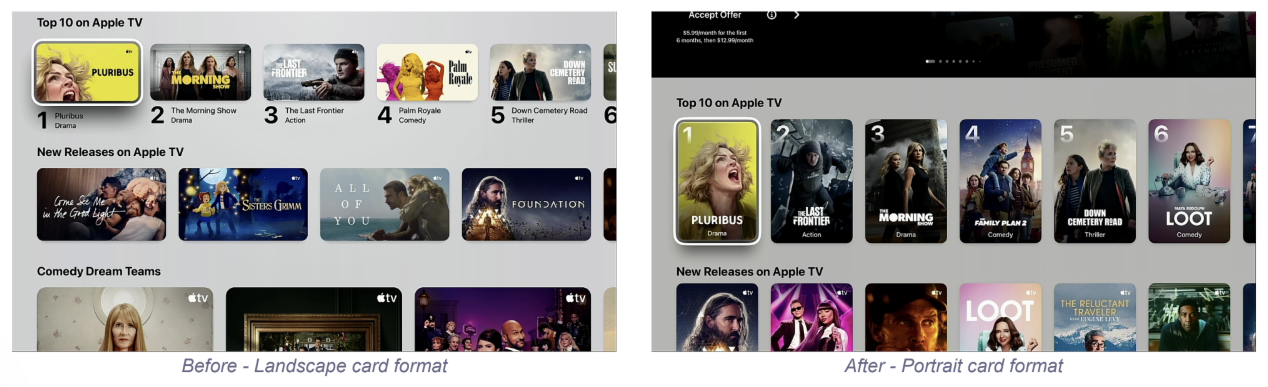
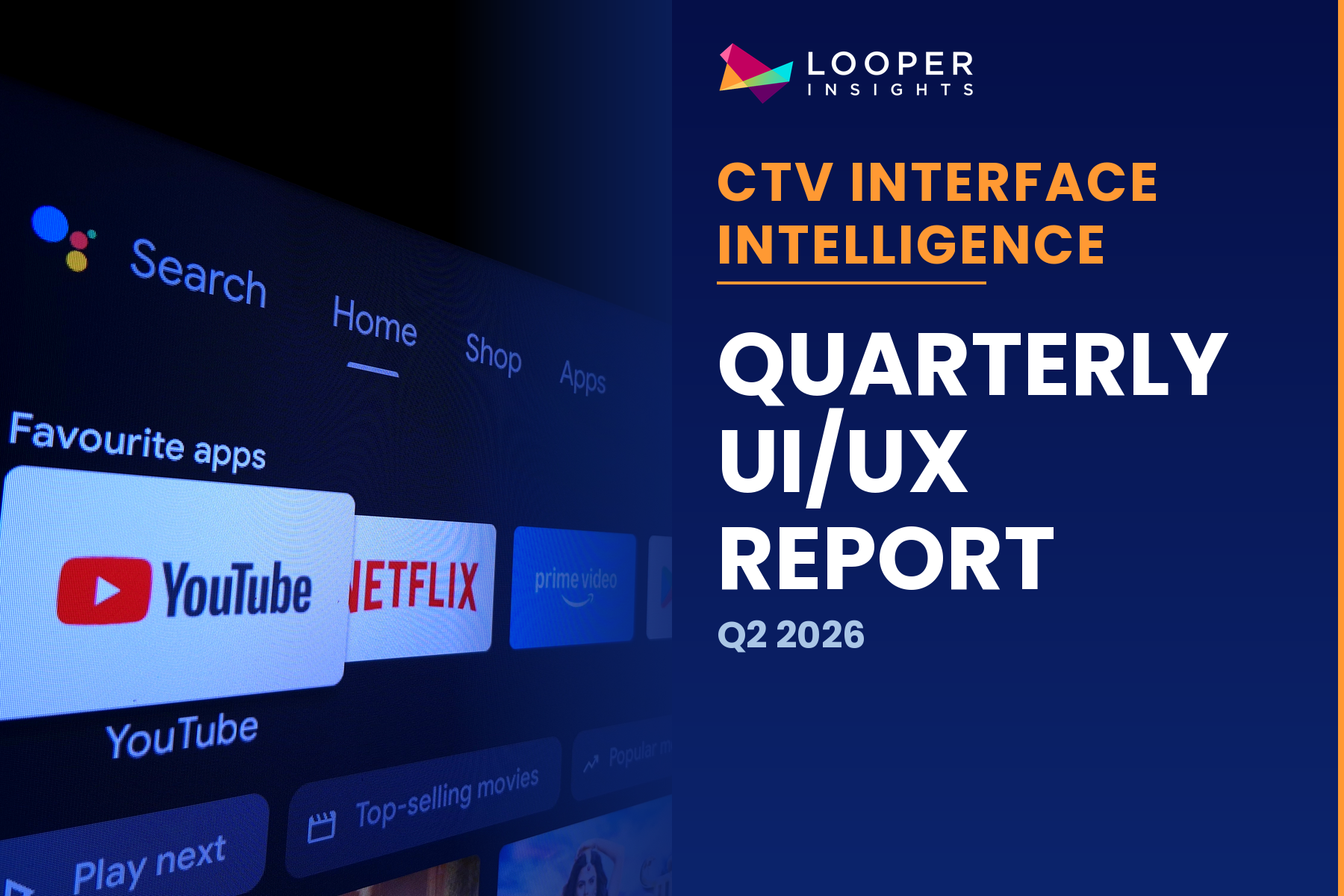
(Image Courtesy of Looper Insights Q2 UI/UX Report - Download it here)
Media Placement Value ($MPV) on Apple TV
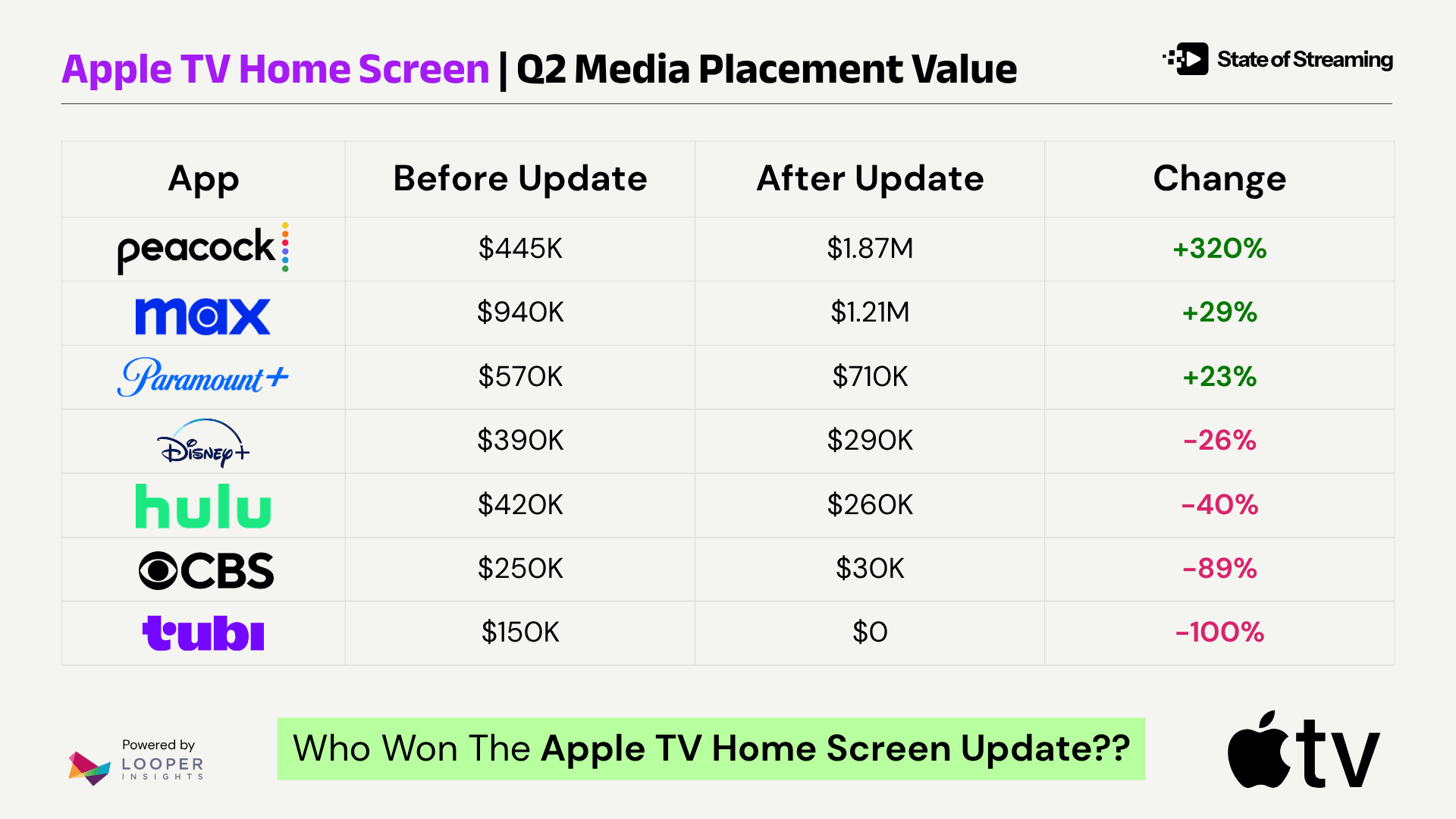
Looper Insights tracked Dollar Media Placement Value ($MPV™) — the dollar cost to reach an audience based on where and how prominently content is placed — across Apple TV's distributor apps for one month before the change and one month after. The results mark a clear leader:
Same home screen UI/UX update yet three entirely different fates. And Peacock? It didn't just grow —
It became the second-biggest presence on the entire Apple TV interface, trailing only Apple TV itself.
Tubi didn't just decline. It disappeared. CBS lost nearly nine-tenths of its shelf value, likely tied to reduced linear network content placement following the update. Nobody flagged any of this until Looper pulled the numbers.
And that's before you account for the fact that 96.6% of all $MPV on the Apple TV interface — over $10.2M a month — flows to Apple TV+ originals. Third-party distributors, Peacock included, are fighting over the remaining 3.4%. Peacock's 320% surge is a rounding error tripling in size. It's still a rounding error.
Signal or Noise?
Here's where we have to be careful, because the easy version of this story writes itself and the easy version is probably wrong.
Apple's recommendation and merchandising systems almost certainly don't know Comcast is spinning off NBCU. There's no evidence Apple is manually weighting Peacock content upward in anticipation of a deal that hasn't been announced, let alone closed. The more boring explanation is that Peacock's content slate simply performed well in a system optimized for engagement, and the portrait-card format happened to showcase whatever Peacock had in market during that window better than the old layout did.
But there's a second, less boring possibility worth naming, and it has nothing to do with M&A timing. Catalog data shows Apple TV quietly building one of the strongest children's content libraries in streaming — strong enough to pose a genuine competitive threat to Disney's grip on family viewing? Perhaps.
Peacock, meanwhile, is one of the last streamers left with a real live sports package: NFL, Premier League, the Olympics. NBCUniversal Media Chairman Matt Strauss has been explicit that Peacock is staying deliberately domestic rather than chasing global scale: "I don't think we need to be global in order for us to continue growing the service, growing revenue, and scaling," he said in June, pointing to the US market's superior video share, ad rates, and per-subscriber revenue. And that sports content does more than drive ratings — Strauss noted that 25% of viewers streaming NBA games on Peacock also engaged with vertical video, and roughly 20% of vertical-video viewers during the Milan-Cortina Winter Olympics went on to watch long-form content.
What It Means
Apple's algorithm independently rewarding a catalog that happens to complement its own content buildout is strong evidence that the household-lock-in logic driving Apple's content strategy may be showing up in what it chooses to surface — the same vertically integrated, sticky-across-every-family-member streaming experience Apple has built its entire consumer hardware and services business around.
Now consider what Roku's own VP of Viewer Product, Preston Smalley, shared on the State of Streaming podcast how these systems actually work. Describing Roku's redesign, he explained that a feature called Quick Access "reduces the discovery window for new or challenger apps" by automatically surfacing whatever a user already uses most. The design philosophy, in his words, is built around a simple bet: personalization should reward existing habit and momentum, not distribute attention evenly. He wasn't describing a flaw. He was describing the product working as intended.
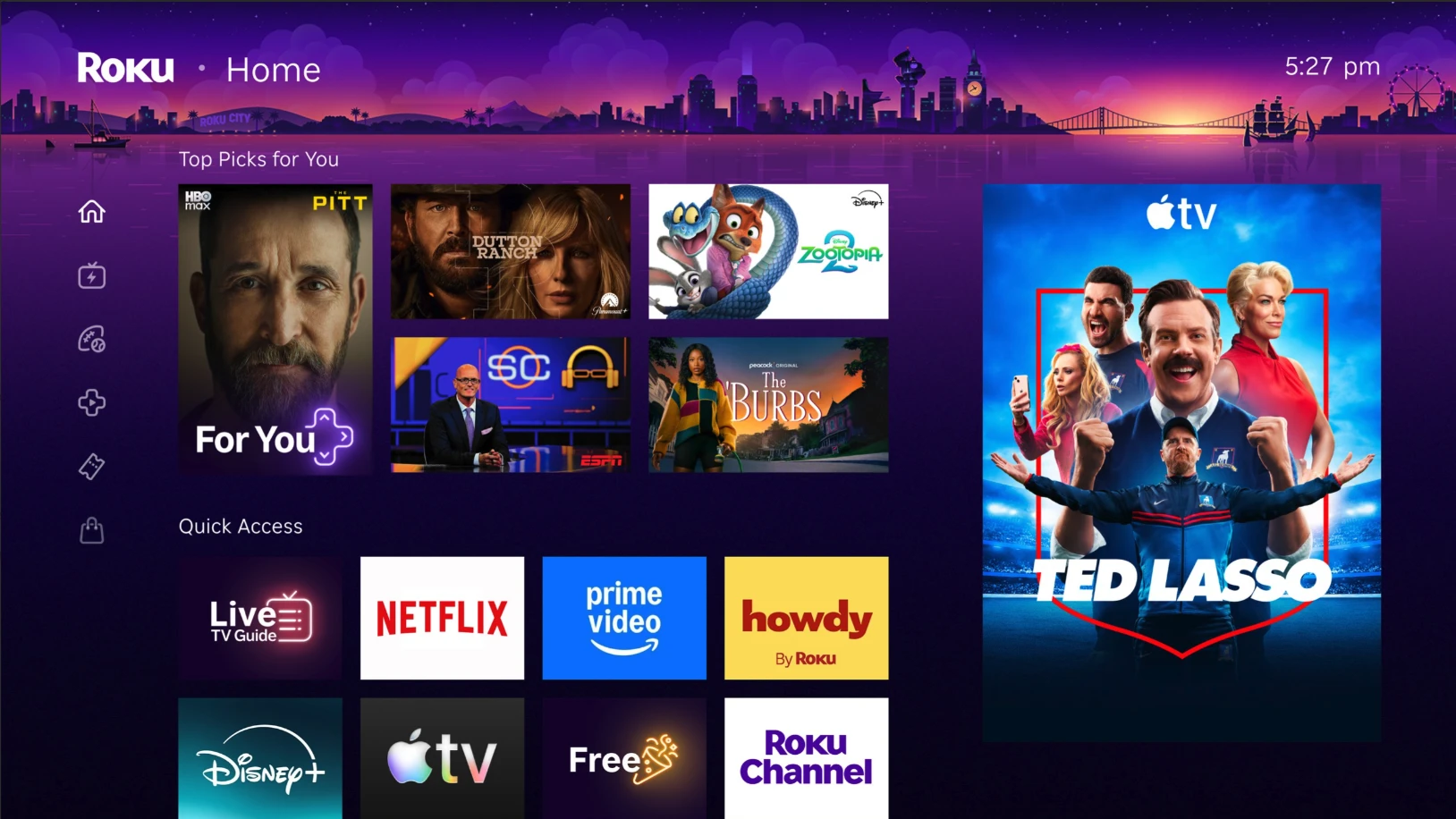
There's no reason to think Apple's system is built on fundamentally different logic. If a distributor's content is already gaining traction — through marketing spend, a hit show, a cultural moment — a personalization-driven UI/UX will amplify that traction rather than referee it neutrally. Peacock's surge might be entirely explainable by what Peacock put in market that quarter, with zero reference to M&A speculation.
That's the boring, probably-true answer.
Why the Coincidence Is the Story Anyway
Here's the uncomfortable part: it doesn't actually matter whether Apple's algorithm "meant" anything by boosting Peacock. What matters is that nobody can decipher the difference between a focused company quietly building toward a strategic outcome and a streaming app just doing what personalization engines do.
At the same time 65% of streaming executives believe platforms charge premium placement rates without adequate proof of performance. Only 8% are using any kind of third-party verification tool. Everyone else is negotiating blind, trusting the platform that sells the inventory to also be the sole reporter of how those placements performed.
Now apply that same blind spot to a home screen owned by a company that could very well become one of the largest content owners in the industry.
If Apple acquires NBCU, Apple TV's home screen — the same interface currently steering 96.6% of its value toward Apple's own originals — would also control distribution for Peacock, Bravo, Telemundo, USA, and Universal's entire slate.
Watch the Home Screen, Not the Headline
We said it before and it's worth repeating:
Apple has the balance sheet
The strategic gap
And historically the least to say publicly about any of it (it's worth noting that John Ternus takes the reigns as Apple CEO on September 1, 2026)
That gap between logic and posture is where the interesting acquisitions come from.
Watch Apple and subscribe to State of Streaming for more data-backed p0erspective like this.
Get the Looper Insights Q2 UI/UX Report for yourself by downloading it here.
Get the SOS. Brief
The sharpest streaming intelligence, delivered to your inbox.