Is Netflix Building an Ad Tech Company? It Sure Seems So.

Here's the timeline so far.
January 22, 2026. Netflix announces a TikTok-style vertical video feed coming to its mobile app, built to surface clips from its library and exclusive video podcasts from licensing deals with iHeartMedia and Spotify. Co-CEO Ted Sarandos identifies Instagram as a key competitor. The company confirms its ad business surpassed $1.5 billion in 2025, with plans to double that figure.
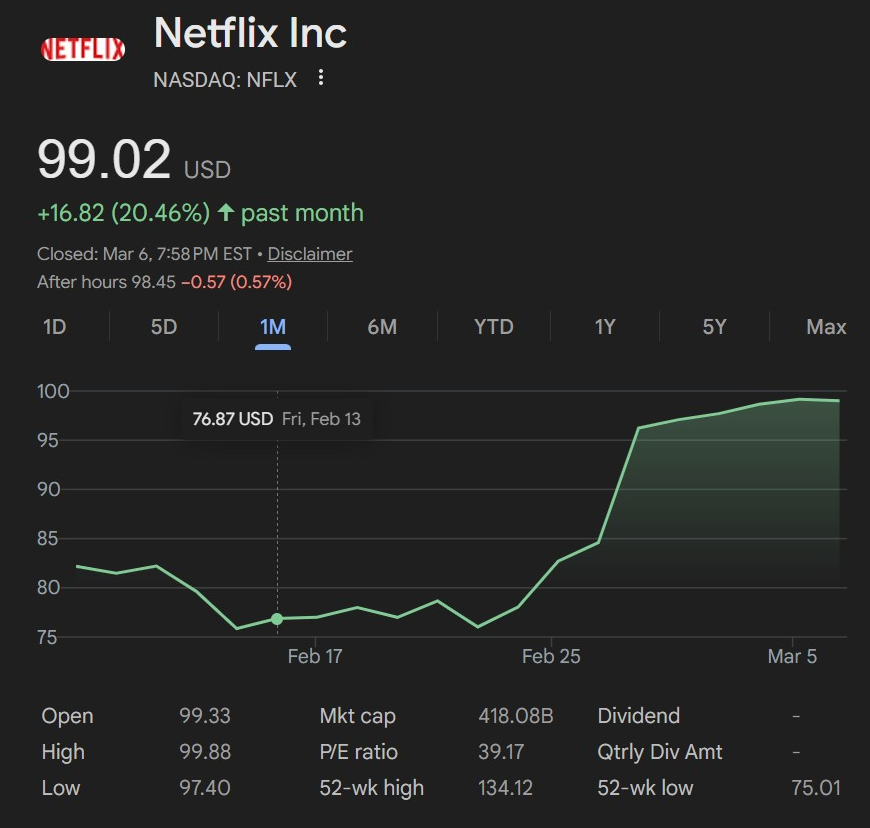
February 13, 2026. Netflix promotes Elizabeth Stone to the newly created role of Chief Product and Technology Officer, consolidating product, engineering, and data under a single executive. Several dozen middle management and administrative roles are cut in the same sweep. $NFLX closes at $76.87.
February 18, 2026. Ampere Analysis data reveals that non-English titles now account for 52% of Netflix's original TV series lineup, with Korean content surging to 20% of non-English originals. English-language productions still command the majority of spending, but the volume tipping point signals where Netflix's growth engine actually lives: global scale.
February 21, 2026. Netflix accelerates its Pay-1 licensing deal with Universal Pictures to begin this year, a full year ahead of the original 2027 start. New films from Universal, Focus Features, DreamWorks Animation, and Illumination will run exclusively on Netflix for 10 months after an initial four-month Peacock window. The deal unseats Prime Video from the Pay-1 position.
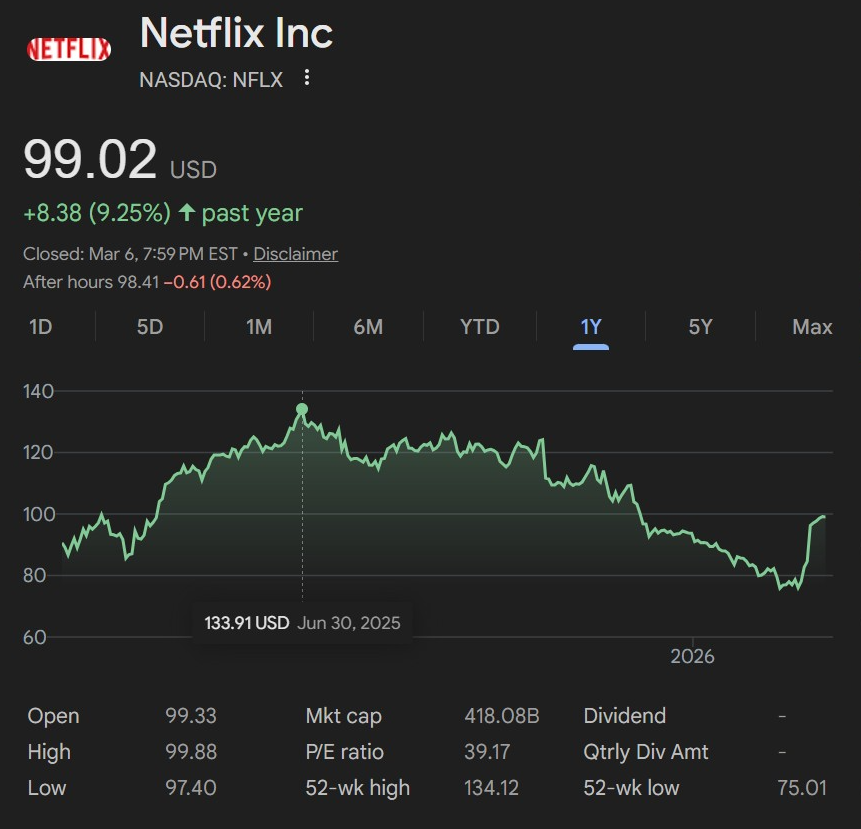
February 23, 2026. $NFLX touches $75.01 intraday, its 52-week low. The stock has shed more than 44% from its June 2025 peak of $134.12, weighed down by the overhang of an $83 billion all-cash WBD acquisition that would have multiplied Netflix's debt load five or six times over.
February 26, 2026. Netflix declines to match Paramount Skydance's $111 billion counteroffer for WBD. Co-CEOs Ted Sarandos and Greg Peters call the deal "no longer financially attractive." $NFLX closes at $84.59, then spikes 10% in after-hours trading. Wall Street exhales.
February 27, 2026. Apple and Netflix announce a Formula 1 cross-platform alliance, bringing Drive to Survive to Apple TV while Netflix simulcasts the Canadian Grand Prix. Separately, Paramount pays Netflix the $2.8 billion breakup fee. $NFLX closes at $96.24 on 200 million shares traded. Single-day gain: 13.77%.
March 4, 2026. Netflix opens audience targeting through Amazon DSP and Yahoo DSP, layering Amazon's purchase behavior data and Yahoo's deterministic behavioral segments into its targeting stack. The same announcement introduces a proprietary Conversion API with early attribution results that outperformed benchmarks by more than 75%.
March 6, 2026. Netflix acquires InterPositive, the AI filmmaking technology company founded by Ben Affleck, absorbing a production toolset designed to reduce the cost and complexity of making content at scale. $NFLX trades around $99.
From 52-week low to a 32% move in eight trading days.
Nine moves in 44 days. Each one with its own news cycle. The vertical feed was a product story. The reorg was a leadership story. The content data was an international story. The Universal deal was a licensing story. The WBD walkaway was an M&A story. The Apple partnership was a sports story. The ad suite expansion was a programmatic story. The InterPositive deal was a Hollywood story.
Individually, each one has its own clean narrative.
For the streaming ad market, the practical implications are already in play. Netflix is ready for this Upfront cycle with a fundamentally different product than it had a year ago. This year the story is programmatic access, behavioral targeting at scale, first-party attribution, short-form mobile inventory, and a content pipeline that spans original production, global licensing, and live events in a single buy. Anyone that was competing on those capabilities now face a competitor that matches their infrastructure while carrying a content brand no one can replicate.
But the longer-term question is structural. When a company controls the content creation pipeline, the audience relationship, the targeting data partnerships, the measurement layer, and the inventory surfaces, the traditional boundaries between content company, ad platform, and technology infrastructure stop meaning much. Netflix doesn't need to declare itself an ad tech company. It just needs to keep building the machine. The content is what makes people show up. Everything else is what makes that attention convertible into revenue at every stage of the funnel.
The industry keeps evaluating Netflix's ad business as if it's a feature bolted onto a streaming service. The org chart, the data partnerships, the production technology acquisition, the content licensing acceleration, the new ad surfaces, and the capital allocation decision that made all of it possible suggest something different. Netflix is engineering a system where content, commerce data, and advertising infrastructure operate as a single integrated loop. Wall Street figured this out in a single trading session. The stock didn't recover 32% because Netflix avoided a bad deal. It recovered because the market saw what Netflix is building with the money it didn't spend.
The companies that should be paying the closest attention aren't other streamers. They're the DSPs, measurement vendors, and ad tech intermediaries who currently sit between advertisers and audiences, occupying exactly the space Netflix is building around.
Get the SOS. Brief
The sharpest streaming intelligence, delivered to your inbox.