Are Media Buyers Buying NBA Blowouts?

The debate over Mark Cuban's proposal to shorten NBA games from 48 minutes to 40 has centered on whether fewer minutes would improve the on-court product. The more consequential question is whether the league can afford to find out.
The NBA's sportsbook partnerships now generate an estimated $585 million in annual revenue, according to projections from the American Gaming Association and Nielsen Sports. That figure includes $160 million in direct gaming-related income from sponsorship, advertising and data licensing. Sportsbook advertisers alone spent $52.1 million on in-game NBA telecasts during the 2024-25 season, producing 1.93 billion household impressions.
Breaking down the math
Points, rebounds, assists, three-pointers made and their various combinations all price against one variable: possessions. A standard NBA game generates approximately 100 possessions per team. A 40-minute game at the same pace would produce roughly 83. That is 17 fewer shot attempts to set a points over/under, 17 fewer trips down the floor to price a rebound, 17 fewer chances for an assist to clear. Multiply across an 82-game season and each team loses roughly 1,400 possessions, the statistical equivalent of 14 full games vanishing from the prop bet menu without removing a single contest from the schedule.
Each lost possession eliminates a pricing surface for the live in-game betting markets that represent the fastest-growing segment of the U.S. sports wagering industry. DraftKings, FanDuel, BetMGM and Caesars all hold official partnerships with the NBA.
The league's authorized real-time data feed is a commercial product, and sportsbooks pay for possession-level information to set and adjust lines during live play.
The integrity problem is older than the apps
Gambling-related corruption in basketball predates the legal sportsbook era by decades, from the 1951 City College of New York point-shaving scandal (that effectively ended Madison Square Garden as the center of college basketball and sent several players to jail) through the Tim Donaghy referee case in 2007. Legalized betting industrialized the incentive structure and prop markets made individual player performance a tradable asset.
That infrastructure has already produced criminal liability. Just six months ago (October 2025), federal authorities arrested 34 people in a scheme involving four organized crime families and insider NBA information used to manipulate prop bets . Players allegedly removed themselves from games so bettors could cash their unders.
How It Works: Because the player left early, they didn't get as many points as projected. The bettor wins the money because they had "inside information" that nobody else knew.
The FBI called it the insider trading saga for the NBA.
The product is already thinning
The counterargument to protecting possession volume is less obvious and potentially more damaging to the league's current position. A study published this week by Yahoo Sports found that only 72 of 220 nationally televised games this season featured all designated star players on both rosters. That is 32.7%. Star availability dropped from approximately 80% last season to around 60% this year, with stars collectively missing more than double the games lost at the same point two seasons ago.
Superstars sitting is bad for business. A shorter game that keeps stars healthier and available for more contests could actually produce higher cumulative betting volume across a season than the current format, where the league's most marketable players routinely sit.
Two formats, one league
The NBA's own expansion plans complicate its resistance further. NBA Europe is targeting a fall 2027 launch across 12 permanent franchise cities including London, Berlin, Madrid, Paris and Rome. The league received more than 120 investor bids this week, with multiple offers exceeding $1 billion . Those games will operate under Fédération Internationale de Basketball (FIBA) rules of 40 minutes. The league is preparing to run the format Cuban proposed while defending the longer one domestically.
The tab nobody audits
One dimension of the gambling economy remains largely unexamined in sports industry coverage. A Federal Reserve Bank of New York study published in March found that credit delinquencies rose 10% among Americans who took up sports betting after their state legalized it. Among bettors under 40, the increase reached 26 percent . Americans have wagered more than $520 billion on sports since the 2018 Supreme Court decision. The NBA collects nine figures annually from the industry those wagers sustain.
The "Efficiency Gap" Breakdown
The Blowout Churn: During the 2025 NBA Finals, Game 1 viewership plummeted to 8.19 million , one of the lowest marks in history. For advertisers, this creates an Effective CPM spike; when 25% of the audience tunes out during a blowout, the price paid per actual viewer remaining in the fourth quarter increases by roughly 35-40%.
Engagement Density: NBA ads in early 2026 are proving 18% more likely to generate consumer engagement than standard primetime spots. Cuban’s argument is that a 40-minute game—which he likens to reducing the schedule by 13.6 games —would eliminate low-leverage minutes, thereby sustaining advertising value throughout the entire broadcast window.
Programmatic Sensitivity: With the NBA seeing a 62% year-over-year increase in ad impact, programmatic buyers are increasingly sensitive to "junk time." A shorter, more competitive game ensures that automated bids are placed against an active, high-intent audience rather than a dwindling pool of "background" viewers.
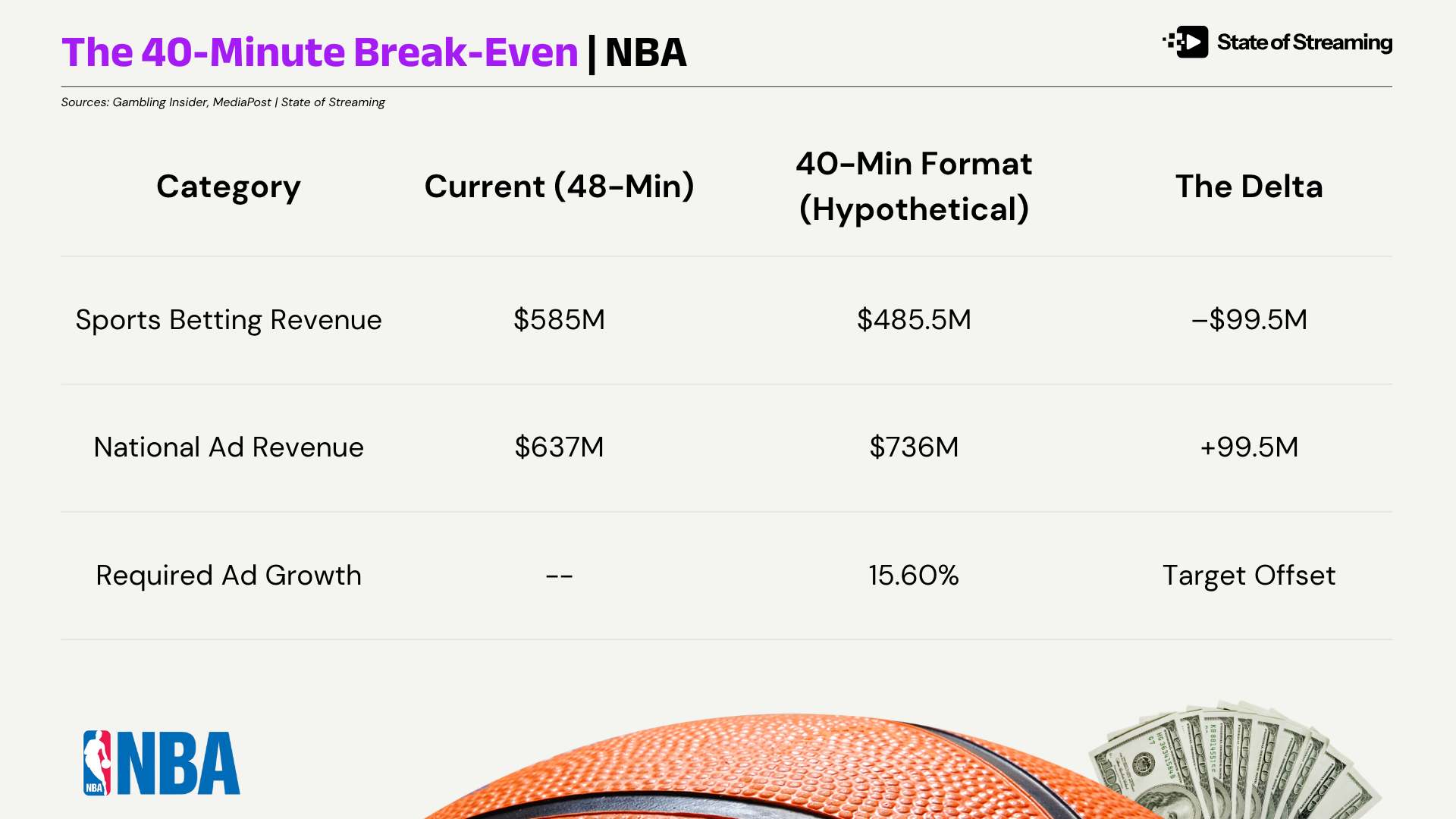
Media partners like Amazon and NBCUniversal want a dense, 40-minute product that holds audience attention, while sportsbook partners want the high-volume, 48-minute product that provides the maximum number of betting opportunities. Cuban's proposal forces the league to decide which "revenue delta" is more sustainable for its long-term health.
The Break-Even Calculation
To recover that $99.45 million loss, the NBA must prove to media buyers that a shorter game creates more than 15.6% in "new" value.
Get the SOS. Brief
The sharpest streaming intelligence, delivered to your inbox.