ViantAI Decisioning Redefines the DSP: What Does It Mean for Advertisers?
Key Takeaways
Viant's AI Decisioning product automates the full programmatic advertising lifecycle in real time, compressing the distance between brief and buy and shifting media planners permanently upstream toward objective-setting rather than execution.
Revenue grew 25% year-over-year to $88.5 million in Q1 2026 and adjusted EBITDA grew 81% to $9.8 million, but traffic acquisition costs grew 37%, a spread that will determine whether AI Decisioning is a margin story or only a product story.
Viant's three-pillar intelligence layer (content, identity, attention) now includes real-time attention signals via the TVision acquisition.
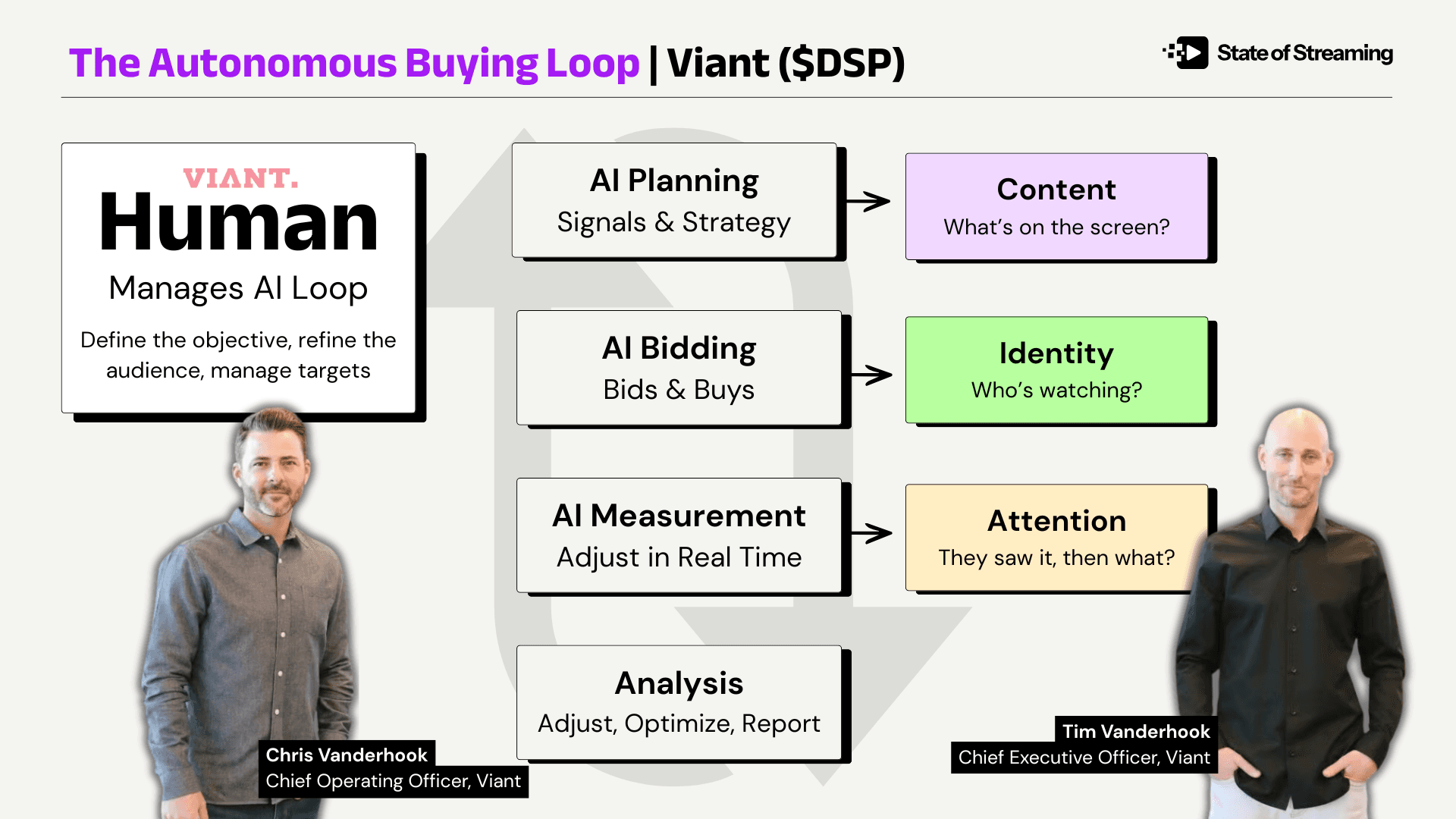
Viant Technology's AI Decisioning product, launched in Q1 2026, reads signals, sets bids, adjusts mid-flight, and reports outcomes without a planner in the seat. From planning to execution, measurement and dynamic optimization, ViantAI is automating the entire programmatic lifecycle in real time.
AI-in-the-Loop
Media planners do not disappear in this model. Instead, they move upstream. The brief, the objective, the audience definition, the outcome target: those remain human decisions. What collapses is the distance between brief and buy.
ViantAI's Decisioning suite includes :
AI Planning
AI Bidding
AI Decisioning
AI Measurement
Analysis
All designed to be the autonomous execution layer, compresses what took days of trafficking, pacing adjustments, and optimization calls into a continuous machine loop.
For brand strategists, this changes the conversation with agency partners.
If the execution layer is automated, the opportunity becomes how well a team is able to define the outcome the machine is optimizing toward. Garbage objectives produce garbage automation.
The brief becomes the most important document in the media plan.
For media buyers evaluating platforms, this creates a new evaluation criteria altogether. Streaming inventory access and CPM matter and so does the quality of the signal that the platform feeds its autonomous layer.
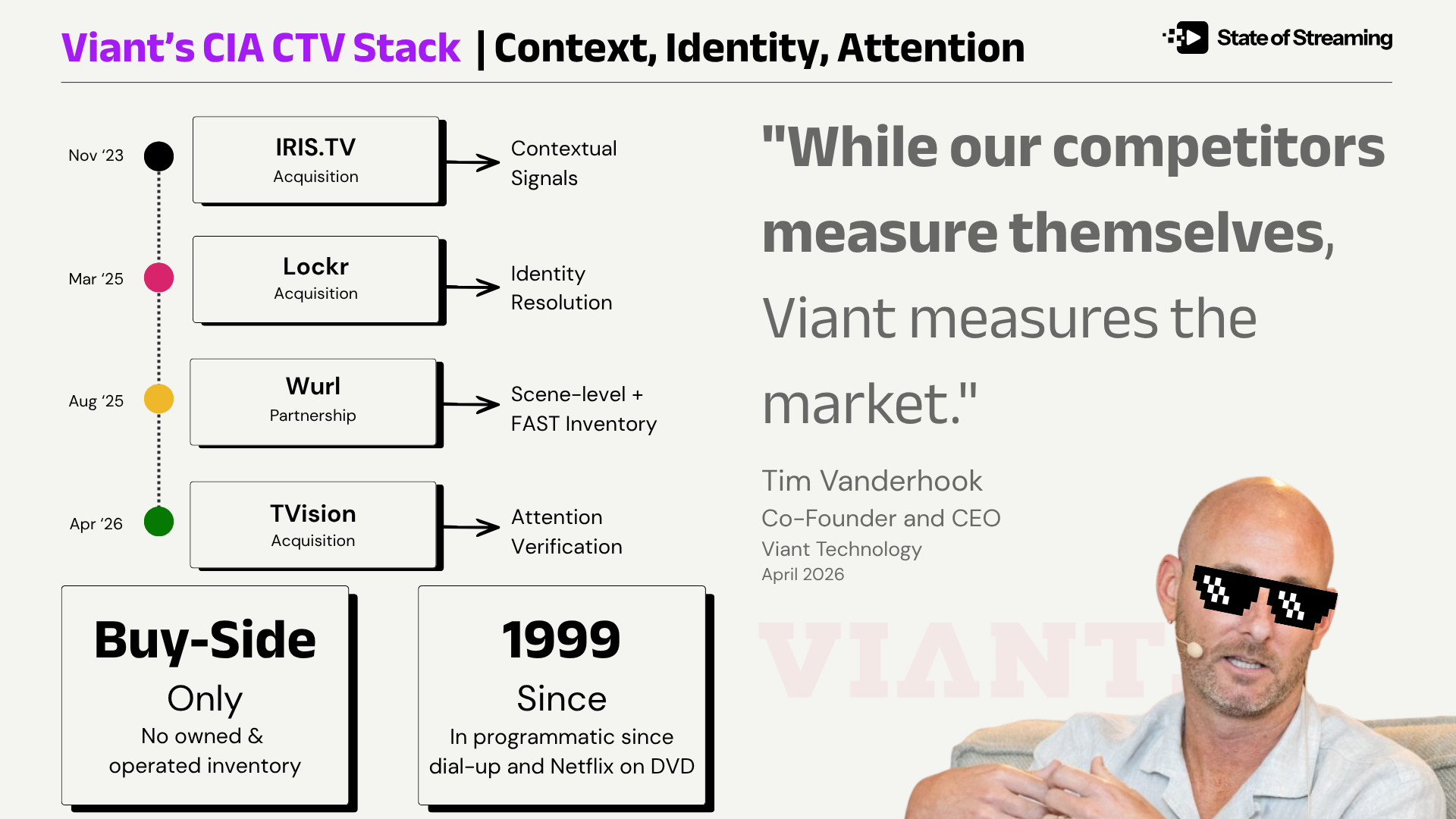
Viant's intelligence layer now runs on three data pillars: content, identity, and attention, the last added through its May 1 acquisition of TVision Insights, which brings real-time attention signals from computer vision technology installed in panelist households.
Read about the Viant CIA CTV Stack next
The Revenue Story Validates the Direction
Viant posted $88.5 million in revenue for the first quarter of 2026, a 25% increase year-over-year. Adjusted earnings before interest, taxes, depreciation, and amortization (EBITDA) reached $9.8 million, up 81% from $5.4 million in the same period a year prior. Non-GAAP net income nearly doubled, from $2.8 million to $5.6 million.
One number cuts against the clean narrative. Traffic acquisition costs (TAC) grew 37% year-over-year, outpacing revenue growth of 25%. TAC is the cost Viant pays to access inventory, and it scales with volume on the fixed CPM model. The spread between TAC growth and revenue growth is a tension worth watching. If AI Decisioning drives more efficient buying at lower eCPMs, that spread should narrow.
What It Means for the Planning Room
The programmatic buying workflow is not being eliminated. Rather, it is being compressed and recentered. The planners who define objectives clearly, select the right outcome targets, and understand what signal quality means for autonomous optimization will get more out of this system than planners who treat it as a black box. The platforms that win the agentic buying era are the ones whose signal layer earns trust. Viant is betting the TVision attention data is that differentiator.
The brief went upstream.
The machine took the wheel.
And over the next two quarters we'll find out if that is full self-driving or something in between.
Get the SOS. Brief
The sharpest streaming intelligence, delivered to your inbox.