The Scoop: March Madness Breaks Every Record, Netflix Opens MLB, And A Rundown Across Leagues

March Madness shattered viewership records across both tournaments. Netflix took its first at-bat with MLB. The streaming premiere calendar finally showed a pulse. And every year-over-year comparison this month carries a massive footnote from Nielsen about viewership.
The Ratings Story
The biggest number this week is 10.7 million. That's the average viewership across CBS, TNT, TBS and TruTV through two rounds of the men's NCAA Tournament. It is the most-watched March Madness ever measured. It is also the first March Madness measured under Nielsen's Big Data + Panel methodology, which debuted in September 2025 and generally inflates live sports figures by capturing out-of-home viewing that older measurement missed.
The 9% first-round increase. The 7% second-round gain. The "most-watched since 1993" framing. All real numbers. All unreliable as trend indicators. The women's tournament is posting the second most-consumed opening rounds on record, trailing only the Caitlin Clark-era 2024 field. Also measured under the new methodology for the first time.
Every pitch deck created in the next 60 days will cite these figures as evidence of sports rights appreciation but the buy side should be asking a simple question: how much of this growth is audience, and how much is measurement? Until Nielsen publishes apples-to-apples rebenchmarking, no one can answer that fully with confidence.
March Madness Rewrites the Record Book (Again)
The tournament delivered exactly what CBS and TNT Sports needed heading into upfront season. The Round of 64 averaged 9.5M viewers across four networks, up 9% year-over-year. The Round of 32 climbed to 11M, the highest second-round figure since 1993. Sunday's early primetime window — St. John's over Kansas on a buzzer-beater, Iowa's upset of top-seeded Florida, Tennessee over Virginia — pulled 19.7M viewers. That single window outperformed last year's per-game NBA Finals average.
St. John's buzzer-beater victory over Kansas was the individual ratings leader at 10.58M on CBS. Nine of the ten most-watched games aired on CBS, reinforcing what the network already knows: tournament inventory on the flagship broadcast channel commands a pricing tier that cable windows cannot match, regardless of matchup quality.
The bracket lost its last mid-major before the Sweet 16 for the second consecutive year. No Cinderella, no problem. The audience showed up anyway. That pattern matters. It suggests the tournament's cultural gravity has decoupled from upset narratives and attached itself to the bracket pool ritual, the viewing-occasion habit, and the sheer density of simultaneous action.
Beyond Single-Star Power
The women's tournament posted the second most-consumed first and second rounds in history, behind only 2024. The Round of 32 averaged 1M viewers, the second-highest mark on record. Total consumption through two rounds hit 3.3 billion minutes across ESPN platforms.
The first round on ABC delivered the strongest numbers. UConn's win over UT-San Antonio drew 981K viewers. South Carolina vs. Southern was right behind at 972K. Both rank among the top seven first-round games ever. NC State's opening win over Tennessee pulled 767K on ESPN to become the most-watched weekday first-round game on record.
The First Four on ESPN2 set its own baseline: Rutgers vs. Nebraska at 456K, Stephen F. Austin vs. Missouri State at 354K, Arizona State vs. Virginia at 314K, Samford vs. Southern at 237K.
The second round escalated. South Carolina vs. USC led at 1.8M. UConn vs. Stanford and Notre Dame vs. Ohio State each drew 1.5M. No. 10 Virginia's upset of Iowa pulled 1.4M. All four games cracked the all-time second-round top ten.
The narrative entering this tournament was whether women's basketball could sustain post-Clark growth. The answer through two rounds is yes. Sarah Strong and Azzi Fudd are the headliners now, and the numbers held.
Netflix Takes Its First At-Bat
Netflix opened the 2026 MLB season Wednesday night with an exclusive broadcast of Yankees vs. Giants from Oracle Park. The Yankees won 7-0. Max Fried threw six scoreless innings. Bert Kreischer introduced the game. A detached hand from Wednesday threw the first pitch.
Set aside the spectacle. The structural question is whether Netflix's $50 million annual commitment — Opening Night, the Home Run Derby, and the Field of Dreams game — produces enough data to justify a larger package when MLB's broader media rights come up after the 2028 season. Netflix VP of Sports Gabe Spitzer framed the goal as converting casual fans and documentary viewers into live sports habit. That is a funnel thesis, not a ratings thesis.
The domestic case is still unproven. Nielsen will report official viewership for the opener (Netflix agreed to measurement, unlike Apple TV+). But the global case is already building. The World Baseball Classic games on Netflix in Japan reached 31.4M viewers across 47 games. That is a staggering number for a single international market and the clearest signal yet that Netflix's sports strategy is a distribution thesis with global math, not a domestic ratings play competing head-to-head with CBS and Fox. The $50M annual MLB commitment looks like a loss leader if you only measure it against U.S. households. Measure it against 190 countries and it starts to look like infrastructure.
The broadcast booth featured Matt Vasgersian on play-by-play with CC Sabathia and Hunter Pence, plus a studio team of Elle Duncan, Barry Bonds, Albert Pujols and Anthony Rizzo. More playing experience than broadcasting experience. Netflix's NFL Christmas games had the same profile. The pattern suggests Netflix views talent pedigree as a credibility signal for casual audiences rather than optimizing for broadcast polish.
Meanwhile, the Red Sox season opener was the most-streamed game in New England Sports Network (NESN) history, 17.5% above the previous record. Regional streaming records getting broken on opening day is a quiet signal that the RSN-to-DTC migration is accelerating, even as the national rights fragment across seven broadcast partners. MLB now has more national broadcast partners than any other major league. Whether that approach maximizes total reach or just diffuses it is the question the next cycle will answer.
The Premiere Calendar Finally Has a Pulse
After a quiet winter, four titles arrived this week with strategic implications worth watching.
Prime Video launched Bait on March 25, a four-episode limited series written by and starring Riz Ahmed as a British-Pakistani actor whose James Bond audition triggers an identity crisis. Four episodes, high-craft, narrow audience. The strategic question for Amazon: do short-run prestige originals drive the same retention signal as franchise IP?
HBO brought back The Comeback for a third season on March 22. Lisa Kudrow's Valerie Cherish navigates an industry dominated by streaming wars and AI-written scripts. More than a decade between seasons. The bet is that the show's cult following has compounded through the exact disruption the new season satirizes.
Disney+ premiered Daredevil: Born Again Season 2 on March 24, adding Krysten Ritter as Jessica Jones and Matthew Lillard to the cast. Marvel's streaming strategy continues to prioritize volume and interconnection. The question remains whether each new season moves subscriber acquisition or simply services the existing base.
Apple TV returned with For All Mankind Season 5 on March 27. Apple's longest-running original drama and one of its most critically regarded. Apple has never disclosed viewership. Five seasons without cancellation on a platform that has axed shows with larger apparent audiences suggests the show serves a brand-positioning function that transcends raw viewership math.
The NBA's Regular-Season Problem Gets Louder
Minnesota Timberwolves vs. Boston Celtics averaged 1.88M on NBC on March 22. For context, that same Sunday early primetime March Madness window pulled more than ten times that figure. College basketball is outperforming the league it feeds into. Last week's rundown flagged the NBA Saturday Primetime decline at 21% year-over-year.
Hockey Finds Its Window
Boston Bruins vs. Detroit Red Wings averaged 1.3M on ABC on March 21, the network's most-watched regular-season game in years. Minnesota Wild vs. Tampa Bay Lightning drew 435K across TNT and truTV on March 24. ESPN losing its Sunday night NBA games to NBC has opened premium windows for hockey.
NASCAR and the Underpriced Inventory Thesis
The Goodyear 400 Cup Series race at Darlington averaged 2.429M on FS1. The CW's Xfinity Series race pulled 1.182M. The Craftsman Truck Series earned 535K on FS1. All three represent healthy linear audiences and further evidence that the CW's pivot to sports programming is generating real inventory. Motorsports continues to be the most underpriced live sports audience relative to its delivery.
Soccer's Cable Ceiling
The English Premier League dominated cable soccer, with USA Network's top telecast drawing 415K on March 22 and Saturday's window adding 396K. ESPN Deportes posted 313K for La Liga on Sunday afternoon. MLS drew 250K for Austin FC vs. LAFC on FOX on March 31.
The EPL's cable ceiling on USA Network is becoming clearer. The question for Comcast is whether Premier League inventory belongs on Peacock to drive subscriber conversion or stays on linear to protect ad revenue.
The Rest of the Card
WWE Raw earned 3M worldwide viewers on Netflix on March 16. Steady, not spectacular. The show's value to Netflix is less about per-episode peaks and more about weekly habit formation on a platform built for binge consumption.
Marshals Episode 2 averaged 17.2M multi-platform viewers in its first seven days across CBS and Paramount+. The Yellowstone universe remains the most efficient content-to-audience pipeline in broadcast. Episode 2 held 17.2M after the premiere's 20.6M. That's retention, not sampling.
The Hannah Montana 20th Anniversary special earned 6.3M viewers in three days on Disney+ and Hulu. Nostalgia IP requires zero marketing spend to find its audience.
BTS: Comeback Concert earned 13.1M viewers in one day on Netflix. Global fandom infrastructure produces numbers that domestic-only measurement frameworks cannot contextualize. This is the same thesis as the Japan WBC figure. Netflix's scale advantage in live events is international reach, not U.S. household share.
Taylor Sheridan's The Madison premiere earned 8M global viewers in its first 10 days on Paramount+. The question is whether that audience follows the creator or the platform when the next rights negotiation arrives.
Scrubs Revival Episode 5 drew 3.07M viewers on ABC. The Faithful: Women of the Bible premiered to 1.544M live viewers on FOX. Faith-based programming remains a consistent performer on broadcast. FOX continues to find pockets of underserved audience.
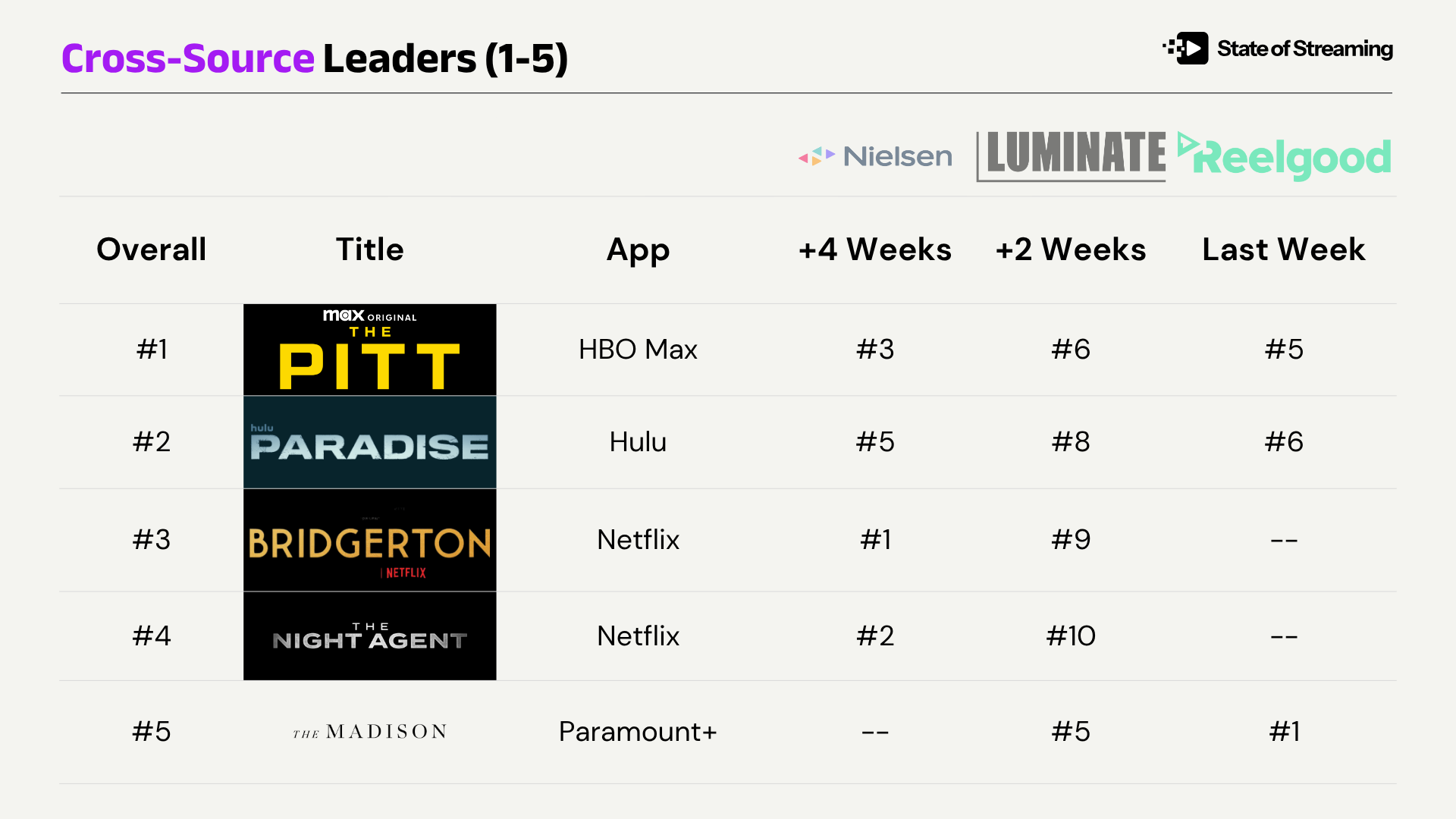
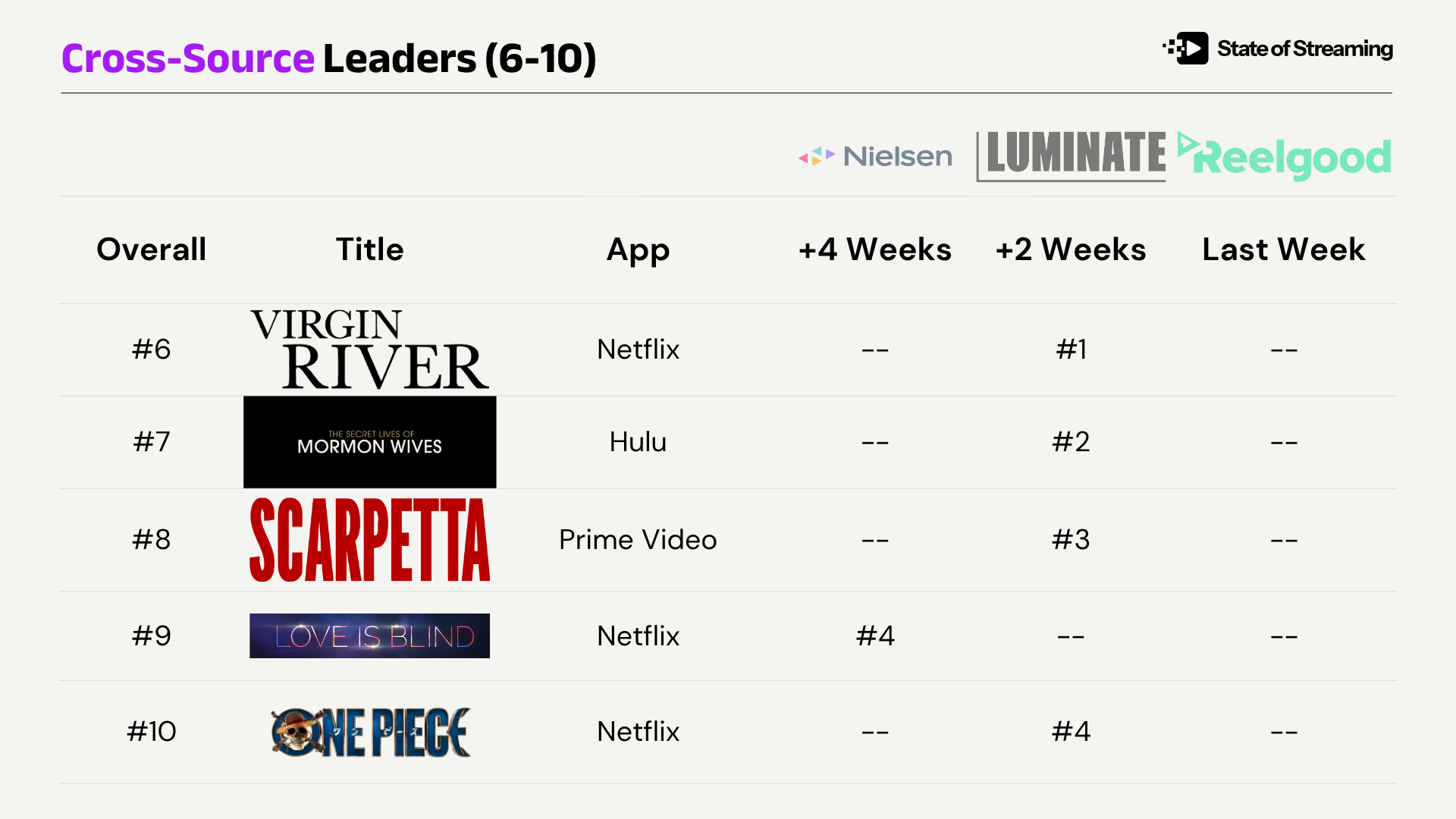
Measurement Snapshot: Three Sources, One Stack Rank
Each measurement provider captures a different slice of audience behavior. Nielsen measures minutes on the TV glass (three-week lag). Luminate tracks streaming engagement across platforms (one-week lag). Reelgood aggregates demand signals in near real-time. SambaTV uses smart TV automatic content recognition (ACR) data but did not report rankings this week.
Titles appearing on two or more sources are ranked first (cross-source presence is the strongest signal of durable audience), followed by each source's unique entries.
This Article By the Numbers
- 10.7M — Average March Madness viewers through two rounds, most-watched ever (with a Nielsen methodology asterisk)
- 19.7M — Sunday early primetime window, largest first-week window in tournament history
- 3.3B min — Women's tournament total consumption through two rounds, second-highest on record
- 31.4M — WBC viewers on Netflix in Japan across 47 games
- 17.2M — Marshals Episode 2 multi-platform viewers, seven-day window
- 13.1M — BTS: Comeback Concert on Netflix, single day
- 10.58M — St. John's over Kansas, most-watched individual game of the tournament
- 1.88M — NBA Timberwolves-Celtics on NBC, one-tenth of the March Madness primetime window that same Sunday
Get the SOS. Brief
The sharpest streaming intelligence, delivered to your inbox.