The Real Reason FIFA Gave Netflix the 2030 World Cup in Spain
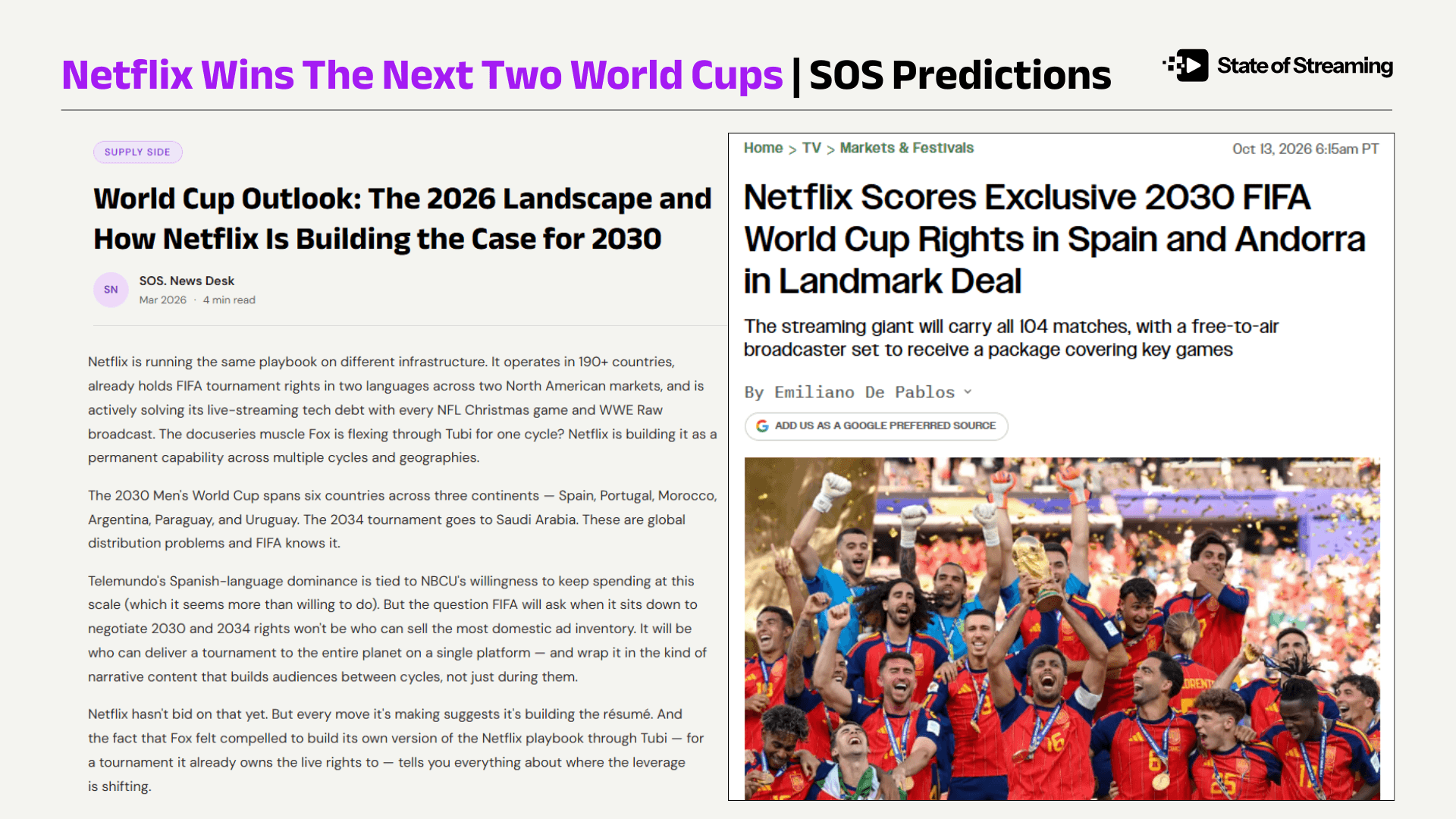
Netflix will stream all 104 matches of the 2030 FIFA World Cup in Spain and Andorra. Free-to-air TV keeps the matches that matter most. That split is the deal structure FIFA will try to sell everywhere else.
Netflix has secured exclusive 2030 FIFA World Cup rights in Spain and Andorra. It will carry all 104 matches of the centenary tournament, which Spain co-hosts with Portugal and Morocco. Financial terms were not disclosed.
In March, we argued Netflix was building a multi-cycle FIFA résumé ahead of the 2030 and 2034 negotiations. At the time, Netflix held no men's World Cup rights anywhere. This week the first piece landed.
It is one market, not the global, single-platform deal our March thesis described. But it is the right market to start with. Spain is the reigning world champion, a 2030 host nation, and a free-to-air TV culture. If the Netflix model works there, FIFA has a template to take to every other territory.
For buyers, the takeaway is simple. The 2030 World Cup will not be sold as one package to one broadcaster. Expect it to be split: streaming gets the volume of matches, broadcast keeps the biggest moments, and the two will be measured differently.
Netflix Gets the Volume. Free TV Keeps the Peaks.
Read about how Free World Cup Streaming Expands the Live Sports Audience here
Netflix's exclusivity comes with two carve-outs. One match per matchday will be available free in Spain. A separate package goes to a national free-to-air (FTA) broadcaster: every Spain match, both semifinals, and the final. Netflix has not named that partner.
Most European markets have "listed events" rules or strong political pressure to keep national-team matches on free TV. FIFA can't sell around that, so it sold around it differently: exclusivity on volume, broadcast on the matches that drive the biggest audiences.
Hear about how that is unfolding in this podcast clip with Keith Bedford, GM of EMEA at Wurl
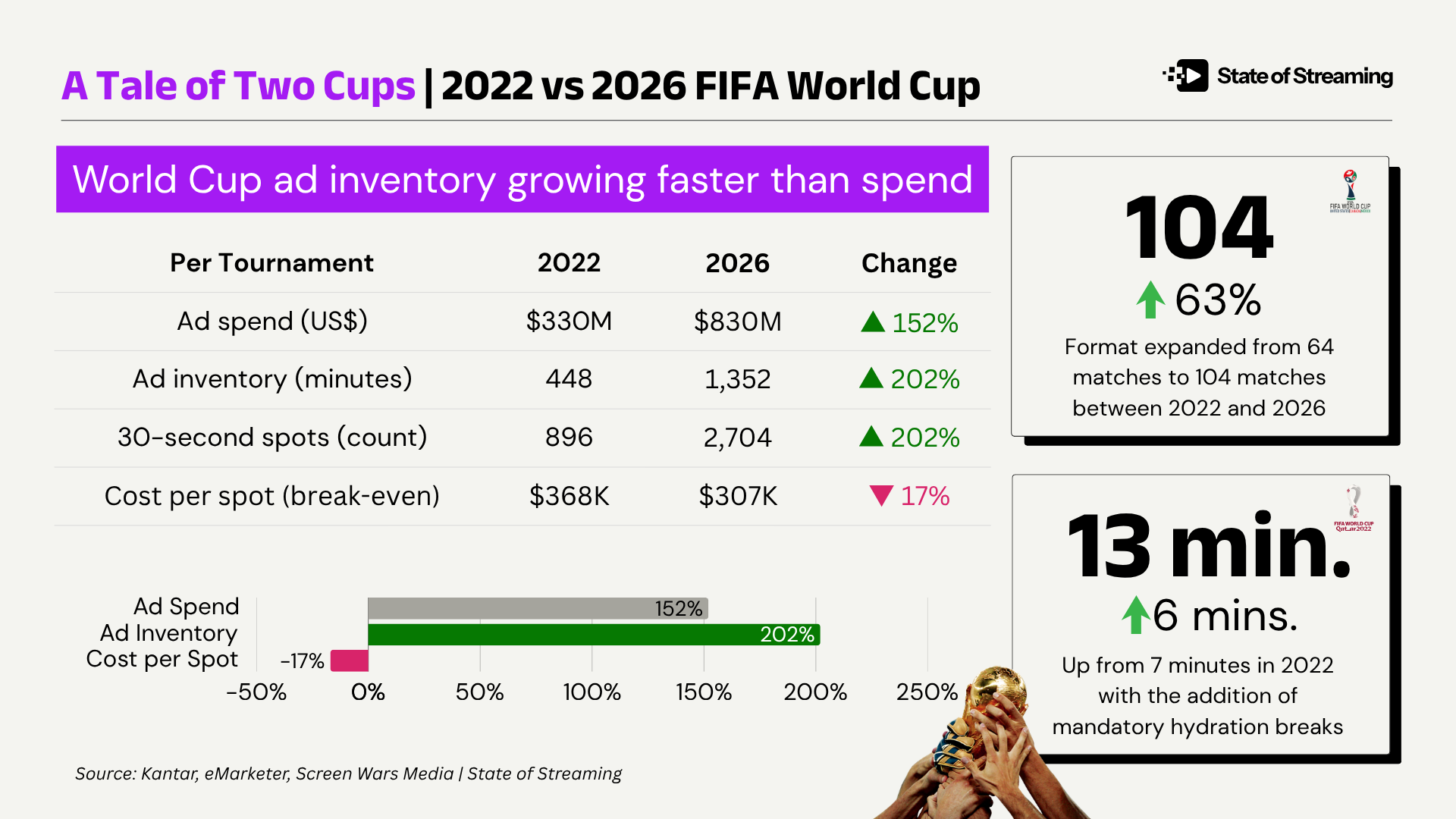
The volume is where the 2026 math points anyway. The format grew from 64 matches to 104. FIFA added two mandatory hydration breaks per match, taking ad time per match from 7 minutes to 13. U.S. ad inventory tripled while spend grew 152%, so the break-even cost per spot fell 17%. The value of a World Cup is shifting from a few must-see matches to the sheer quantity of live hours. Netflix took the quantity.
It also took the programming around the matches. Netflix plans Spanish-language pre-game, half-time and post-game shows, daily highlights programs, and content building up to the tournament. That is the shoulder programming Fox ran through Tubi in 2026 for one cycle. Netflix is building it to last.
What we're looking for next: Let's see who wins the Free-to-Air (FTA) package. If it's RTVE, Spain's public broadcaster, the template is "streamer plus public broadcaster." If it's a commercial network, FIFA has created a two-buyer auction it can run in every market.
The Women's World Cup Was the Audition
The Spain deal didn't start this week. It actually started during the Women's World Cup.
Netflix took exclusive U.S. rights to the 2027 Women's World Cup from Fox Sports, and Canadian rights from TSN. It then added the 2031 edition. Those deals gave FIFA what it needed to see before trusting Netflix with a men's tournament: a live-streaming track record and a narrative engine.
The track record came from NFL Christmas games, WWE Raw, boxing and MLB events. The narrative engine came from the FIFA docuseries "Captains of the World" and a FIFA-licensed game, "FIFA World Cup: Launch Edition," on Netflix Games. Outgoing Netflix Chief Content Officer Bela Bajaria tied the Spain deal directly to the Women's World Cup partnership in announcing it.
The sequence matters for anyone pricing the next cycle. FIFA didn't hand Netflix a flagship property cold. It tested Netflix on a smaller tournament in two markets, then gave it a men's tournament in one. The next step is more men's markets, not a global deal all at once.
What we're looking for next: In March we said FIFA was buying Netflix's audience-building machine, not just its streaming tech. The Spain deal's emphasis on Spanish-language studio shows and tournament build-up content supports that read. The live matches are the reason to sign. The year-round programming is the reason Netflix wins the bid.
Split Rights Means Split Measurement
A World Cup split between a streamer and a broadcaster is a World Cup counted two ways. 2026 already showed buyers what that costs.
In June, Nielsen revised Telemundo's opening-week World Cup viewership down 25 to 29 percent, mid-tournament, with no public explanation. The revisions hit Total Audience Delivery (TAD), the figure that combines Nielsen's linear TV panel with first-party streaming data from Peacock. The linear and streaming components on their own were not in dispute. The combined number was.
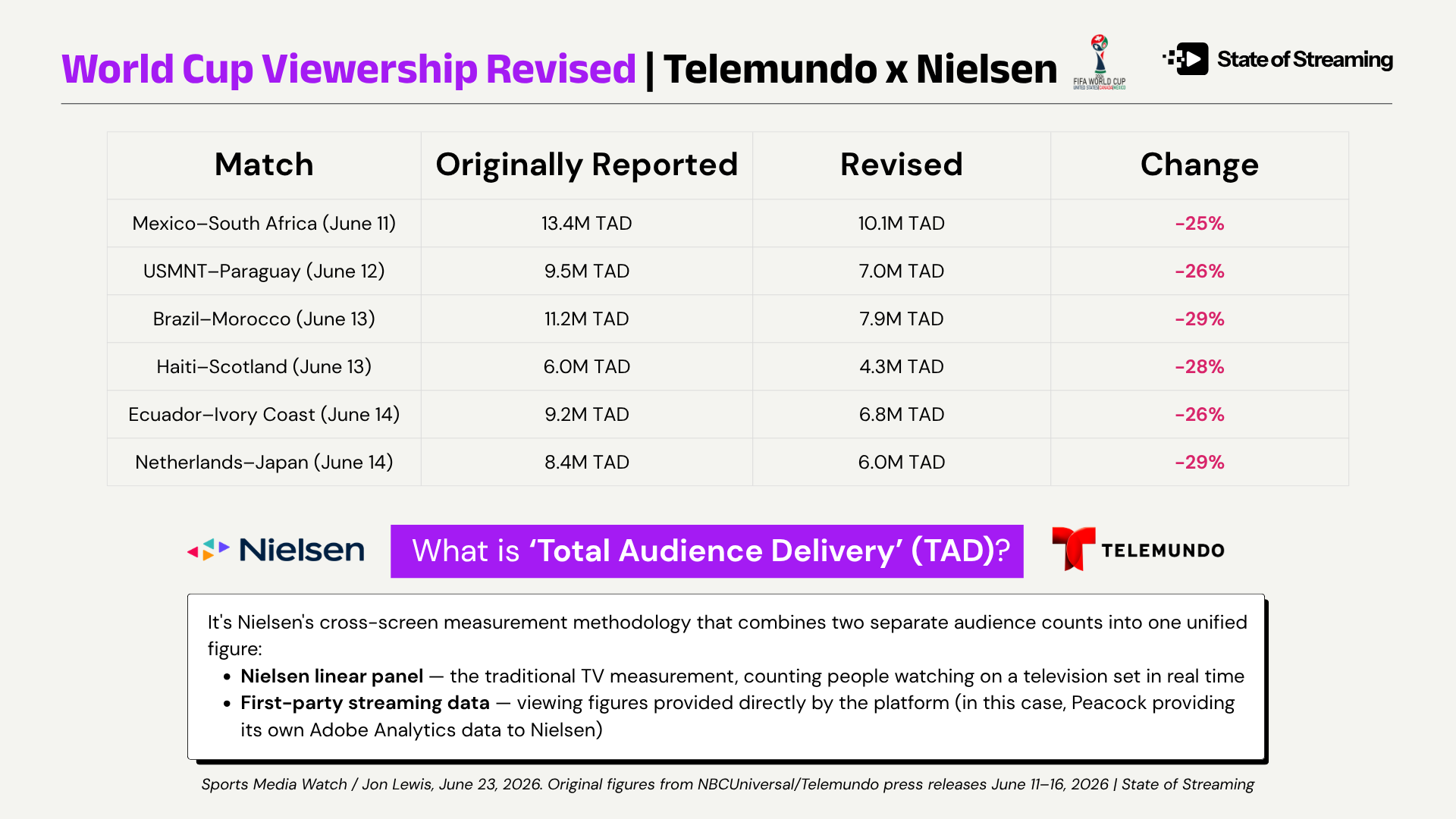
Spain in 2030 will have the same structure on a bigger scale but Netflix will grade its own homework. The FTA partner will report broadcast ratings from a TV panel. Any combined "total audience" figure will merge two sources that weren't designed to fit together. As we wrote in our viewership footnote piece, a real audience and an auditable number are not the same product.
The Fox side of 2026 offers the other lesson. Fox's English-language rights ran out on July 19. Its Tubi docuseries, Fox One subscriber push and free simulcasts were all built for a single tournament, with no 2030 rights behind them. As we put it in our Fox One analysis, Fox made the most of a one-time opportunity, while Netflix is building a franchise. Spain is the first proof that the franchise approach wins at the bidding table.
What buyers should do: When Netflix and its FTA partner start selling 2030 inventory, ask for each source's numbers separately. Price streaming against Netflix's first-party data and broadcast against the panel. Get a written correction policy before treating any combined figure as a planning metric.
What to Watch Next
The other 2030 hosts. Portugal and Morocco are co-hosts with the same national-team politics as Spain. Argentina, Paraguay and Uruguay host the three centenary matches on June 8 and 9. If Netflix's next deal is with any of them, FIFA is selling the Spain template host by host.
The big European markets. The U.K., Germany, France and Italy all protect major tournaments for free TV. A Spain-style split is the only version of Netflix exclusivity that works there. If it shows up in one of them, the template has gone from experiment to standard.
2034. Saudi Arabia hosts, and a winter tournament would land on top of the NFL season, the same clash that forced FIFA to extend Fox's and Telemundo's deals without a bidding war after Qatar 2022. Broadcasters with NFL rights will discount that tournament. A streamer with no NFL Sunday commitments won't have to.
The U.S. This is the market that decides the economics. The U.S. accounts for roughly 4% of global World Cup TV reach but about 16% of FIFA's media-rights revenue. Fox and Telemundo got 2026 without a competitive bid. 2030 will be contested, with kickoffs falling in U.S. mornings and afternoons. Netflix already holds U.S. Women's World Cup rights through 2031. In our March outlook, we argued FIFA's question for 2030 would be which platform can deliver the tournament everywhere, wrapped in programming that builds audiences between tournaments. Spain is the first answer. The U.S. will be the one that settles it.
This Article By the Numbers
104 matches Netflix will carry in Spain and Andorra in 2030
1 match per matchday available free in Spain
3 FIFA tournaments now on Netflix: 2027 and 2031 Women's World Cups (U.S. and Canada), 2030 men's World Cup (Spain and Andorra)
6 countries hosting 2030 matches across three continents
13 minutes of ad time per 2026 match, up from 7 in 2022
17% drop in U.S. break-even cost per spot, 2022 to 2026
25–29% downward Nielsen revision to Telemundo's 2026 opening-week figures
July 21, 2030: the scheduled final
And if you enjoyed this article, you may enjoy one of these, too:
World Cup Outlook: The 2026 Landscape and How Netflix Is Building the Case for 2030
The World Cup's Viewership Record Numbers Have a Footnote. This is the Footnote.
Why Fox Is Running the Largest Streaming Acquisition Test in Sports Media History
Netflix Expands Live Sports Playbook with FIFA World Cup Rights in Canada
Streaming giant Netflix challenges traditional broadcasters with Women's World Cup deal
Sources: Variety; Sports Media Watch; Kantar, eMarketer, Screen Wars Media; SOS. analysis.
Get the SOS. Brief
The sharpest streaming intelligence, delivered to your inbox.