The True Cost Of The Invisible Shelf: What It Costs Fans, Advertisers, And Rights Holders

You paid $1,500 a year. The game is on. And you're staring at a wall of tiles with no indication it's live.
No "watch now" badge. No start time. No signpost of any kind. Just another thumbnail in an endless grid. You paid for the right package, on the right app, for the right league. The content is there...you just can't find it.
That's the invisible shelf of streaming. Lucas Bertrand, CEO of Looper Insights , joined the State of Streaming Podcast to break down why the gap between what streamers spend on rights and what they spend on merchandising destroys value for fans, advertisers, and rights holders simultaneously.
The Cost Compounds
Advertisers buy against an audience the platform promised but the signpost failed to deliver. Sponsorship value collapses when top-of-funnel visibility breaks.
Rights holders price every deal on an assumption: the platform will surface the content effectively. At 1.3 errors per event, that assumption fails at scale, and the rights holder is the last to find out. The economics already don't work for anyone except the leagues: CBS generated $1.7 billion in NFL ad revenue last season against a $2.1 billion rights fee, and the NFL wants $3 billion a year for the next four years on a package CBS already holds the rights to.
At the IAB NewFronts, Horizon Media's David Campanelli put it plainly from the buy side. Even as a media executive, he has to research where his Celtics game is airing before he can watch it. "That's an issue," he said.
"It's a big issue for linear TV as these leagues get divvied up."
When the people buying the ads can't find the games, the value chain has a structural problem.
The Shelf Is Broken
One major rights holder's pointed fans to a completely different league during a live broadcast. Wrong sport. Wrong logo. The F1 Melbourne Grand Prix went live on the largest connected TV (CTV) platform in the US with no live indicator, no start time, and nothing distinguishing it from a catalog tile. "It just looks like another tile," Bertrand said. "There's no like, 'Oh my God', I've got to stop and watch that now."
Bertrand's company, Looper Insights, tracks this across 250 platforms in 25 countries. The number that matters: 1.3 merchandising errors per platform per event across major US streaming surfaces. The problem is structural, not occasional.
🆘 SOS Insight: Placement quality correlates 80%+ with content performance. Put something mediocre in a premium slot, and it still performs. Bury a title, and engagement collapses regardless of the content itself. The shelf determines the outcome more than the product.
One Platform Getting It Right
During the Xumo presentation at the IAB NewFronts, my phone buzzed. A friend who owns a popular restaurant in Long Island had just invested in turning his bar into a premium sports destination and couldn't find MLB Opening Day on his existing setup. I told him about Xumo. He's a Comcast customer. He switched that afternoon.
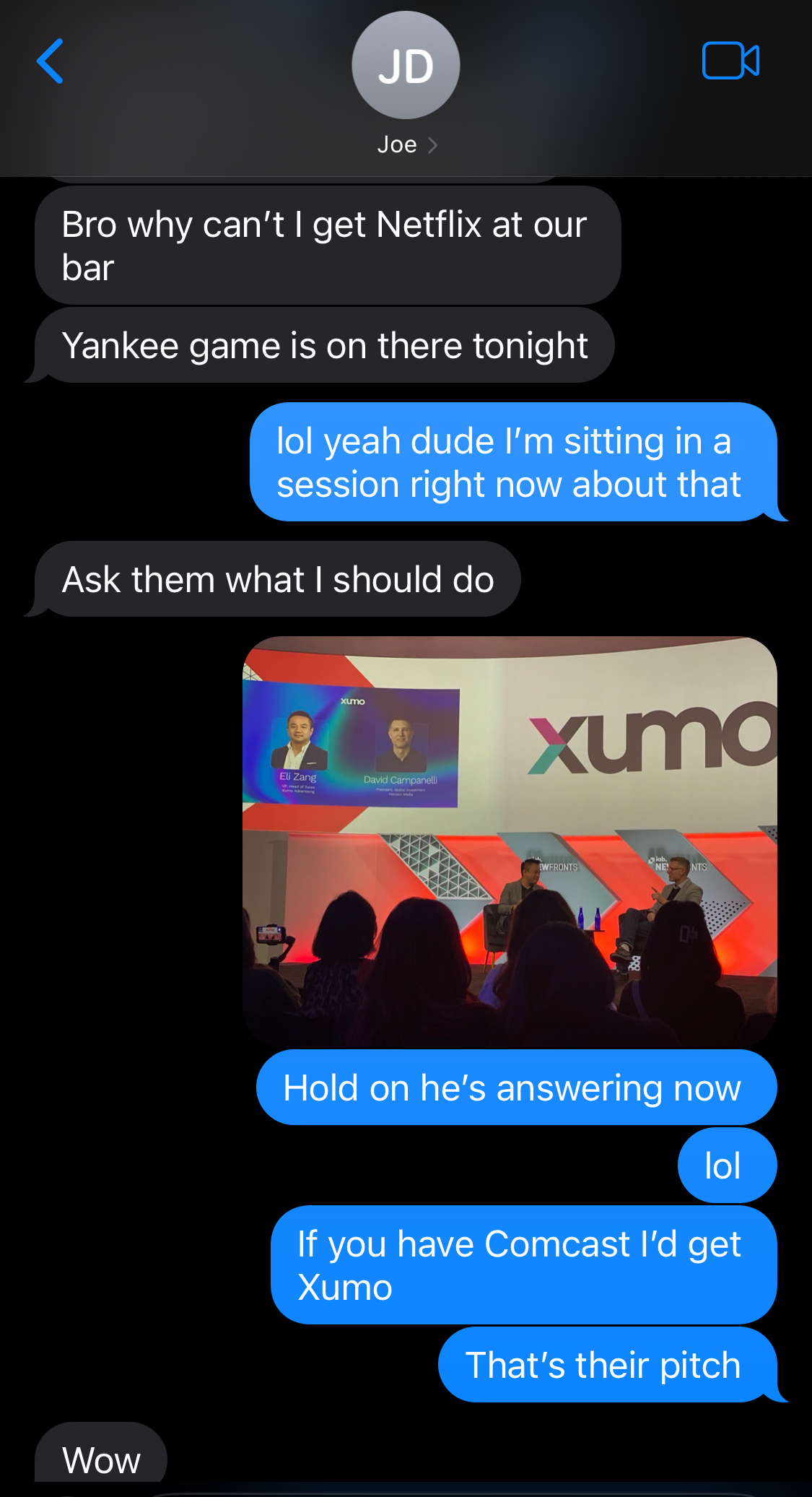
Texts from my buddy Joe
I had just demoed the Xumo TV and Xumo Play at the Comcast booth minutes earlier, and now I was watching the presentation on stage while the exact problem they built the product to solve was happening in my text messages. The sports experience is the strongest live sports interface on any operating system right now. Live games, highlights, and recaps consolidated into a single sports hub that Xumo describes as "one of the only destinations that bring together both live and streaming sports in one place." The interface does one simple thing especially well: help you find the game you're looking for without ever taking your eyes off the screen.
The hardware matches. The Xumo remote is the closest thing to an Apple-designed piece of technology in the space. It feels intentional in a category dominated by disposable afterthoughts.
This is what happens when ecosystem builders solve the merchandising problem instead of outsourcing it. Comcast and Charter, the two largest internet providers in the US, built Xumo as an operating system, not a channel. That's the same structural logic driving Roku's aggregation play and Amazon's commerce-to-advertising flywheel. The platforms that own the glass, the billing relationship, and the home screen is best positioned to actually fix the shelf.
Here's the problem. Try searching for "Xumo TV sports experience" on your favorite search engine. Try finding a detailed review of the sports hub. The product that arguably solves the live sports discoverability problem is itself nearly undiscoverable. The best shelf in streaming is sitting on its own invisible shelf.
🆘 SOS Insight: Xumo proves the merchandising thesis from the product side. But Xumo also proves the ecosystem-builder thesis: only companies that control the operating system, the billing layer, and the home screen can fix discoverability at the infrastructure level.
Piracy Is a Receipt
According to Bertrand, as much as 60% of Brazilian football viewership runs through pirated devices. Not from sophisticated hacking ops. Rather, consumer-grade dongles sold for the equivalent of $120 a year that surface every league, every match, in one interface.
Because when the content is expensive, fragmented across apps, and impossible to find even after you've paid, piracy becomes the better product. "You're gonna get done if you don't give it to them in the way that they need it," he said.
🆘 SOS Insight: A 60% piracy rate is evidence of a merchandising and pricing failure the industry created. The platforms that solve discoverability for live sports will capture the audience the black market is currently serving for free.
What It All Means
Xumo has the best live sports product in streaming hardware and almost no one knows it exists. Near-zero online discoverability suggests the go-to-market hasn't caught up to the product.
Streamers acquiring live sports rights face a math problem that gets worse at every layer. with every year. The rights fee exceeds the ad revenue. The signpost fails 1.3 times per event. The fan who paid can't find the game. And 65% of NFL streaming subscribers churn after the playoffs. Merchandising infrastructure isn't a nice-to-have. It's the only thing that makes the unit economics survivable.
Advertisers should demand merchandising compliance data as a standard term on every rights-adjacent buy. Horizon is already using Xumo's sports hub to complement national NFL campaigns. That's the early signal. If placement correlates 80%+ with performance, then impression guarantees built on assumed discoverability are structurally inflated. The buy side has the leverage to force this transparency. The question is whether they'll use it in these now or later.
🎧 Listen: How Media Placement Value Quantifies Attention for Streaming Apps with Lucas Bertrand
📊 Explore: Unified Streaming Power Index (USPI)
Get the SOS. Brief
The sharpest streaming intelligence, delivered to your inbox.